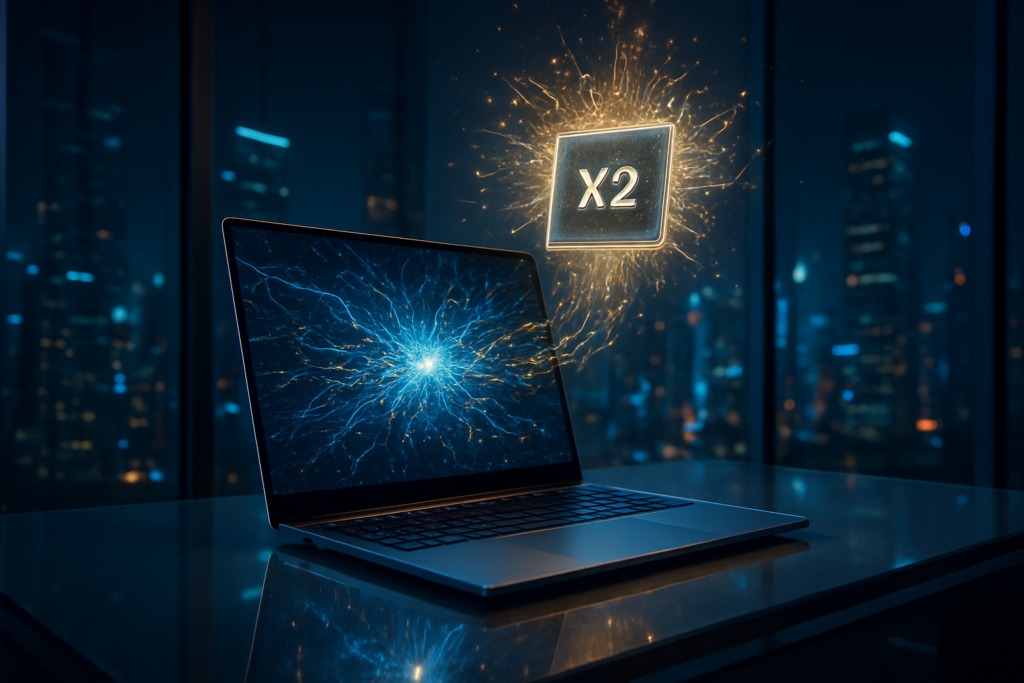
The landscape of personal computing underwent a seismic shift at CES 2026 as Qualcomm (NASDAQ: QCOM) officially launched its next-generation Snapdragon X2 Elite and X2 Plus processors. Building on the momentum of its predecessor, the X2 series represents a pivotal moment in the transition toward the "AI PC," moving local artificial intelligence from a niche novelty to the core of the user experience. By delivering unprecedented performance-per-watt and the industry’s first 85 TOPS (Tera Operations Per Second) NPU, Qualcomm is positioning itself as the primary architect of a new era where laptops are no longer tethered to power outlets, promising true multi-day battery life without sacrificing high-end compute power.
The announcement at CES 2026 served as the commercial debut for the flagship Snapdragon X2 Elite Extreme and the more accessible X2 Plus, targeting a wide range of price points from premium workstation laptops to the $800 "sweet spot" for mainstream consumers. With over 150 design wins already secured from major manufacturers like HP Inc. (NYSE: HPQ), ASUS (TPE: 2357), and Lenovo (HKG: 0992), the Snapdragon X2 series is not just a hardware refresh; it is a declaration of dominance in the burgeoning market for agentic AI—software that can autonomously reason and act on a user’s behalf, powered entirely by on-device silicon.
Technical Mastery: The 85 TOPS Breakthrough and the 3rd Gen Oryon CPU
At the heart of the Snapdragon X2 Elite lies the 6th Generation Hexagon Neural Processing Unit (NPU), a marvel of efficiency that achieves up to 85 TOPS in its highest-binned configurations. This is a massive leap from the 45 TOPS of the first-generation X Elite, effectively doubling the local AI throughput. Unlike previous iterations that shared memory resources with the CPU, the X2’s NPU features a dedicated 64-bit DMA architecture and a staggering 228 GB/s of memory bandwidth in the "Extreme" models. This technical evolution allows the chip to run complex Large Language Models (LLMs) and generative AI tasks entirely offline, ensuring user privacy and reducing the latency typically associated with cloud-based AI services like ChatGPT.
The computational muscle is provided by the 3rd Generation Oryon CPU, manufactured on a cutting-edge 3nm process. The flagship X2 Elite Extreme features an 18-core configuration (12 Prime cores and 6 Performance cores) capable of reaching boost clocks of 5.0 GHz—a first for an Arm-based Windows processor. This architecture allows the X2 Elite to outperform current-generation x86 chips in single-core tasks while consuming up to 43% less power. The industry research community has noted that the NPU now operates on its own independent power rail, allowing the device to maintain background AI tasks—such as real-time language translation or "Snapdragon Guardian" security monitoring—with negligible impact on the overall battery drain.
Initial reactions from tech experts at CES 2026 have been overwhelmingly positive, particularly regarding the Snapdragon X2 Plus. By bringing an 80+ TOPS NPU to the sub-$1,000 laptop market, Qualcomm is effectively "democratizing" high-end AI. Early benchmarks shared during the keynote showed the X2 Elite Extreme handily beating the Apple (NASDAQ: AAPL) M4 and rivaling the early performance data for the M5 in multi-threaded workflows, signaling that the "efficiency gap" between Windows and macOS has effectively vanished.
Competitive Shockwaves: A New Reality for Intel and AMD
The launch of the X2 series has sent shockwaves through the traditional silicon powerhouses. For decades, Intel (NASDAQ: INTC) and Advanced Micro Devices (NASDAQ: AMD) have dominated the Windows ecosystem, but the X2 Elite’s launch marks a point where x86-based systems are finding it difficult to compete on efficiency. While Intel responded at CES 2026 with its Panther Lake (Core Ultra Series 3) architecture, analysts point out that Qualcomm still maintains a 40-50% lead in performance-per-watt for ultra-portable laptops. This has forced Intel to pivot its marketing heavily toward "Platform TOPS"—the combined power of CPU, GPU, and NPU—to stay competitive in the numbers game.
For AMD, the challenge is equally steep. While their Ryzen AI MX "Strix-Scale" chips continue to hold an edge in integrated gaming performance, Qualcomm is winning the battle for the "mobile professional." The inclusion of integrated 5G connectivity and the superior endurance of the Snapdragon X2 series are making it the preferred choice for corporate fleets. Furthermore, Microsoft (NASDAQ: MSFT) has deepened its partnership with Qualcomm, optimizing Windows 12 to take full advantage of the X2’s 85 TOPS NPU for its new "Agentic Copilot" features, which require more local compute than previous x86 architectures could provide without overheating.
Major PC manufacturers are already shifting their product roadmaps to accommodate this shift. HP showcased the OmniBook Ultra 14, which claims a record-breaking 29 hours of video playback on a single charge. ASUS and Lenovo followed suit with ultra-thin designs like the ZenBook A16 and Yoga Slim 7x, both weighing less than 1.3kg while providing "multi-day" productivity. This mass adoption by OEMs suggests that the market has finally reached a tipping point where Arm-based Windows devices are no longer viewed as "alternatives," but as the gold standard for portable computing.
The Edge AI Shift: Broad Implications for the Tech Landscape
The broader significance of the Snapdragon X2 launch lies in the migration of AI from the data center to the edge. For the past three years, the AI boom has been defined by massive GPU clusters in the cloud. However, the X2 Elite’s 85 TOPS NPU enables a shift toward "Local Intelligence." This has profound implications for data privacy, as sensitive personal or corporate data no longer needs to leave the device to be processed by an AI assistant. It also addresses the looming energy crisis facing cloud providers; by offloading AI tasks to millions of local NPUs, the tech industry can significantly reduce the carbon footprint of the AI revolution.
Furthermore, the "multi-day battery life" promised by Qualcomm is set to change user behavior. When a laptop can reliably last 24 to 30 hours of actual work time, the design of workspaces, schools, and transportation will change. The "charger anxiety" that has defined the laptop era is being replaced by a smartphone-like charging cadence, where users only plug in their devices every two or three days. This paradigm shift makes the laptop a truly mobile-first device for the first time in its history.
However, this transition is not without concerns. The rapid obsolescence of non-AI-capable hardware is creating a significant divide in the consumer market. There are also ongoing discussions regarding "Arm emulation" for legacy Windows software. While Qualcomm has made massive strides with its "Prism" translation layer, some high-end creative and specialized software still perform better on native x86 silicon. The industry must now race to ensure that the software ecosystem catches up to the rapid hardware advancements seen at CES 2026.
Looking Ahead: The Road to 20% Market Share
As we move further into 2026, the trajectory for the Snapdragon X2 series looks remarkably steep. Industry analysts predict that Arm-based laptops could capture between 20% and 25% of the total Windows market share by the end of 2027. This growth will be driven by the release of "Agentic AI" applications that are specifically designed to require the 80+ TOPS threshold set by Qualcomm. We can expect to see a surge in autonomous AI agents that can manage emails, organize files, and even perform complex coding or design tasks locally while the user is offline.
In the near term, the focus will shift to how NVIDIA (NASDAQ: NVDA) responds. Rumors suggest that NVIDIA may enter the consumer Arm-based CPU market in late 2026 or early 2027, potentially bringing their world-class GPU architecture to a mobile SoC to challenge Qualcomm’s gaming performance. Additionally, the second half of 2026 will likely see the launch of "Snapdragon-powered" tablets and 2-in-1s that aim to disrupt the iPad Pro’s dominance in the creative sector, leveraging the X2’s thermal efficiency to provide fanless designs with "Pro" level performance.
The biggest challenge facing Qualcomm in the coming months will be supply chain scaling. As demand for 3nm wafers from TSMC remains high due to competition from Apple and NVIDIA, Qualcomm will need to ensure it can produce enough X2 Elite and Plus silicon to meet the ambitious sales targets of its OEM partners.
Final Assessment: A Landmark in Computing History
The launch of the Snapdragon X2 Elite and X2 Plus at CES 2026 will likely be remembered as the moment the "AI PC" transitioned from marketing jargon to a tangible reality. By delivering an 85 TOPS NPU and closing the performance gap with Apple, Qualcomm has fundamentally rewritten the rules of the Windows ecosystem. The focus has officially moved away from raw clock speeds and toward "intelligence per watt," a metric that Qualcomm currently leads by a significant margin.
The significance of this development in AI history cannot be overstated. By placing high-performance neural processing in the hands of millions of mainstream users, Qualcomm is providing the foundation upon which the next generation of software will be built. The "multi-day battery life" is the catalyst that will drive mass adoption, while the 85 TOPS NPU is the engine that will power the autonomous agents of the future.
In the coming weeks, as the first retail units of the HP OmniBook and Lenovo Yoga Slim 7x hit the shelves, the tech world will be watching closely to see if the real-world performance matches the impressive benchmarks shown in Las Vegas. If these devices deliver on the promise of 30-hour battery life and seamless AI integration, the era of the traditional x86 laptop may finally be drawing to a close.
This content is intended for informational purposes only and represents analysis of current AI developments.
TokenRing AI delivers enterprise-grade solutions for multi-agent AI workflow orchestration, AI-powered development tools, and seamless remote collaboration platforms.
For more information, visit https://www.tokenring.ai/.