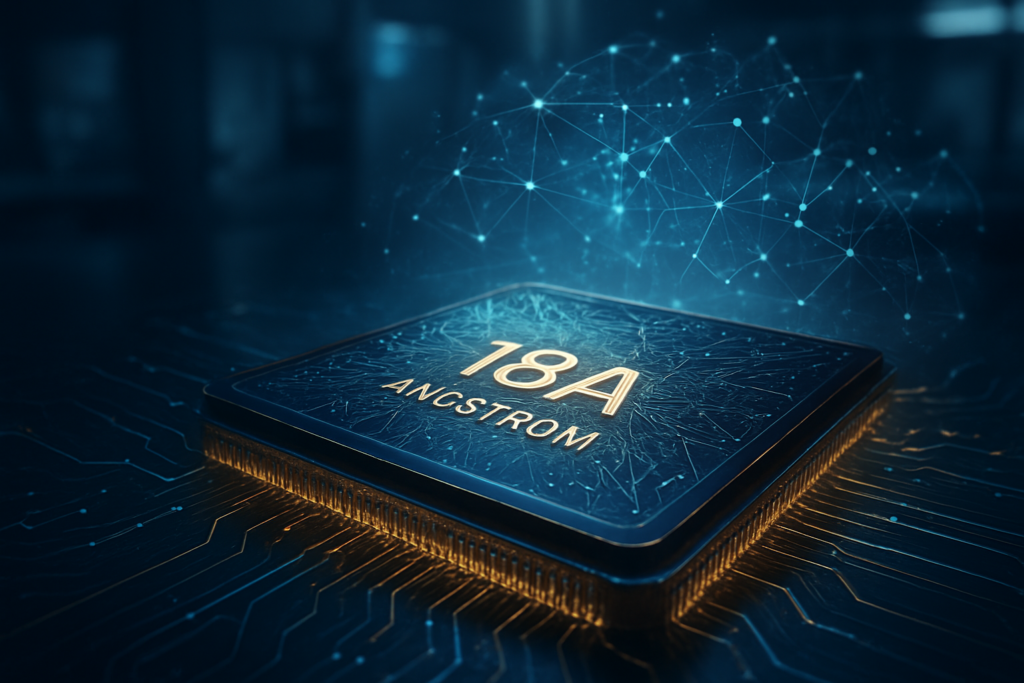
In a landmark achievement that marks the culmination of the most aggressive turnaround in semiconductor history, Intel (NASDAQ: INTC) has officially launched the Core Ultra Series 3 processor family. Codenamed "Panther Lake," this new lineup is the first consumer platform built on the cutting-edge Intel 18A process node, signaling a definitive shift in the global balance of power for chip manufacturing. By bringing the "Angstrom Era" to the mass market, Intel has not only met its ambitious "five nodes in four years" roadmap but has also secured its position as a leader in the rapidly evolving AI PC category.
The launch is accompanied by a massive wave of industry support, with Intel confirming that the Core Ultra Series 3 will power over 200 distinct AI PC designs from global partners. This hardware blitz represents a full-scale assault on the premium laptop, handheld gaming, and professional workstation markets. As the first chips to successfully integrate both Gate-All-Around (GAA) transistors and backside power delivery in high-volume consumer silicon, the Series 3 stands as a testament to Intel’s renewed engineering prowess and its determination to dominate the next decade of decentralized artificial intelligence.
Technical Prowess: The Anatomy of the 18A Revolution
At the heart of the Core Ultra Series 3 is the Intel 18A node, which introduces two foundational technologies: RibbonFET and PowerVia. RibbonFET is Intel’s implementation of Gate-All-Around (GAA) architecture, which replaces traditional FinFET transistors to provide better electrostatic control and higher drive current at lower voltages. Complementing this is PowerVia, the industry’s first high-volume implementation of backside power delivery. By moving power routing to the back of the wafer, Intel has decoupled power and signal wires, drastically reducing "voltage droop" and allowing for higher clock speeds and significantly improved energy efficiency.
The architectural improvements in Panther Lake are equally striking. The platform features a hybrid core design led by the new "Cougar Cove" P-cores and "Darkmont" E-cores. Early benchmarks suggest a 60% improvement in multithreaded performance within a 25W power envelope compared to the previous generation. For graphics, the Series 3 debuts the Xe3 "Celestial" architecture (Xe3-LPG), which delivers up to a 77% boost in gaming performance. This leap is expected to disrupt the handheld gaming PC market, offering discrete-level performance in integrated form factors that can sustain high frame rates in modern AAA titles while maintaining superior thermal efficiency.
The most critical component for the AI era is the NPU 5 (Neural Processing Unit), which now delivers 50 TOPS (Trillions of Operations Per Second) of dedicated AI performance. When combined with the CPU and GPU, the total platform AI throughput exceeds 120 TOPS, easily surpassing the requirements for Microsoft’s latest Copilot+ PC standards. This enables complex on-device tasks—such as real-time language translation, advanced video editing, and local execution of Vision-Language Models (VLMs)—to run with minimal latency and without the need for a constant cloud connection.
A Massive Ecosystem: 200+ Designs and Market Impact
The sheer scale of the Core Ultra Series 3 rollout is unprecedented. Intel has confirmed partnerships for over 200 designs across the industry's biggest names, including ASUS, Lenovo, Dell, HP, MSI, and Samsung. Notable flagship models like the Dell (NASDAQ: DELL) XPS 13, the Lenovo (HKG: 0992) Yoga Pro 9i, and the Samsung (KRX: 005930) Galaxy Book6 are all set to transition to the 18A platform. This broad adoption suggests that Intel has successfully convinced the world's leading OEMs that its silicon is once again the gold standard for performance-per-watt and integrated AI capabilities.
The business implications are profound. For years, Intel struggled to match the efficiency of Apple (NASDAQ: AAPL) Silicon and the manufacturing consistency of TSMC (NYSE: TSM). With 18A, Intel has moved roughly one year ahead of TSMC in the implementation of backside power delivery, a lead that could prove decisive in winning back high-profile foundry customers. By proving that 18A can yield at high volumes for its own flagship consumer chips, Intel is sending a powerful message to potential external customers like NVIDIA (NASDAQ: NVDA) and Qualcomm (NASDAQ: QCOM): the Intel Foundry is open for business and technically superior.
Furthermore, this launch creates a challenging environment for competitors in the Windows ecosystem. AMD (NASDAQ: AMD) and Qualcomm, which both made significant gains in the laptop market during Intel’s transition period, now face a rejuvenated incumbent with a superior process node. The inclusion of high-performance Xe3 graphics specifically targets the niche carved out by AMD’s Ryzen AI series, potentially stalling AMD’s momentum in the premium ultrabook and gaming handheld segments.
The Global AI Landscape and the "Foundry 2.0" Milestone
The launch of the Core Ultra Series 3 is more than just a product update; it is a geopolitical and industrial milestone. As the first major platform built on a sub-2nm-class node in the United States, 18A represents a critical success for the "Made in America" semiconductor push. It validates the billions of dollars in investment fueled by the CHIPS Act and reinforces the strategic importance of domestic leading-edge manufacturing. In an era where AI is viewed as a national security priority, Intel's ability to produce the world's most advanced AI PC silicon on home soil is a significant strategic advantage.
In the broader AI landscape, Panther Lake accelerates the transition from "cloud-first" to "hybrid AI." By putting 50 NPU TOPS into the hands of millions of consumers, Intel is providing the hardware base necessary for software developers to create a new generation of local AI applications. This shift reduces the massive energy and financial costs associated with running AI models in data centers and addresses growing consumer concerns regarding data privacy. If the 2010s were defined by the mobile revolution, the 2020s are increasingly defined by the "On-Device AI" revolution, and Intel has just claimed the driver's seat.
However, the transition is not without its risks. The success of the "AI PC" depends heavily on software ecosystems maturing as quickly as the hardware. While the hardware is ready, the industry is still waiting for a "killer app" that makes a high-TOPS NPU an absolute necessity for the average consumer. Furthermore, the complexity of the 18A node and its advanced packaging requirements will test Intel's supply chain resilience. Any hiccups in yield or global distribution could provide a window of opportunity for competitors to strike back.
Future Horizons: Beyond Panther Lake
Looking ahead, the 18A node is just the beginning of Intel’s long-term strategy. The architectural foundations laid by Panther Lake will soon extend into the data center with the "Clearwater Forest" Xeon processors, which utilize the same 18A process to deliver massive core counts for cloud providers. Intel has already teased its next-generation node, Intel 14A, which is expected to utilize High-NA EUV lithography to further push the boundaries of transistor density by 2027.
In the near term, the industry is watching for the expansion of the Core Ultra Series 3 into the desktop and enthusiast gaming markets. While the initial focus is on mobile efficiency, the scalability of the 18A node suggests that we will see high-wattage desktop variants later this year that could redefine peak PC performance. Additionally, the second half of 2026 is expected to see the first wave of third-party chips manufactured on Intel 18A, which will finally reveal the true potential of Intel’s Foundry services.
A New Chapter for Computing
The launch of the Intel Core Ultra Series 3 and the 18A node marks the end of Intel's "catch-up" phase and the beginning of a new era of silicon leadership. By delivering a platform that excels in energy efficiency, integrated graphics, and AI throughput, Intel has silenced many of its critics and proved that it can still execute at the highest levels of semiconductor engineering. The 200+ designs currently heading to market represent a vote of confidence from the global tech industry that Intel is, once again, the architect of the future.
As we move through 2026, the success of this platform will be measured not just by benchmarks, but by how it changes our daily interaction with technology. With the power of 120 TOPS in their laps, users are no longer tethered to the cloud for the most advanced digital tools. The "AI PC" has moved from a marketing buzzword to a tangible, high-performance reality, and Intel has positioned itself at the very center of this transformation.
This content is intended for informational purposes only and represents analysis of current AI developments.
TokenRing AI delivers enterprise-grade solutions for multi-agent AI workflow orchestration, AI-powered development tools, and seamless remote collaboration platforms.
For more information, visit https://www.tokenring.ai/.