As of January 27, 2026, the ambitious dream of the U.S. CHIPS and Science Act has transitioned from legislative promise to a complex, grit-and-mortar reality. While the United States has successfully spurred the largest industrial reshoring effort in half a century, the path to domestic semiconductor self-sufficiency has been marred by stark "efficiency gaps," labor friction, and massive cost overruns. The effort to bring advanced logic chip manufacturing back to American soil is no longer just a policy goal; it is a high-stakes stress test of the nation's industrial capacity and its ability to compete with the hyper-efficient manufacturing ecosystems of East Asia.
The immediate significance of this transition cannot be overstated. With Intel Corporation (NASDAQ: INTC) recently announcing high-volume manufacturing (HVM) of its 18A (1.8nm-class) node in Arizona, and Taiwan Semiconductor Manufacturing Company (NYSE: TSM) reaching high-volume production for 3nm at its Phoenix site, the U.S. has officially broken its reliance on foreign soil for the world's most advanced processors. However, this "Silicon Sovereignty" comes with a caveat: building and operating these facilities in the U.S. remains significantly more expensive and time-consuming than in Taiwan, forcing a massive realignment of the global supply chain that is already impacting the pricing of everything from AI servers to consumer electronics.
The technical landscape of January 2026 is defined by a fierce race for the 2-nanometer (2nm) threshold. In Taiwan, TSMC has already achieved high-volume manufacturing of its N2 nanosheet process at its "mother fabs" in Hsinchu and Kaohsiung, boasting yields between 70% and 80%. In contrast, while Intel’s 18A process has reached the HVM stage in Arizona, initial yields are estimated at a more modest 60%, highlighting the lingering difficulty of stabilizing leading-edge nodes outside of the established Taiwanese ecosystem. Samsung Electronics Co., Ltd. (KRX:005930) has also pivoted, skipping its initial 4nm plans for its Taylor, Texas facility to install 2nm (SF2) equipment directly, though mass production there is not expected until late 2026.
The "efficiency gap" between the two regions remains the primary technical and economic hurdle. Data from early 2026 shows that while a fab shell in Taiwan can be completed in approximately 20 to 28 months, a comparable facility in the U.S. takes between 38 and 60 months. Construction costs in the U.S. are nearly double, ranging from $4 billion to $6 billion per fab shell compared to $2 billion to $3 billion in Hsinchu. While semiconductor equipment from providers like ASML (NASDAQ: ASML) and Applied Materials (NASDAQ: AMAT) is priced globally—keeping total wafer processing costs to a manageable 10–15% premium in the U.S.—the sheer capital expenditure (CAPEX) required to break ground is staggering.
Industry experts note that these delays are often tied to the "cultural clash" of manufacturing philosophies. Throughout 2025, several high-profile labor disputes surfaced, including a class-action lawsuit against TSMC Arizona regarding its reliance on Taiwanese "transplant" workers to maintain a 24/7 "war room" work culture. This culture, which is standard in Taiwan’s Science Parks, has met significant resistance from the American workforce, which prioritizes different work-life balance standards. These frictions have directly influenced the speed at which equipment can be calibrated and yields can be optimized.
The impact on major tech players is a study in strategic navigation. For companies like NVIDIA Corporation (NASDAQ: NVDA) and Apple Inc. (NASDAQ: AAPL), the reshoring effort provides a "dual-source" security blanket but introduces new pricing pressures. In early 2026, the U.S. government imposed a 25% Section 232 tariff on advanced AI chips not manufactured or packaged on U.S. soil. This move has effectively forced NVIDIA to prioritize U.S.-made silicon for its latest "Rubin" architecture, ensuring that its primary domestic customers—including government agencies and major cloud providers—remain compliant with new "secure supply" mandates.
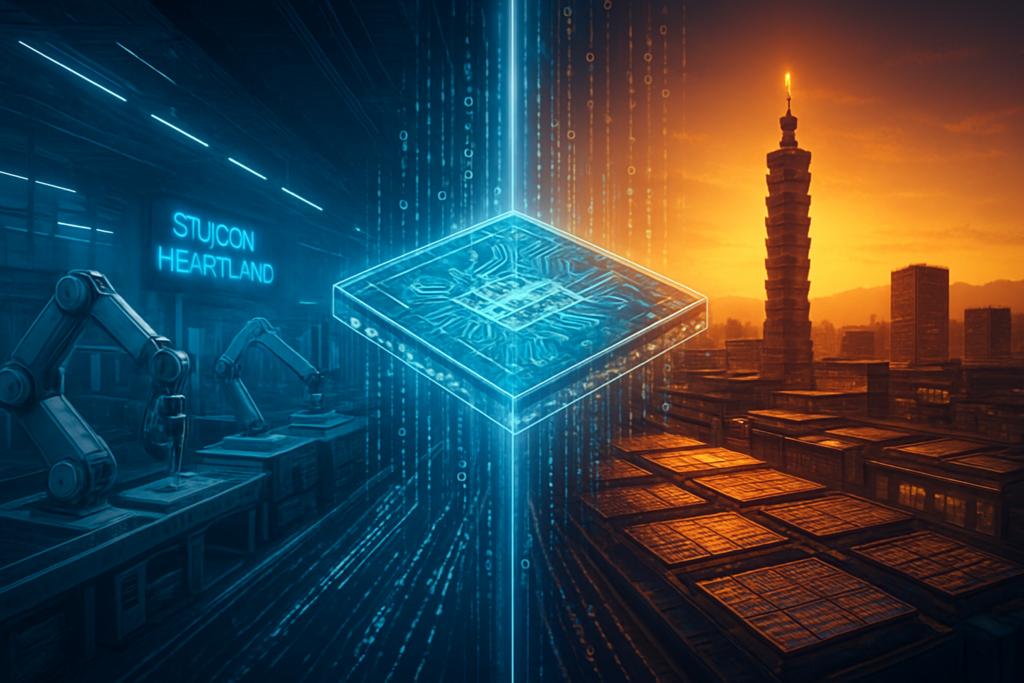
Intel stands as a major beneficiary of the CHIPS Act, having reclaimed a temporary title of "process leadership" with its 18A node. However, the company has had to scale back its "Silicon Heartland" project in Ohio, delaying the completion of its first two fabs to 2030 to align with market demand and capital constraints. This strategic pause has allowed competitors to catch up, but Intel’s position as the primary domestic foundry for the U.S. Department of Defense remains a powerful competitive advantage. Meanwhile, fabless firms like Advanced Micro Devices, Inc. (NASDAQ: AMD) are navigating a split strategy, utilizing TSMC’s Arizona capacity for domestic needs while keeping their highest-volume, cost-sensitive production in Taiwan.
The shift has also birthed a new ecosystem of localized suppliers. Over 75 tier-one suppliers, including Amkor Technology, Inc. (NASDAQ: AMKR) and Tokyo Electron, have established regional hubs in Phoenix, creating a "Silicon Desert" that mirrors the density of Taiwan’s Hsinchu Science Park. This migration is essential for reducing the "latencies of distance" that plagued the supply chain during the early 2020s. However, smaller startups are finding it harder to compete in this high-cost environment, as the premium for U.S.-made silicon often eats into the thin margins of new hardware ventures.
This development aligns directly with Item 21 of our top 25 list: the reshoring of advanced manufacturing. The reality of 2026 is that the global supply chain is no longer optimized solely for "just-in-time" efficiency, but for "just-in-case" resilience. The "Silicon Shield"—the theory that Taiwan’s dominance in chips prevents geopolitical conflict—is being augmented by a "Silicon Fortress" in the U.S. This shift represents a fundamental rejection of the hyper-globalized model that dominated the last thirty years, favoring a fragmented, "friend-shored" system where manufacturing is tied to national security alliances.
The wider significance of this reshoring effort also touches on the accelerating demand for AI infrastructure. As AI models grow in complexity, the chips required to train them have become strategic assets on par with oil or grain. By reshoring the manufacturing of these chips, the U.S. is attempting to insulate its AI-driven economy from potential blockades or regional conflicts in the Taiwan Strait. However, this move has raised concerns about "technology inflation," as the higher costs of domestic production are inevitably passed down to the end-users of AI services, potentially widening the gap between well-funded tech giants and smaller players.
Comparisons to previous industrial milestones, such as the space race or the build-out of the interstate highway system, are common among policymakers. However, the semiconductor industry is unique in its pace of change. Unlike a road or a bridge, a $20 billion fab can become obsolete in five years if the technology node it supports is surpassed. This creates a "permanent investment trap" where the U.S. must not only build these fabs but continually subsidize their upgrades to prevent them from becoming expensive relics of a previous generation of technology.
Looking ahead, the next 24 months will be focused on the deployment of 1.4-nanometer (1.4nm) technology and the maturation of advanced packaging. While the U.S. has made strides in wafer fabrication, "backend" packaging remains a bottleneck, with the majority of the world's advanced chip-stacking capacity still located in Asia. To address this, expect a new wave of CHIPS Act grants specifically targeting companies like Amkor and Intel to build out "Substrate-to-System" facilities that can package chips domestically.
Labor remains the most significant long-term challenge. Experts predict that by 2028, the U.S. semiconductor industry will face a shortage of over 60,000 technicians and engineers. To combat this, several "Semiconductor Academies" have been launched in Arizona and Ohio, but the timeline for training a specialized workforce often exceeds the timeline for building a fab. Furthermore, the industry is closely watching the implementation of Executive Order 14318, which aims to streamline environmental reviews for chip projects. If these regulatory reforms fail to stick, future fab expansions could be stalled for years in the courts.
Near-term developments will likely include more aggressive trade deals. The landmark agreement signed on January 15, 2026, between the U.S. and Taiwan—which exchanged massive Taiwanese investment for tariff caps—is expected to be a blueprint for future deals with Japan and South Korea. These "Chip Alliances" will define the geopolitical landscape for the remainder of the decade, as nations scramble to secure their place in the post-globalized semiconductor hierarchy.
In summary, the reshoring of advanced manufacturing via the CHIPS Act has reached a pivotal, albeit difficult, success. The U.S. has proven it can build leading-edge fabs and produce the world's most advanced silicon, but it has also learned that the "Taiwan Advantage"—a combination of hyper-efficient labor, specialized infrastructure, and government prioritization—cannot be replicated overnight or through capital alone. The reality of 2026 is a bifurcated world where the U.S. serves as the secure, high-cost "fortress" for chip production, while Taiwan remains the efficient, high-yield "brain" of the industry.
The long-term impact of this development will be felt in the resilience of the AI economy. By decoupling the most critical components of the tech stack from a single geographic point of failure, the U.S. has significantly mitigated the risk of a total supply chain collapse. However, the cost of this insurance is high, manifesting in higher hardware prices and a permanent need for government industrial policy.
As we move into the second half of 2026, watch for the first yield reports from Samsung’s Taylor fab and the progress of Intel’s 14A node development. These will be the true indicators of whether the U.S. can sustain its momentum or if the high costs of reshoring will eventually lead to a "silicon fatigue" that slows the pace of domestic innovation.
This content is intended for informational purposes only and represents analysis of current AI developments.
TokenRing AI delivers enterprise-grade solutions for multi-agent AI workflow orchestration, AI-powered development tools, and seamless remote collaboration platforms.
For more information, visit https://www.tokenring.ai/.