In a landmark demonstration of semiconductor engineering, Intel (NASDAQ: INTC) has officially showcased its next-generation multi-chiplet processors built on the 18A and 14A process nodes. This milestone, revealed at the start of 2026, marks the successful culmination of Intel’s "five nodes in four years" strategy and signals the company's aggressive return to the forefront of the silicon manufacturing race. By leveraging advanced 3D packaging and the industry’s first commercial implementation of High-Numerical Aperture (High-NA) EUV lithography, Intel is positioning itself as a formidable "Systems Foundry" capable of producing the massive, high-density chips required for the next decade of artificial intelligence and high-performance computing (HPC).
The showcase featured the first live silicon of the "Clearwater Forest" Xeon processor, a multi-tile marvel that utilizes Intel 18A for its compute logic, and a conceptual "Mega-Package" built on the upcoming 14A node. These developments are not merely incremental updates; they represent a fundamental shift in how chips are designed and manufactured. By decoupling the various components of a processor into specialized "chiplets" and reassembling them with high-speed interconnects, Intel is challenging the dominance of Taiwan Semiconductor Manufacturing Company (NYSE: TSM) and aiming to reclaim the crown of process leadership it lost nearly a decade ago.
Technical Breakthroughs: RibbonFET, PowerVia, and High-NA EUV
The technical foundation of Intel’s resurgence lies in two revolutionary technologies: RibbonFET and PowerVia. RibbonFET, Intel’s implementation of a Gate-All-Around (GAA) transistor, is now in high-volume manufacturing on the 18A node. Unlike traditional FinFETs, RibbonFET surrounds the transistor channel on all four sides, allowing for precise control over current flow and significantly reducing power leakage—a critical requirement for AI data centers operating at the edge of thermal limits. Complementing this is PowerVia, a groundbreaking "backside power delivery" system that moves power routing to the reverse side of the silicon wafer. This separation of power and signal lines eliminates the "wiring congestion" that has plagued chip designers for years, enabling higher clock speeds and improved energy efficiency.
Moving beyond 18A, the 14A node represents Intel's first full-scale utilization of High-NA EUV lithography, powered by the ASML (NASDAQ: ASML) Twinscan EXE:5200B. This advanced machinery provides a resolution of 8nm, nearly doubling the precision of standard EUV tools. For the 14A node, this allows Intel to print the most critical circuit patterns in a single pass, avoiding the complexity and yield-loss risks associated with multi-patterning. Furthermore, Intel has introduced "PowerDirect" on the 14A node, a second-generation backside power solution designed to handle the extreme current densities required by future AI accelerators.
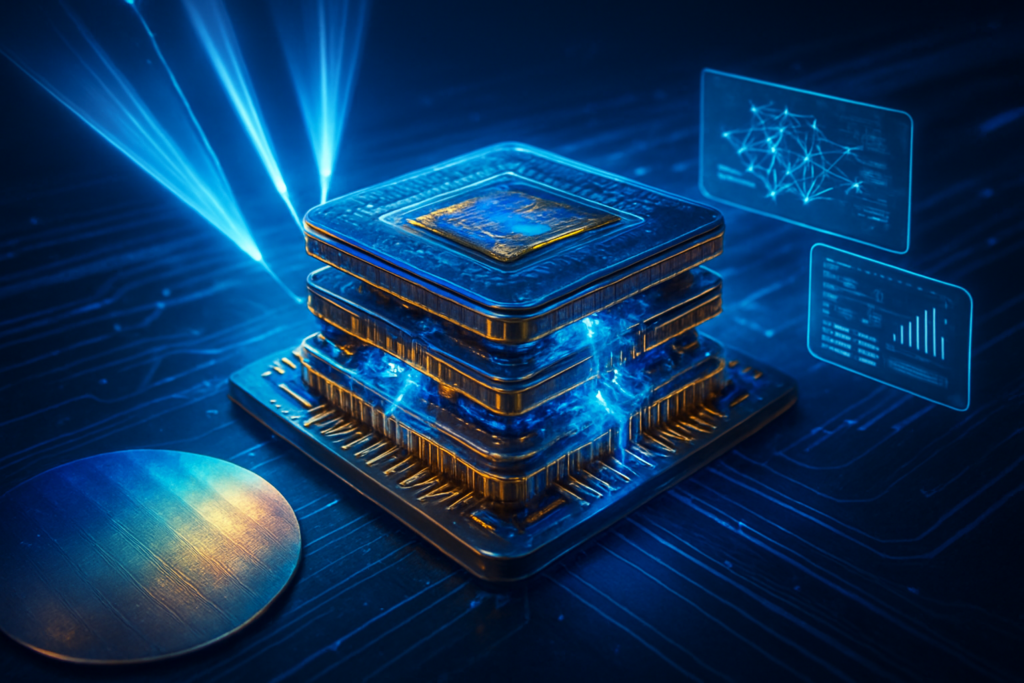
The multi-chiplet architecture showcased by Intel also highlights the company’s lead in advanced packaging. Using Foveros Direct 3D and EMIB (Embedded Multi-die Interconnect Bridge), Intel demonstrated the ability to stack and tile chips with unprecedented density. One of the most striking reveals was a 14A-based AI "Mega-Package" that integrates 16 compute tiles with 24 stacks of HBM5 memory. To manage the immense heat and physical stress of such a large package, Intel has transitioned to glass substrates, which offer 50% less pattern distortion and superior thermal stability compared to traditional organic materials.
Initial reactions from the semiconductor research community have been cautiously optimistic, with many experts noting that Intel has achieved a significant "first-mover" advantage in backside power delivery. While TSMC and Samsung (KRX: 005930) are working on similar technologies, Intel’s 18A is the first to reach high-volume production with these features. Industry analysts suggest that if Intel can maintain its yield rates, the combination of RibbonFET, PowerVia, and High-NA EUV could provide a 12-to-18-month technological lead over its rivals in specific high-performance metrics.
Market Impact: Securing the AI Supply Chain
The implications for the broader tech industry are profound, as Intel Foundry begins to secure "anchor" customers who were previously reliant solely on TSMC. Microsoft (NASDAQ: MSFT) has already committed to using the 18A and 18A-P nodes for its next-generation Maia 2 AI accelerators, a move that allows the software giant to secure a domestic U.S. supply chain for its Azure AI infrastructure. Similarly, Amazon (NASDAQ: AMZN) through its AWS division, has signed a multi-billion dollar deal to produce custom Trainium3 chips on Intel’s 18A node. These partnerships validate Intel’s "Systems Foundry" model, where the company provides not just the silicon, but the packaging and interconnect standards necessary for complex AI systems.
NVIDIA (NASDAQ: NVDA), the current king of AI hardware, has also entered the fold in a strategic shift that could disrupt the status quo. While NVIDIA continues to manufacture its primary GPUs with TSMC, it has signed a landmark $5 billion agreement to utilize Intel’s advanced packaging services. More intriguingly, the two companies are reportedly co-developing "Intel x86 RTX SOCs"—hybrid processors that fuse Intel’s high-performance x86 cores with NVIDIA’s RTX graphics chiplets. This collaboration suggests that even the fiercest competitors see the value in Intel’s unique packaging capabilities, potentially leading to a new class of "best-of-both-worlds" hardware for workstations and high-end gaming.
For startups and smaller AI labs, Intel’s progress offers a much-needed alternative in a market that has been bottlenecked by TSMC’s capacity limits. By providing a credible second source for leading-edge manufacturing, Intel is likely to drive down costs and accelerate the pace of hardware iteration. However, the competitive pressure on TSMC remains high; the Taiwanese giant still holds the lead in raw transistor density and has a decades-long track record of manufacturing reliability. Intel’s challenge will be to prove that it can match TSMC’s legendary yield consistency at scale, especially as it navigates the transition to the 14A node.
Geopolitics and the New "System-Level" Moore’s Law
Beyond the corporate rivalry, Intel’s 18A and 14A progress carries significant geopolitical and economic weight. As the only Western company capable of manufacturing chips at the Angstrom level, Intel is the primary beneficiary of the U.S. CHIPS and Science Act. The successful ramp-up of Fab 52 in Arizona and the High-NA installation in Oregon are seen as critical milestones in the effort to rebalance the global semiconductor supply chain, which is currently heavily concentrated in East Asia. This "Silicon Shield" strategy is designed to ensure that the most advanced AI capabilities remain accessible to Western nations regardless of regional instability.
The shift toward multi-chiplet "systems-on-package" also signals the end of the traditional Moore’s Law era, where performance gains were driven primarily by shrinking individual transistors. We are now entering the era of "System-Level Moore’s Law," where the focus has shifted to how efficiently different chips can talk to one another. Intel’s embrace of open standards like UCIe (Universal Chiplet Interconnect Express) ensures that its 18A and 14A nodes can serve as a "chassis" for a diverse ecosystem of chiplets from different vendors, fostering a more modular and innovative hardware landscape.
However, this transition is not without its concerns. The extreme cost of High-NA EUV tools—upwards of $350 million per machine—and the complexity of glass substrate manufacturing create a high barrier to entry that could further centralize power among a few "mega-foundries." There are also environmental considerations; the massive energy requirements of these advanced fabs and the AI chips they produce continue to be a point of contention for sustainability advocates. Despite these challenges, the leap from the 5nm/3nm era to the 1.8nm/1.4nm era is being hailed as the most significant jump in computing power since the introduction of the microprocessor.
The Road to 10A: What’s Next for Intel Foundry?
Looking ahead, the roadmap for 2026 and beyond is focused on the refinement of the 14A node and the early research into the "10A" (1nm) generation. Intel has hinted that its 14A-P (Performance) variant, expected in late 2027, will introduce even more advanced 3D stacking techniques that could allow for memory to be bonded directly on top of logic with near-zero latency. This would be a game-changer for Large Language Models (LLMs) that are currently limited by the "memory wall"—the speed at which data can move between the processor and RAM.
Experts predict that the next two years will see a surge in "specialized AI silicon" as companies move away from general-purpose GPUs toward custom chiplet-based designs tailored for specific neural network architectures. Intel’s ability to offer a "menu" of chiplets—some on 18A for efficiency, some on 14A for peak performance—will likely make it the preferred partner for this custom silicon wave. The main hurdle remains the software stack; while Intel’s hardware is catching up, it must continue to invest in its OneAPI and OpenVINO platforms to ensure that developers can easily port their AI workloads from NVIDIA’s proprietary CUDA environment.
Conclusion: A New Chapter in Silicon History
The showcase of Intel’s 18A and 14A nodes marks a definitive turning point in the history of the semiconductor industry. After years of delays and skepticism, the company has demonstrated that it possesses the technical roadmap and the manufacturing discipline to compete at the absolute cutting edge. The arrival of the "Angstrom Era" is not just a win for Intel; it is a catalyst for the entire AI industry, providing the raw compute power and architectural flexibility needed to move toward more autonomous and sophisticated artificial intelligence systems.
As we move through 2026, the industry will be watching Intel’s yield rates and the commercial success of the Panther Lake and Clearwater Forest chips with a magnifying glass. If Intel can deliver on its promises of performance-per-watt leadership, it will have successfully rewritten its narrative from a legacy giant in decline to the primary architect of the AI hardware future. The race for silicon supremacy has never been more intense, and for the first time in a decade, the path to the top runs through Santa Clara.
This content is intended for informational purposes only and represents analysis of current AI developments.
TokenRing AI delivers enterprise-grade solutions for multi-agent AI workflow orchestration, AI-powered development tools, and seamless remote collaboration platforms.
For more information, visit https://www.tokenring.ai/.