In a move that signals the definitive end of the "chatbot era" and the beginning of the "autonomous agent era," NVIDIA (NASDAQ: NVDA) has officially unveiled its new BlueField-4 Data Processing Unit (DPU) and the underlying Vera Rubin architecture. Announced this month at CES 2026, these developments represent a radical shift in how silicon is designed, moving away from raw mathematical throughput and toward hardware capable of managing the complex, multi-step reasoning cycles and massive "stateful" memory required by next-generation AI agents.
The significance of this announcement cannot be overstated: for the first time, the industry is seeing silicon specifically engineered to solve the "Context Wall"—the primary physical bottleneck preventing AI from acting as a truly autonomous digital employee. While previous GPU generations focused on training massive models, BlueField-4 and the Rubin platform are built for the execution of agentic workflows, where AI doesn't just respond to prompts but orchestrates its own sub-tasks, maintains long-term memory, and reasons across millions of tokens of context in real-time.
The Architecture of Autonomy: Inside BlueField-4
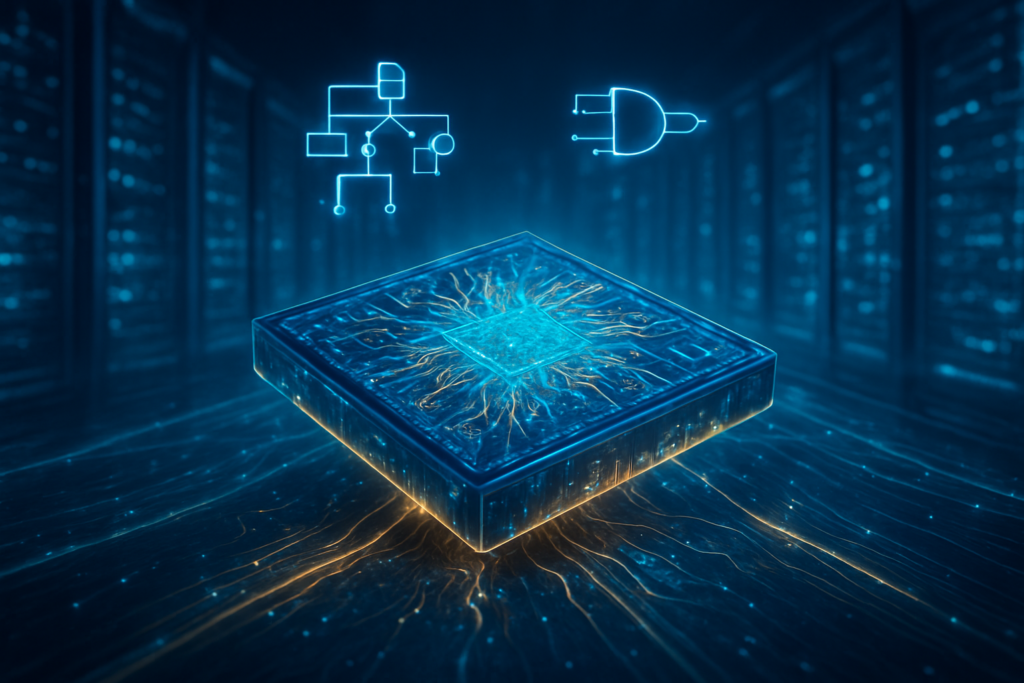
Technical specifications for the BlueField-4 reveal a massive leap in orchestrational power. Boasting 64 Arm Neoverse V2 cores—a six-fold increase over the previous BlueField-3—and a blistering 800 Gb/s throughput via integrated ConnectX-9 networking, the chip is designed to act as the "nervous system" of the Vera Rubin platform. Unlike standard processors, BlueField-4 introduces the Inference Context Memory Storage (ICMS) platform. This creates a new "G3.5" storage tier—a high-speed, Ethernet-attached flash layer that sits between the GPU’s ultra-fast High Bandwidth Memory (HBM) and traditional data center storage.
This architectural shift is critical for "long-context reasoning." In agentic AI, the system must maintain a Key-Value (KV) cache—essentially the "active memory" of every interaction and data point an agent encounters during a long-running task. Previously, this cache would quickly overwhelm a GPU's memory, causing "context collapse." BlueField-4 offloads and manages this memory management at ultra-low latency, effectively allowing agents to "remember" thousands of pages of history and complex goals without stalling the primary compute units. This approach differs from previous technologies by treating the entire data center fabric, rather than a single chip, as the fundamental unit of compute.
Initial reactions from the AI research community have been electric. "We are moving from one-shot inference to reasoning loops," noted Simon Robinson, an analyst at Omdia. Experts highlight that while startups like Etched have focused on "burning" Transformer models into specialized ASICs for raw speed, and Groq (the current leader in low-latency Language Processing Units) has prioritized "Speed of Thought," NVIDIA’s BlueField-4 offers the infrastructure necessary for these agents to work in massive, coordinated swarms. The industry consensus is that 2026 will be the year of high-utility inference, where the hardware finally catches up to the demands of autonomous software.
Market Wars: The Integrated vs. The Open
NVIDIA’s announcement has effectively divided the high-end AI market into two distinct camps. By integrating the Vera CPU, Rubin GPU, and BlueField-4 DPU into a singular, tightly coupled ecosystem, NVIDIA (NASDAQ: NVDA) is doubling down on its "Apple-like" strategy of vertical integration. This positioning grants the company a massive strategic advantage in the enterprise sector, where companies are desperate for "turnkey" agentic solutions. However, this move has also galvanized the competition.
Advanced Micro Devices (NASDAQ: AMD) responded at CES with its own "Helios" platform, featuring the MI455X GPU. Boasting 432GB of HBM4 memory—the largest in the industry—AMD is positioning itself as the "Android" of the AI world. By leading the Ultra Accelerator Link (UALink) consortium, AMD is championing an open, modular architecture that allows hyperscalers like Google and Amazon to mix and match hardware. This competitive dynamic is likely to disrupt existing product cycles, as customers must now choose between NVIDIA’s optimized, closed-loop performance and the flexibility of the AMD-led open standard.
Startups like Etched and Groq also face a new reality. While their specialized silicon offers superior performance for specific tasks, NVIDIA's move to integrate agentic management directly into the data center fabric makes it harder for specialized ASICs to gain a foothold in general-purpose data centers. Major AI labs, such as OpenAI and Anthropic, stand to benefit most from this development, as the drop in "token-per-task" costs—projected to be up to 10x lower with BlueField-4—will finally make the mass deployment of autonomous agents economically viable.
Beyond the Chatbot: The Broader AI Landscape
The shift toward agentic silicon marks a significant milestone in AI history, comparable to the original "Transformer" breakthrough of 2017. We are moving away from "Generative AI"—which focuses on creating content—toward "Agentic AI," which focuses on achieving outcomes. This evolution fits into the broader trend of "Physical AI" and "Sovereign AI," where nations and corporations seek to build autonomous systems that can manage power grids, optimize supply chains, and conduct scientific research with minimal human intervention.
However, the rise of chips designed for autonomous decision-making brings significant concerns. As hardware becomes more efficient at running long-horizon reasoning, the "black box" problem of AI transparency becomes more acute. If an agentic system makes a series of autonomous decisions over several hours of compute time, auditing that decision-making path becomes a Herculean task for human overseers. Furthermore, the power consumption required to maintain the "G3.5" memory tier at a global scale remains a looming environmental challenge, even with the efficiency gains of the 3nm and 2nm process nodes.
Compared to previous milestones, the BlueField-4 era represents the "industrialization" of AI reasoning. Just as the steam engine required specialized infrastructure to become a global force, agentic AI requires this new silicon "nervous system" to move out of the lab and into the foundation of the global economy. The transition from "thinking" chips to "acting" chips is perhaps the most significant hardware pivot of the decade.
The Horizon: What Comes After Rubin?
Looking ahead, the roadmap for agentic silicon is moving toward even tighter integration. Near-term developments will likely focus on "Agentic Processing Units" (APUs)—a rumored 2027 product category that would see CPU, GPU, and DPU functions merged onto a single massive "system-on-a-chip" (SoC) for edge-based autonomy. We can expect to see these chips integrated into sophisticated robotics and autonomous vehicles, allowing for complex decision-making without a constant connection to the cloud.
The challenges remaining are largely centered on memory bandwidth and heat dissipation. As agents become more complex, the demand for HBM4 and HBM5 will likely outstrip supply well into 2027. Experts predict that the next "frontier" will be the development of neuromorphic-inspired memory architectures that mimic the human brain's ability to store and retrieve information with almost zero energy cost. Until then, the industry will be focused on mastering the "Vera Rubin" platform and proving that these agents can deliver a clear Return on Investment (ROI) for the enterprises currently spending billions on infrastructure.
A New Chapter in Silicon History
NVIDIA’s BlueField-4 and the Rubin architecture represent more than just a faster chip; they represent a fundamental re-definition of what a "computer" is. In the agentic era, the computer is no longer a device that waits for instructions; it is a system that understands context, remembers history, and pursues goals. The pivot from training to stateful, long-context reasoning is the final piece of the puzzle required to make AI agents a ubiquitous part of daily life.
As we look toward the second half of 2026, the key metric for success will no longer be TFLOPS (Teraflops), but "Tokens per Task" and "Reasoning Steps per Watt." The arrival of BlueField-4 has set a high bar for the rest of the industry, and the coming months will likely see a flurry of counter-announcements as the "Silicon Wars" enter their most intense phase yet. For now, the message from the hardware world is clear: the agents are coming, and the silicon to power them is finally ready.
This content is intended for informational purposes only and represents analysis of current AI developments.
TokenRing AI delivers enterprise-grade solutions for multi-agent AI workflow orchestration, AI-powered development tools, and seamless remote collaboration platforms.
For more information, visit https://www.tokenring.ai/.