As artificial intelligence models grow from billions to trillions of parameters, the physical infrastructure supporting them has hit a "power wall." Traditional copper interconnects and pluggable optical modules, which have served as the backbone of data centers for decades, are no longer able to keep pace with the massive bandwidth demands and extreme energy requirements of next-generation AI clusters. In a landmark shift for the industry, semiconductor giants Broadcom Inc. (NASDAQ: AVGO) and Marvell Technology, Inc. (NASDAQ: MRVL) have successfully commercialized Co-Packaged Optics (CPO), a revolutionary technology that integrates light-based communication directly into the heart of the chip.
This transition marks a pivotal moment in the evolution of data centers. By replacing electrical signals traveling over bulky copper wires with laser-driven light pulses integrated onto the silicon substrate, Broadcom and Marvell are enabling AI clusters to scale far beyond previous physical limits. The move to CPO is not just an incremental speed boost; it is a fundamental architectural redesign that reduces interconnect power consumption by up to 70% and drastically improves the reliability of the massive "back-end" fabrics that link thousands of GPUs and AI accelerators together.
The Light on the Chip: Breaking the 100-Terabit Barrier
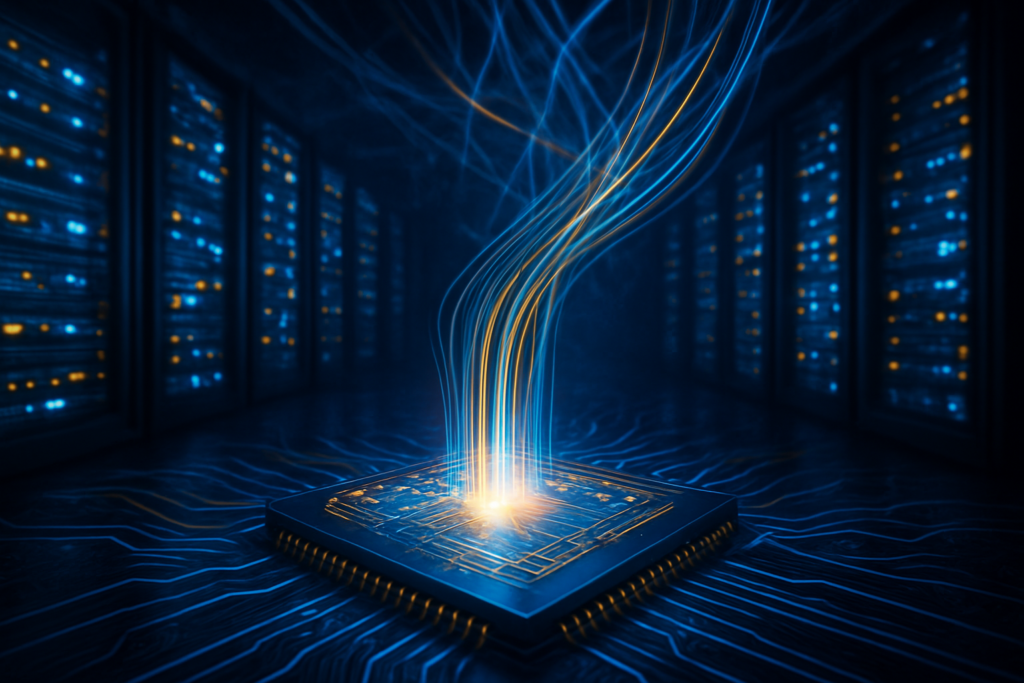
At the core of this advancement is the integration of Silicon Photonics—the process of manufacturing optical components like lasers, modulators, and detectors using standard CMOS silicon fabrication techniques. Previously, optical communication required separate, "pluggable" modules that sat on the faceplate of a switch. These modules converted electrical signals from the processor into light. However, at speeds of 200G per lane, the electrical signals degrade so rapidly that they require high-power Digital Signal Processors (DSPs) to "clean" the signal before it even reaches the optics. Co-Packaged Optics solves this by placing the optical engine on the same package as the switch ASIC, shortening the electrical path to mere microns and eliminating the need for power-hungry re-timers.
Broadcom has taken a decisive lead in this space with its third-generation CPO platform, the Tomahawk 6 "Davisson." As of early 2026, the Davisson is the industry’s first 102.4-Tbps switch, utilizing 200G-per-lane optical interfaces integrated via Taiwan Semiconductor Manufacturing Company (NYSE: TSM) and its COUPE (Compact Universal Photonic Engine) technology. This achievement follows the successful field verification of Broadcom’s 51.2T "Bailly" system, which logged over one million cumulative port hours with hyperscalers like Meta Platforms, Inc. (NASDAQ: META). The ability to move 100 terabits of data through a single chip while slashing power consumption is a feat that traditional copper-based architectures simply cannot replicate.
Marvell has pursued a parallel but specialized strategy, focusing on its "Nova" optical engines and Teralynx switch line. While Broadcom dominates the standard Ethernet switch market, Marvell has pioneered custom CPO solutions for AI accelerators. Their latest "Nova 2" DSPs allow for 1.6-Tbps optical engines that are integrated directly onto the same substrate as the AI processor and High Bandwidth Memory (HBM). This "Optical I/O" approach allows an AI server to communicate across multiple racks with near-zero latency, effectively turning an entire data center into a single, massive GPU. Unlike previous approaches that treated optics as an afterthought, Marvell’s integration makes light an intrinsic part of the compute cycle.
Realigning the Silicon Power Structure
The commercialization of CPO is creating a clear divide between the winners and losers of the AI infrastructure boom. Companies like Broadcom and Marvell are solidifying their positions as the indispensable architects of the AI era, moving beyond simple chip design into full-stack interconnect providers. By controlling the optical interface, these companies are capturing value that previously belonged to independent optical module manufacturers. For hyperscale giants like Alphabet Inc. (NASDAQ: GOOGL) and Microsoft Corp. (NASDAQ: MSFT), the shift to CPO is a strategic necessity to manage the soaring electricity costs and thermal management challenges associated with their multi-billion-dollar AI investments.
The competitive landscape is also shifting for NVIDIA Corp. (NASDAQ: NVDA). While NVIDIA’s proprietary NVLink has long been the gold standard for intra-rack GPU communication, the emergence of CPO-enabled Ethernet is providing a viable, open-standard alternative for "scale-out" and "scale-up" networking. Broadcom’s Scale-Up Ethernet (SUE) framework, powered by CPO, now allows massive clusters of up to 1,024 nodes to communicate with the efficiency of a single machine. This creates a more competitive market where cloud providers are no longer locked into a single vendor's proprietary networking stack, potentially disrupting NVIDIA’s end-to-end dominance in the AI cluster market.
A Greener, Faster Horizon for Artificial Intelligence
The wider significance of Co-Packaged Optics extends beyond just speed; it is perhaps the most critical technology for the environmental sustainability of AI. As the world grows concerned over the massive power consumption of AI data centers, CPO offers a rare "free lunch"—higher performance for significantly less energy. By eliminating the "DSP tax" associated with traditional pluggable modules, CPO can save hundreds of megawatts of power across a single large-scale deployment. This energy efficiency is the only way for the industry to reach the 200.0T and 400.0T bandwidth levels expected in the late 2020s without building dedicated power plants for every data center.
Furthermore, this transition represents a major milestone in the history of computing. Much like the transition from vacuum tubes to transistors, the shift from electrical to optical chip-to-chip communication represents a phase change in how information is processed. We are moving toward a future where "computing" and "networking" are no longer distinct categories. In the CPO era, the network is the computer. This shift mirrors earlier breakthroughs like the introduction of HBM, which solved the "memory wall"; now, CPO is solving the "interconnect wall," ensuring that the rapid progress of AI models is not throttled by the physical limitations of copper.
The Road to 200T and Beyond
Looking ahead, the near-term focus will be on the mass deployment of 102.4T CPO systems throughout 2026. Industry experts predict that as these systems become the standard, the focus will shift toward even tighter integration. We are likely to see "Optical Chiplets" where the laser itself is integrated into the silicon, though the current "External Laser" (ELSFP) approach used by Broadcom remains the favorite for its serviceability. By 2027, the industry is expected to begin sampling 204.8T switches, a milestone that would be physically impossible without the density provided by Silicon Photonics.
The long-term challenge remains the manufacturing yield of these highly complex, heterogeneous packages. Combining high-speed logic, memory, and photonics into a single package is a feat of extreme engineering that requires flawless execution from foundry partners. However, as the ecosystem around the Ultra Accelerator Link (UALink) and other open standards matures, the hurdles of interoperability and multi-vendor support are being cleared. The next major frontier will be bringing optical I/O directly into consumer-grade hardware, though that remains a goal for the end of the decade.
A Brighter Future for AI Networking
The successful commercialization of Co-Packaged Optics by Broadcom and Marvell signals the definitive end of the "Copper Era" for high-performance AI networking. By successfully integrating light into the chip package, these companies have provided the essential plumbing needed for the next generation of generative AI and autonomous systems. The significance of this development cannot be overstated: it is the primary technological enabler that allows AI scaling to continue its exponential trajectory while keeping power budgets within the realm of reality.
In the coming weeks and months, the industry will be watching for the first large-scale performance benchmarks of the TH6-Davisson and Nova 2 systems as they go live in flagship AI clusters. As these results emerge, the shift from pluggable optics to CPO is expected to accelerate, fundamentally changing the hardware profile of the modern data center. For the AI industry, the future is no longer just digital—it is optical.
This content is intended for informational purposes only and represents analysis of current AI developments.
TokenRing AI delivers enterprise-grade solutions for multi-agent AI workflow orchestration, AI-powered development tools, and seamless remote collaboration platforms.
For more information, visit https://www.tokenring.ai/.