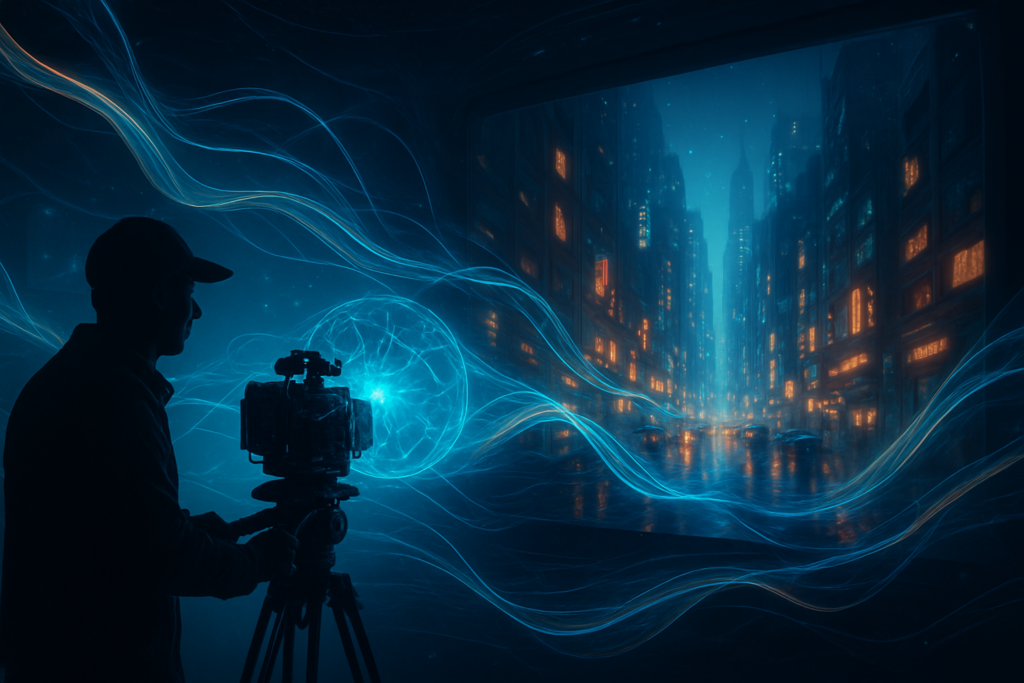
The landscape of digital storytelling has been fundamentally rewritten. As of early 2026, the "Cinematic Singularity"—the point where AI-generated video becomes indistinguishable from high-end practical cinematography—is no longer a theoretical debate but a commercial reality. OpenAI's release of Sora 2 in late 2025 has cemented this shift, turning a once-clunky experimental tool into a sophisticated world-simulator capable of generating complex, physics-consistent narratives from simple text prompts.
This evolution marks a pivot point for the creative industry, moving from the "uncanny valley" of early AI video to a professional-grade production standard. With the integration of high-fidelity video generation directly into industry-standard editing suites, the barrier between imagination and visual execution has all but vanished. This rapid advancement has forced a massive realignment across major tech corridors and Hollywood studios alike, as the cost of high-production-value content continues to plummet while the demand for hyper-personalized media surges.
The Architecture of Realism: Decoding Sora 2’s "Physics Moment"
OpenAI, backed heavily by Microsoft (NASDAQ: MSFT), achieved what many researchers are calling the "GPT-3.5 moment" for video physics with the launch of Sora 2. Unlike its predecessor, which often struggled with object permanence—the ability for an object to remain unchanged after being obscured—Sora 2 utilizes a refined diffusion transformer architecture that treats video as a series of 3D-aware latent space patches. This allows the model to maintain perfect consistency; if a character walks behind a tree and reappears, their clothing, scars, and even the direction of the wind blowing through their hair remain identical. The model now natively supports Full HD 1080p resolution at 30 FPS, with a new "Character Cameo" feature that allows creators to upload a static image of a person or object to serve as a consistent visual anchor across multiple scenes.
Technically, the leap from the original Sora to the current iteration lies in its improved understanding of physical dynamics like fluid buoyancy and friction. Industry experts note that where earlier models would often "hallucinate" movement—such as a glass breaking before it hits the floor—Sora 2 calculates the trajectory and impact with startling accuracy. This is achieved through a massive expansion of synthetic training data, where the model was trained on millions of hours of simulated physics environments alongside real-world footage. The result is a system that doesn't just predict pixels, but understands the underlying rules of the world it is rendering.
Initial reactions from the AI research community have been a mix of awe and strategic pivot. Leading voices in computer vision have lauded the model's ability to handle complex occlusion and reflections, which were once the hallmarks of expensive CGI rendering. However, the release wasn't without its hurdles; OpenAI has implemented a stringent "Red Teaming 2.0" protocol, requiring mandatory phone verification and C2PA metadata tagging to combat the proliferation of deepfakes. This move was essential to gaining the trust of creative professionals who were initially wary of the technology's potential to facilitate misinformation.
The Multi-Model Arms Race: Google, Kling, and the Battle for Creative Dominance
The competitive landscape in 2026 is no longer a monopoly. Google, under Alphabet Inc. (NASDAQ: GOOGL), has responded with Veo 3.1, a model that many professional editors currently prefer for high-end B-roll. While Sora 2 excels at world simulation, Veo 3.1 is the undisputed leader in audio-visual synchronization, generating high-fidelity native soundscapes—from footsteps to orchestral swells—simultaneously with the video. This "holistic generation" approach allows for continuous clips of up to 60 seconds, significantly longer than Sora's 25-second limit, and offers precise cinematic controls over virtual camera movements like dolly zooms and Dutch angles.
Simultaneously, the global market has seen a surge from Kuaishou Technology (HKG: 1024) with its Kling AI 2.6. Kling has carved out a massive niche by mastering human body mechanics, specifically in the realms of dance and high-speed athletics where Western models sometimes falter. With the ability to generate sequences up to three minutes long, Kling has become the go-to tool for independent music video directors and the booming social media automation industry. This tri-polar market—Sora for storytelling, Veo for cinematic control, and Kling for long-form movement—has created a healthy but high-stakes environment where each lab is racing to achieve 4K native generation and real-time editing capabilities.
The disruption has extended deep into the software ecosystem, most notably with Adobe Inc. (NASDAQ: ADBE). By integrating Sora and other third-party models directly into Premiere Pro via a "Generative Extend" feature, Adobe has effectively turned every video editor into a director. Editors can now highlight a gap in their timeline and prompt Sora to fill it with matching footage that respects the lighting and color grade of the surrounding practical shots. This integration has bridged the gap between AI startups and legacy creative workflows, ensuring that the traditional industry remains relevant by adopting the very tools that threatened to disrupt it.
Economic and Ethical Ripples Across the Broader AI Landscape
The implications of this technology extend far beyond the "wow factor" of realistic clips. We are seeing a fundamental shift in the economics of content creation, where the "cost-per-pixel" is approaching zero. This has caused significant tremors in the stock footage industry, which has seen a 60% decline in revenue for generic b-roll since the start of 2025. Conversely, it has empowered a new generation of "solo-studios"—individual creators who can now produce cinematic-quality pilots and advertisements that would have previously required a $500,000 budget and a crew of fifty.
However, this democratization of high-end visuals brings profound concerns regarding authenticity and labor. The 2024-2025 Hollywood strikes were only the beginning; by 2026, the focus has shifted toward "data dignity" and the right of actors to own their digital likenesses. While Sora 2's consistency features are a boon for narrative continuity, they also raise the risk of unauthorized digital resurrections or the creation of non-consensual content. The broader AI trend is moving toward "verified-origin" media, where the lack of a digital watermark or cryptographic signature is becoming a red flag for audiences who are increasingly skeptical of what they see on screen.
Furthermore, the environmental and computational costs of running these "world simulators" remain a major point of contention. Training and serving video models requires an order of magnitude more energy than text-based LLMs. This has led to a strategic divergence in the industry: while some companies chase "maximalist" models like Sora, others are focusing on "efficient video" that can run on consumer-grade hardware. This tension between fidelity and accessibility will likely define the next stage of the AI landscape as governments begin to implement more stringent carbon-accounting rules for data centers.
Beyond the Prompt: The Future of Agentic and Interactive Video
Looking toward the end of 2026 and into 2027, the industry is preparing for the transition from "prompt-to-video" to "interactive world-streaming." Experts predict the rise of agentic video systems that don't just generate a static file but can be manipulated in real-time like a video game. This would allow a director to "step into" a generated scene using a VR headset and adjust the lighting or move a character manually, with the AI re-rendering the scene on the fly. This convergence of generative AI and real-time game engines like Unreal Engine is the next great frontier for the creative tech sector.
The most immediate challenge remains the "data wall." As AI models consume the vast majority of high-quality human-made video on the internet, researchers are increasingly relying on synthetic data to train the next generation of models. The risk of "model collapse"—where AI begins to amplify its own errors—is a primary concern for OpenAI and its competitors. To address this, we expect to see more direct partnerships between AI labs and major film archives, as the value of "pristine, human-verified" video data becomes the new gold in the AI economy.
A New Era for Visual Media: Summary and Outlook
The evolution of Sora and its rivals has successfully transitioned generative video from a technical curiosity to a foundational pillar of the modern media stack. Key takeaways from the past year include the mastery of physics-consistent world simulation, the deep integration of AI into professional editing software like Adobe Premiere Pro, and the emergence of a competitive multi-model market that includes Google and Kling AI. We have moved past the era where "AI-generated" was a synonym for "low-quality," and entered an era where the prompt is the new camera.
As we look ahead, the significance of this development in AI history cannot be overstated; it represents the moment AI moved from understanding language to understanding the physical reality of our visual world. In the coming weeks and months, watchers should keep a close eye on the rollout of native 4K capabilities and the potential for "real-time" video generation during live broadcasts. The cinematic singularity is here, and the only limit left is the depth of the creator's imagination.
This content is intended for informational purposes only and represents analysis of current AI developments.
TokenRing AI delivers enterprise-grade solutions for multi-agent AI workflow orchestration, AI-powered development tools, and seamless remote collaboration platforms.
For more information, visit https://www.tokenring.ai/.