
Financial services company Triumph Financial (NASDAQ: TFIN) reported Q4 CY2025 results topping the market’s revenue expectations, with sales up 16% year on year to $120.1 million. Its GAAP profit of $0.77 per share was significantly above analysts’ consensus estimates.
Is now the time to buy Triumph Financial? Find out by accessing our full research report, it’s free.
Triumph Financial (TFIN) Q4 CY2025 Highlights:
- Net Interest Income: $89.69 million vs analyst estimates of $89.13 million (2.1% year-on-year growth, 0.6% beat)
- Net Interest Margin: 6.4% vs analyst estimates of 6.3% (8.8 basis point beat)
- Revenue: $120.1 million vs analyst estimates of $110.4 million (16% year-on-year growth, 8.8% beat)
- EPS (GAAP): $0.77 vs analyst estimates of $0.30 (significant beat)
- Tangible Book Value per Share: $20.77 vs analyst estimates of $20.15 (11.8% year-on-year decline, 3.1% beat)
- Market Capitalization: $1.65 billion
Company Overview
Originally focused on traditional banking before pivoting to serve the transportation sector, Triumph Financial (NASDAQ: TFIN) provides specialized financial services to the trucking industry, including payments processing, factoring, banking, and data intelligence solutions.
Sales Growth
In general, banks make money from two primary sources. The first is net interest income, which is interest earned on loans, mortgages, and investments in securities minus interest paid out on deposits. The second source is non-interest income, which can come from bank account, credit card, wealth management, investing banking, and trading fees. Over the last five years, Triumph Financial grew its revenue at a tepid 6.5% compounded annual growth rate. This was below our standard for the banking sector and is a tough starting point for our analysis.
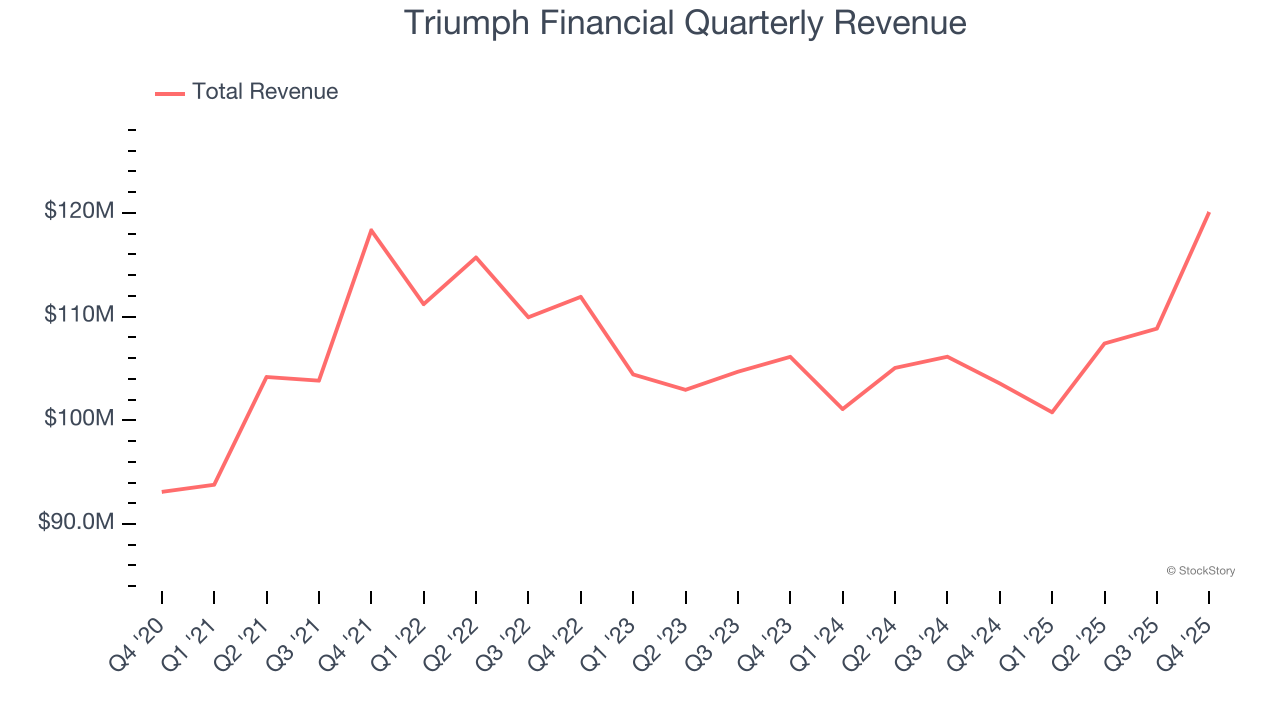
We at StockStory place the most emphasis on long-term growth, but within financials, a half-decade historical view may miss recent interest rate changes, market returns, and industry trends. Triumph Financial’s recent performance shows its demand has slowed as its annualized revenue growth of 2.2% over the last two years was below its five-year trend. 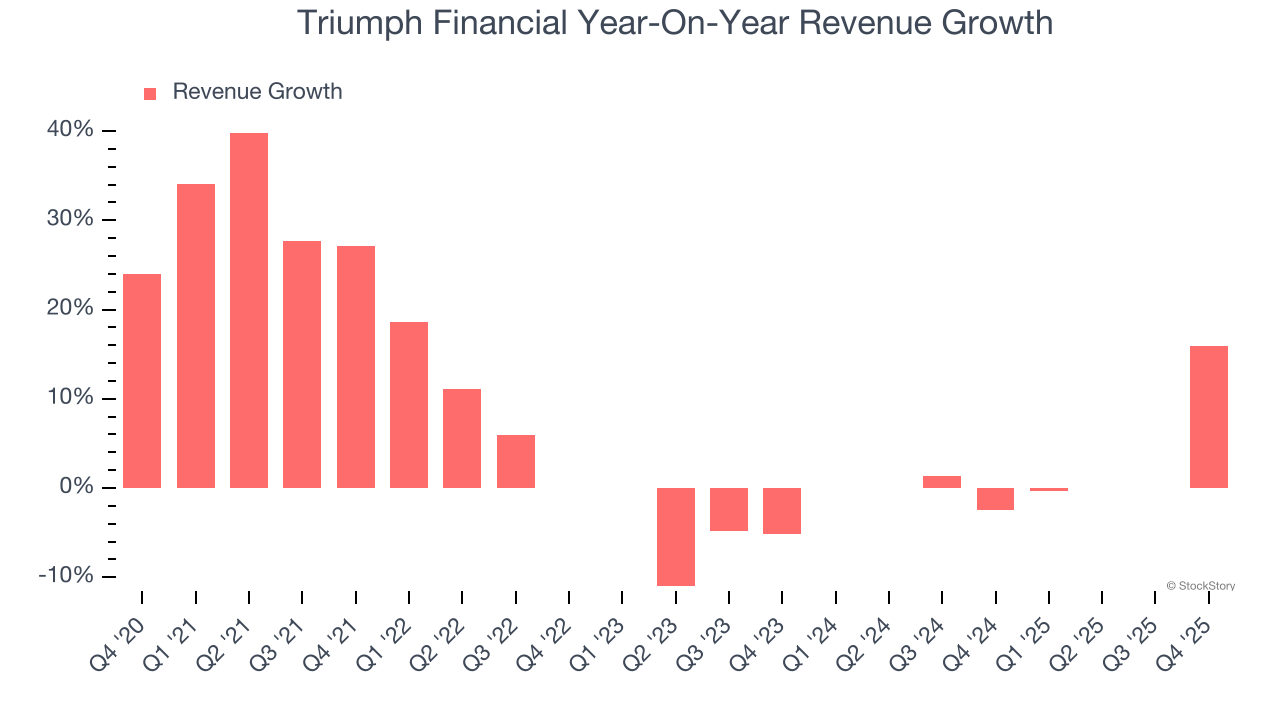 Note: Quarters not shown were determined to be outliers, impacted by outsized investment gains/losses that are not indicative of the recurring fundamentals of the business.
This quarter, Triumph Financial reported year-on-year revenue growth of 16%, and its $120.1 million of revenue exceeded Wall Street’s estimates by 8.8%.
Net interest income made up 86% of the company’s total revenue during the last five years, meaning Triumph Financial barely relies on non-interest income to drive its overall growth.
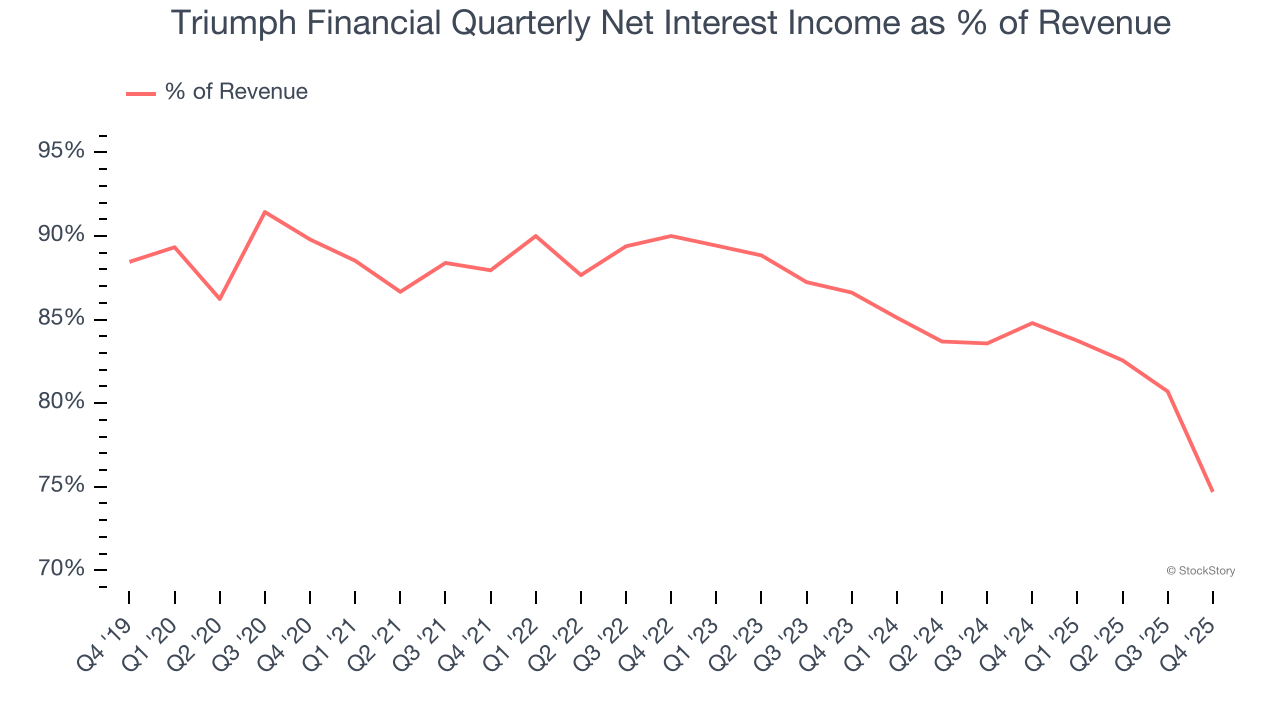
While banks generate revenue from multiple sources, investors view net interest income as the cornerstone - its predictable, recurring characteristics stand in sharp contrast to the volatility of non-interest income.
While Wall Street chases Nvidia at all-time highs, an under-the-radar semiconductor supplier is dominating a critical AI component these giants can’t build without. Click here to access our free report one of our favorites growth stories.
Tangible Book Value Per Share (TBVPS)
Banks are balance sheet-driven businesses because they generate earnings primarily through borrowing and lending. They’re also valued based on their balance sheet strength and ability to compound book value (another name for shareholders’ equity) over time.
When analyzing banks, tangible book value per share (TBVPS) takes precedence over many other metrics. This measure isolates genuine per-share value by removing intangible assets of debatable liquidation worth. EPS can become murky due to acquisition impacts or accounting flexibility around loan provisions, and TBVPS resists financial engineering manipulation.
Triumph Financial’s TBVPS was flat over the last five years. A turnaround doesn’t seem to be in sight as its TBVPS also dropped by 5.6% annually over the last two years ($23.28 to $20.77 per share).
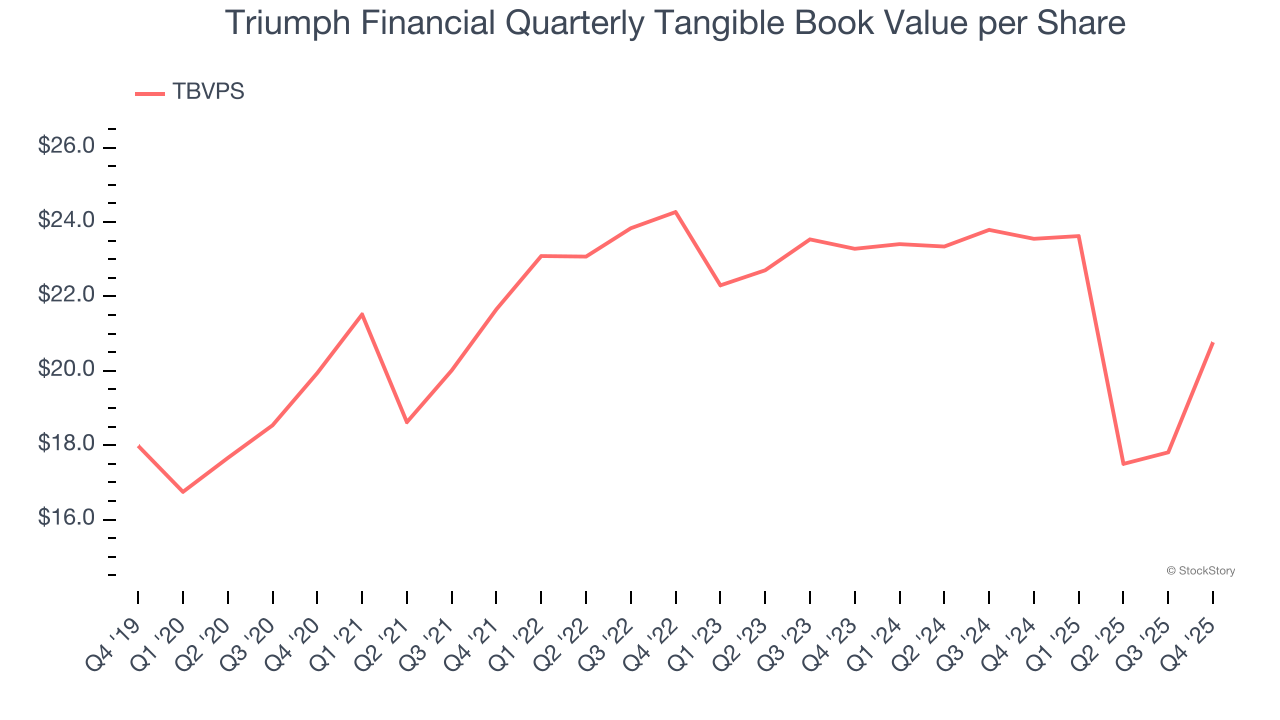
Over the next 12 months, Consensus estimates call for Triumph Financial’s TBVPS to grow by 8.1% to $22.46, paltry growth rate.
Key Takeaways from Triumph Financial’s Q4 Results
It was good to see Triumph Financial beat analysts’ EPS expectations this quarter. We were also excited its revenue outperformed Wall Street’s estimates by a wide margin. Zooming out, we think this quarter featured some important positives. The stock remained flat at $70.55 immediately following the results.
Is Triumph Financial an attractive investment opportunity right now? If you’re making that decision, you should consider the bigger picture of valuation, business qualities, as well as the latest earnings. We cover that in our actionable full research report which you can read here (it’s free).