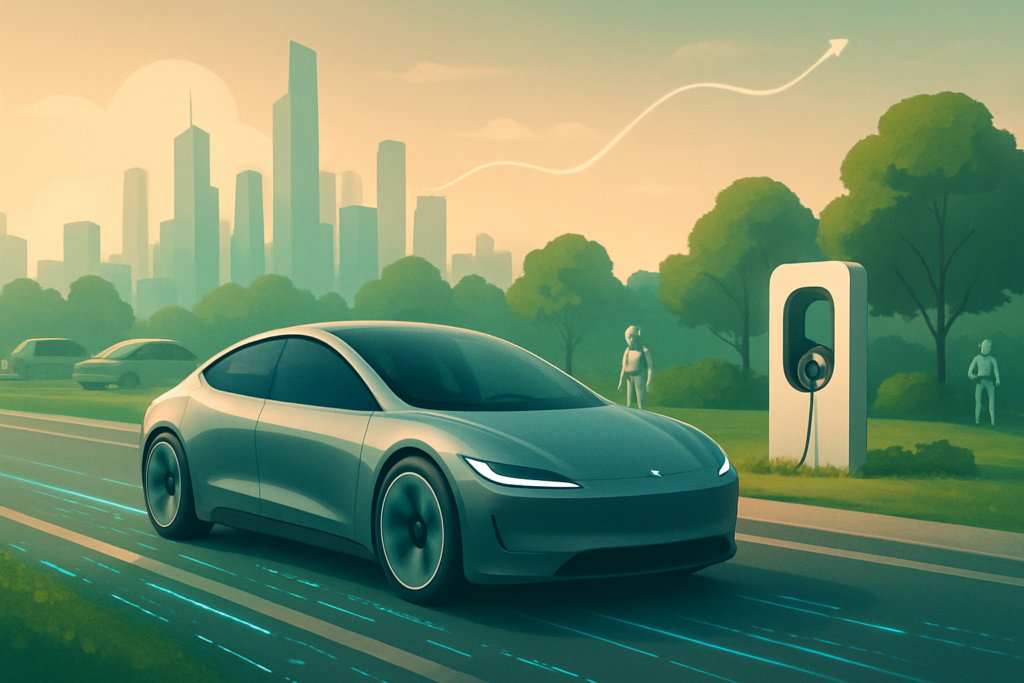
As the Consumer Electronics Show (CES) 2026 unfolds in Las Vegas, the spotlight has once again shifted toward Tesla, Inc. (NASDAQ: TSLA). Historically known for avoiding the official trade show floor, Tesla made waves this week with a parallel "AI Mobility Showcase" held at the Las Vegas Convention Center’s Loop. This event, coinciding with the broader CES schedule, focused exclusively on the latest iteration of Full Self-Driving (FSD) and the production-ready Cybercab. Despite the technological optimism, Tesla’s stock has entered 2026 with significant volatility, driven by a complex mix of shrinking automotive margins and a pivotal shift toward a software-first business model. Today, January 7, 2026, investors are weighing the promise of "unsupervised" autonomy against the reality of a global EV market that is becoming increasingly crowded and price-sensitive.
Historical Background
Founded in 2003 by Martin Eberhard and Marc Tarpenning, and famously scaled by Elon Musk, Tesla has evolved through several distinct eras. The "Proof of Concept" era (2008–2012) saw the launch of the Roadster, proving that EVs could be desirable. The "Expansion" era (2012–2019) introduced the Model S, X, and the mass-market Model 3, though it was nearly derailed by "production hell." The "Dominance" era (2020–2023) saw Tesla become the world’s most valuable automaker, peaking at a trillion-dollar valuation and achieving record profitability. However, 2024 and 2025 marked a "Transformation" era, where the company began de-emphasizing its status as a car manufacturer in favor of becoming an AI and robotics powerhouse.
Business Model
Tesla’s revenue streams are currently categorized into four primary segments:
- Automotive: Sale and leasing of the Model S, 3, X, Y, and Cybertruck. This remains the largest revenue driver but has faced margin compression due to global price wars.
- Energy Generation and Storage: A rapidly growing segment featuring Powerwall, Megapack, and solar products.
- Services and Other: This includes Supercharging revenue, insurance, and after-sales service.
- FSD/Software-as-a-Service (SaaS): A high-margin segment where Tesla sells or leases its autonomous driving software. In 2025, Tesla began exploring "FSD Licensing" agreements with legacy OEMs, a move analysts believe is critical for long-term valuation.
Stock Performance Overview
The last decade has been a rollercoaster for TSLA shareholders. Over the 10-year horizon, the stock remains one of the best-performing assets in history, up over 1,500%. However, the 5-year window shows extreme volatility, with a massive run-up in 2021 followed by a deep correction in 2022 and 2024. In the past year (2025), the stock gained a modest 11%, significantly underperforming the broader NASDAQ 100 as the market reacted to Tesla losing its title as the world's top EV seller to BYD (HKG: 1211). Entering January 2026, the stock is currently trading roughly 15% below its December 2024 high of $473, as investors digest a year-over-year decline in total vehicle deliveries.
Financial Performance
In its most recent quarterly filing (Q4 2025), Tesla reported a cooling of its automotive growth.
- Revenue: Stagnated at approximately $98 billion for the full year 2025, as price cuts offset volume increases.
- Margins: Automotive gross margins (excluding credits) hovered around 16.5%, down from historical highs of 25%+.
- Cash Flow: Free cash flow remains robust at $7.2 billion, supported by the high-margin Energy segment.
- Deliveries: Tesla delivered 1.64 million vehicles in 2025, an 8.5% decline from 2024, falling behind BYD’s 2.26 million units.
- Valuation: Tesla continues to trade at a significant premium (P/E ratio of ~65x) compared to traditional automakers (typically 5x–10x), a valuation supported almost entirely by its AI and Robotaxi potential.
Leadership and Management
Elon Musk remains the central figure, though his focus is increasingly divided between Tesla, SpaceX, and xAI. In late 2025, the board appointed a new Chief Operating Officer (COO) to handle day-to-day automotive manufacturing, allowing Musk to focus on "End-to-End AI." Despite controversies surrounding his social media presence, Musk’s leadership is still viewed as the primary reason for Tesla's technological lead. The board has also seen increased pressure for more independent oversight, particularly regarding Tesla’s resource-sharing agreements with Musk’s private AI venture, xAI.
Products, Services, and Innovations
The CES 2026 presentation highlighted three core innovations:
- FSD v14: A complete architectural rewrite using 10x larger neural networks, capable of "Park to Park" autonomy.
- AI5 (Hardware 5): A proprietary chip designed for the Cybercab, boasting 3x the compute of AI4 (Hardware 4).
- Cybercab: A dedicated two-seater autonomous vehicle without a steering wheel, now entering its final "pre-production" phase in Austin, Texas.
Tesla also demonstrated "Actually Smart Summon" integration with the Vegas Loop, allowing vehicles to navigate complex underground terminals without human intervention.
Competitive Landscape
Tesla faces a two-front war:
- Automotive: BYD has surpassed Tesla in volume, while companies like Rivian (NASDAQ: RIVN) and Lucid (NASDAQ: LCID) compete in the premium and lifestyle segments.
- AI/Self-Driving: Waymo (Alphabet/NASDAQ: GOOGL) has a lead in commercialized Level 4 autonomy in urban centers, while NVIDIA (NASDAQ: NVDA) recently unveiled its "Alpamayo" open-source autonomous driving platform at CES 2026, which could allow traditional automakers to catch up to Tesla’s software capabilities.
Industry and Market Trends
The "EV Slowdown" of 2024–2025 has forced a market consolidation. High interest rates and the expiration of federal EV tax credits in early 2025 significantly impacted US demand. Furthermore, the shift from "Electric Vehicles" to "Software Defined Vehicles" (SDVs) is the dominant trend. Analysts note that the industry is moving away from selling hardware at a profit and toward long-term monetization through software subscriptions and autonomous ride-hailing services.
Risks and Challenges
- Execution Risk: Delays in the mass production of the $25,000 "Model 2" have left Tesla’s lineup feeling aged.
- Regulatory Scrutiny: NHTSA continues to investigate "Unsupervised FSD" claims, and California regulators remain hesitant to grant Tesla a full autonomous testing permit.
- Compute Limits: There is growing concern that older Hardware 3 vehicles will not be able to run the latest FSD v14 models, potentially leading to expensive retrofitting or legal challenges from early adopters.
Opportunities and Catalysts
- Robotaxi Launch: The commercial rollout of the Tesla Network (ride-hailing) in Texas and Florida, expected mid-2026, could re-rate the stock.
- FSD Licensing: A major partnership with a legacy OEM (e.g., Ford or VW) to use Tesla’s FSD stack would provide a massive, high-margin revenue stream.
- Energy Storage: The Megapack business is currently supply-constrained; as production scales, it could eventually represent 25% of Tesla’s total profit.
Investor Sentiment and Analyst Coverage
Wall Street is deeply divided. "Bulls" see Tesla as an AI company and point to the CES FSD v14 demo as proof of an impending "Level 5" breakthrough. "Bears" argue that Tesla is a slowing car company with an AI valuation that is disconnected from its financial fundamentals. Institutional ownership remains high (~42%), but hedge fund positioning has become increasingly tactical, with many using options to play the extreme volatility surrounding quarterly delivery reports.
Regulatory, Policy, and Geopolitical Factors
Tesla’s global strategy is heavily influenced by the U.S.-China trade relationship. With BYD dominating the Chinese market, Tesla is increasingly reliant on its Gigafactory Berlin and Giga Texas to maintain margins. In the U.S., Tesla is actively lobbying for a federal autonomous vehicle framework, which would allow the company to bypass the patchwork of state-level regulations that currently hinder its Robotaxi ambitions.
Conclusion
Tesla enters 2026 at a crossroads. Its CES presentation reaffirmed its status as a leader in vision-based AI, yet the stock’s recent volatility reflects a market that is losing patience with declining vehicle sales. For investors, the "Tesla Narrative" has successfully transitioned from "Can they build cars?" to "Can they solve autonomy?" If FSD v14 delivers on its "unsupervised" promise by the end of 2026, the current volatility may be viewed as a generational buying opportunity. However, if regulatory hurdles or compute limitations persist, Tesla faces the risk of being re-valued as a high-end, but traditional, automaker.
This content is intended for informational purposes only and is not financial advice.