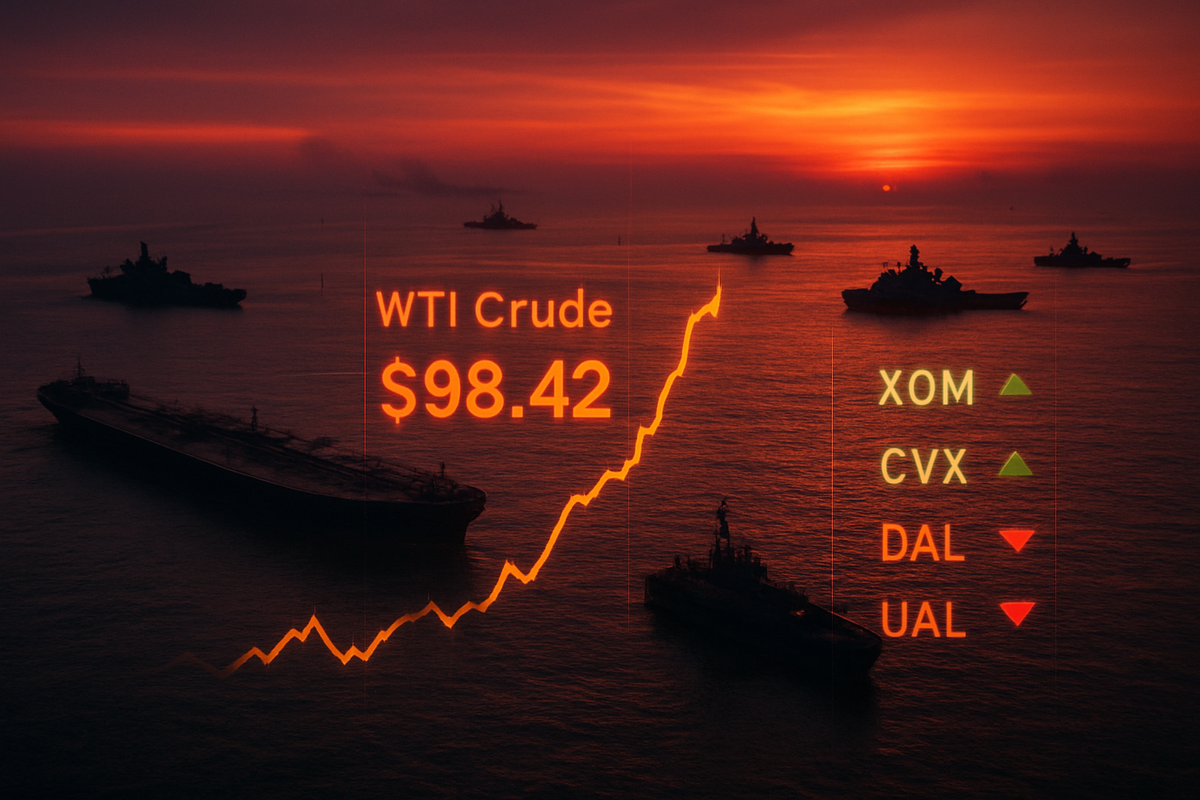
The global energy landscape has been thrust into a state of acute crisis as West Texas Intermediate (WTI) crude oil prices surged past the $90 per barrel threshold this week, fueled by a dramatic military escalation between the United States and Iran. Following the effective closure of the Strait of Hormuz—the world’s most vital maritime oil artery—energy markets have experienced a level of volatility not seen in decades. As of today, March 12, 2026, WTI is trading in a turbulent range between $94 and $98 per barrel, having briefly touched a harrowing peak of $108.58 earlier in the month.
This rapid price appreciation has sent shockwaves through the broader financial markets, derailing hopes for a period of low inflation and steady interest rate cuts. With approximately 20% of the world’s daily oil consumption normally transiting the now-blocked Strait, the threat of a prolonged supply deficit has forced the International Energy Agency (IEA) to coordinate a massive emergency reserve release. However, even these historic measures have only partially cushioned the blow, as investors brace for the possibility of "stagflation" and a potential pivot in central bank policy.
Escalation in the Gulf: From "Epic Fury" to a Maritime Blockade
The current crisis traces its origins to a significant military operation late last month. On February 28, 2026, a joint force of U.S. and allied assets launched "Operation Epic Fury," a series of precision air strikes targeting Iranian military infrastructure and nuclear facilities. The strikes, which were a response to escalating regional provocations, reportedly caused significant damage to Iran's command structure. The immediate aftermath saw a swift and aggressive response from Tehran. On March 1 and 2, the Islamic Revolutionary Guard Corps (IRGC) launched a barrage of over 1,000 missiles and drones aimed at U.S. bases and regional energy hubs in Saudi Arabia and the United Arab Emirates.
The most crippling blow to global commerce came on March 2, 2026, when Iran officially declared the Strait of Hormuz "closed" to international traffic. While international law makes a formal closure difficult, the reality on the water has become a de facto blockade. Attacks on several commercial tankers and the subsequent withdrawal of maritime insurance coverage for the region have effectively halted the flow of nearly 20 million barrels of oil per day. By March 6, WTI futures breached $90, marking a "historic short squeeze" as traders rushed to hedge against a total loss of Persian Gulf supply.
The timeline of the past two weeks has been characterized by a desperate scramble for alternative routes and supply sources. While some oil can be diverted through pipelines in Saudi Arabia and the UAE to the Red Sea or the Gulf of Oman, these alternatives lack the capacity to replace the massive volumes typically moved via the Strait. Major Asian economies, including China, India, and Japan—which rely on the Strait for nearly 70% of their crude imports—have already begun implementing fuel rationing measures and emergency conservation protocols as the "energy weaponization" of the waterway enters its second week.
Market Winners and Losers: Energy Giants Surge While Transport Sinks
The sudden spike in crude prices has created a stark divide in the equity markets. Domestic energy producers and integrated oil majors have seen their valuations soar as they benefit from higher margins and their relative insulation from Middle Eastern logistics. ExxonMobil (NYSE: XOM) has emerged as a primary beneficiary, with its stock price climbing over 26% since the start of the year to reach record highs near $159. Similarly, Chevron (NYSE: CVX) has seen a 25% year-to-date gain, bolstered by its robust balance sheet and diversified global production footprint that includes significant U.S.-based assets.
In the shale patch, Occidental Petroleum (NYSE: OXY) has outpaced even the majors, surging 32% since January. Investors are betting heavily on Occidental’s domestic production capabilities in the Permian Basin, which can be brought to market without transiting the volatile Middle East. For these companies, the current price environment represents a massive windfall, provided they can manage the inflationary pressures on their own service and equipment costs.
Conversely, the transportation and consumer-facing sectors are reeling from the "energy tax." The airline industry, in particular, has seen its recovery hopes dashed. Delta Air Lines (NYSE: DAL) and United Airlines (NASDAQ: UAL) have both faced steep sell-offs, as the Arca Airline Index lost 15% of its value in early March alone. With jet fuel prices jumping roughly 45% since the onset of the conflict, analysts warn that the anticipated profit margins for 2026 could be entirely wiped out. Beyond airlines, logistics companies and retailers are also under pressure, as the cost of shipping goods across the globe rises in lockstep with the price of diesel and marine fuel.
The Broader Significance: Inflationary Relapse and Historical Echoes
This event is not merely a localized price spike; it represents a fundamental shift in the global economic narrative for 2026. For much of late 2025, the prevailing market sentiment was one of cautious optimism that inflation was finally under control. The "Hormuz Shock" has shattered that consensus. Financial institutions like Vanguard and RBC are now warning that headline inflation could remain above 3% for the remainder of the year. This has profound implications for the Federal Reserve, which was previously expected to initiate multiple interest rate cuts in 2026. Markets are now pricing in a "higher-for-longer" stance, as the Fed may be forced to keep rates restrictive to counter the inflationary pressure of $100 oil.
Historically, the closure of the Strait of Hormuz has been the "nightmare scenario" for energy analysts. Comparisons are already being drawn to the 1979 Iranian Revolution, which saw global oil prices double and triggered a severe global recession. While the world is less oil-intensive today than it was in the late 1970s, the interconnectedness of modern supply chains means that a disruption of this magnitude has a far-reaching "ripple effect." The current crisis is arguably more severe than the 2019-2020 tensions, as it involves a direct and sustained military confrontation rather than isolated tanker seizures or drone strikes.
Furthermore, the crisis highlights the ongoing struggle between traditional energy security and the long-term transition to renewables. While high oil prices typically accelerate interest in electric vehicles and alternative power, the immediate urgency of the crisis has forced governments to prioritize short-term fossil fuel supply. This may lead to a temporary pause in some climate-focused policy initiatives as nations scramble to secure enough energy to keep their economies functioning through the 2026 winter.
Looking Ahead: Diplomatic Maneuvers and the $150 Scenario
The short-term outlook depends almost entirely on the duration of the maritime blockade. If a diplomatic solution or a successful naval escort operation—reminiscent of the 1980s "Operation Earnest Will"—can be established quickly, oil prices could stabilize in the $80-$90 range. However, if the IRGC continues to effectively deny passage through the Strait, some analysts at Goldman Sachs and Morgan Stanley have warned that WTI could test $150 or even $200 per barrel. Such a price level would almost certainly tip the global economy into a "moderate to severe" recession by late 2026.
In the coming months, market participants should watch for potential strategic pivots from major oil-consuming nations. The U.S. and its allies may attempt to negotiate increased production from non-OPEC+ sources or provide military escorts for commercial shipping. Additionally, the role of China will be critical; as a major buyer of Iranian oil, Beijing’s diplomatic pressure on Tehran could be a deciding factor in reopening the waterway. For investors, the "energy trade" remains the dominant theme, but the risks of a broader market correction grow as higher energy costs begin to eat into consumer discretionary spending.
Final Assessment: A Lasting Impact on Global Policy
As we move through mid-March 2026, the primary takeaway is that energy security has returned to the forefront of the global agenda. The "peace dividend" of the early 2020s has vanished, replaced by a geopolitical reality where vital supply lines can be severed overnight. The surge in oil prices above $90 is more than just a number; it is a signal of a more fragmented and volatile world order.
Investors should remain vigilant, watching not only the headlines from the Persian Gulf but also the Federal Reserve’s rhetoric regarding inflation and the IEA's management of strategic reserves. While the energy sector currently offers a hedge against these geopolitical risks, the broader economic fallout of sustained high prices could eventually weigh on all asset classes. The "Hormuz Crisis of 2026" will likely be remembered as a turning point that forced a major reassessment of inflation expectations and the fragility of global trade.
This content is intended for informational purposes only and is not financial advice