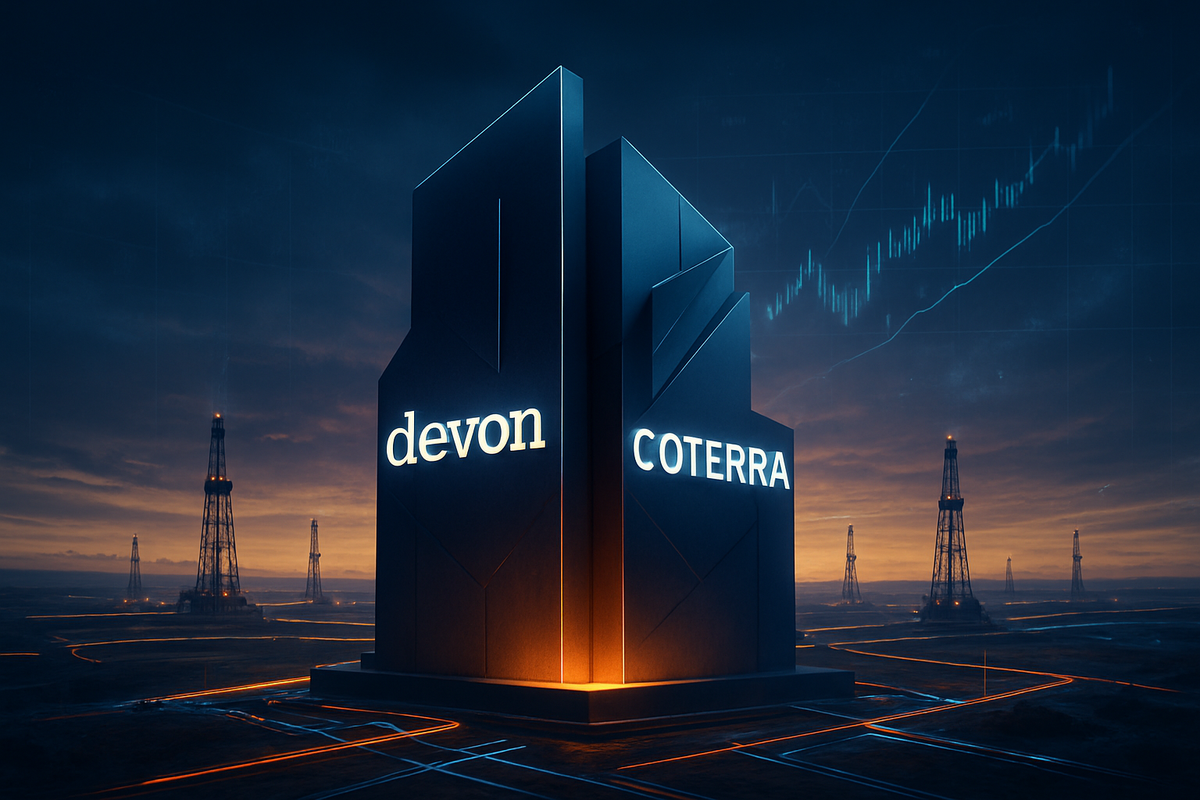
The American energy landscape has shifted once again as Devon Energy (NYSE: DVN) and Coterra Energy (NYSE: CTRA) officially announced a definitive merger agreement valued at $58 billion. This massive "merger of equals" creates a new premier "super-independent" producer, boasting a pro forma production capacity exceeding 1.6 million barrels of oil equivalent per day (boepd). The deal comes at a critical juncture for the global economy, as the United States solidifies its role as a stabilizing force amidst severe international supply shocks.
The immediate implications of this tie-up are profound. By combining Devon’s powerhouse Delaware Basin assets with Coterra’s high-margin Marcellus Shale natural gas footprint, the new entity—retaining the Devon Energy name—becomes the fourth-largest oil and gas producer in the country. This scale is intended to provide a financial fortress against the extreme price volatility seen in early 2026, while positioning the company to meet the surging electricity demands of domestic AI data centers and the growing hunger for U.S. liquefied natural gas (LNG) exports.
A Strategic Marriage Amidst Global Turmoil
The path to this $58 billion deal was paved by a series of quiet negotiations beginning in mid-January 2026, following a year of intense consolidation across the Permian Basin. The transaction is structured as an all-stock deal where Coterra shareholders will receive 0.70 shares of Devon common stock for each share held. Upon the expected close in the second quarter of 2026, Devon shareholders will own 54% of the combined company, with Coterra shareholders holding the remaining 46%. This structure, carrying a modest 12% premium, emphasizes long-term value creation over immediate cash payouts, a hallmark of the "Shale 4.0" era.
Leadership of the new Houston-based giant will be split between the two firms' top brass. Clay Gaspar, who ascended to the CEO role at Devon Energy in early 2025, will serve as President and CEO of the combined company. Tom Jorden, the architect behind Coterra’s success, will transition to the role of Non-Executive Chairman. Initial market reactions were measured but positive; Devon shares saw a slight uptick of 0.6% on the news, while Coterra experienced a minor 1.4% dip as arbitrageurs adjusted their positions. Analysts suggest the "merger of equals" approach is designed to mitigate the integration risks that often plague high-premium acquisitions.
The timing of the announcement coincided with a dramatic escalation of geopolitical tensions in the Middle East. With the Strait of Hormuz effectively closed due to military conflict, and Brent crude prices surging toward $120 per barrel in early March 2026, the need for reliable, scaled domestic production has never been higher. This merger allows the combined company to optimize capital programs across six major shale plays, targeting $1 billion in annual pre-tax synergies by the end of 2027 through streamlined corporate costs and shared technological platforms.
Identifying the Winners and Losers in a Consolidated Market
The primary winners in this transaction appear to be the long-term shareholders of both Devon and Coterra, who now gain exposure to a more diversified and resilient asset base. By merging oil-rich Permian assets with gas-heavy Marcellus holdings, the company is effectively hedged against fluctuations in any single commodity. Furthermore, midstream operators like Enterprise Products Partners (NYSE: EPD) and Williams Companies (NYSE: WMB) stand to benefit from more predictable, large-scale volumes flowing through their gathering and processing networks as the combined entity optimizes its drilling inventory.
On the other side of the ledger, smaller "pure-play" independent explorers may find themselves in a precarious position. As Devon and Coterra achieve lower unit costs through scale, smaller firms like Diamondback Energy (NASDAQ: FANG) or Matador Resources (NYSE: MTDR) could face increased pressure to either find their own merger partners or risk being squeezed by rising service costs that favor larger operators with greater bargaining power. For these smaller players, the "scarcity of tier-one acreage" has become a literal existential threat as the largest swaths of the Permian are now controlled by a handful of mega-caps.
Consumers may also face a double-edged sword. While the merger ensures a more stable and efficient supply of domestic energy, the continued consolidation of the industry reduces the number of independent actors who might otherwise increase production to chase high prices. In the 2026 market, "capital discipline" remains the mantra, meaning that even with $120 oil, this new energy giant is likely to prioritize dividend increases and share buybacks over aggressive new drilling, potentially keeping energy prices higher for longer for the American public.
Broader Significance: The Great Inventory Race of 2026
The Devon-Coterra merger is the latest and perhaps most significant piece of a consolidation puzzle that began in earnest with the 2023 acquisitions by ExxonMobil (NYSE: XOM) and Chevron (NYSE: CVX). It signals that the era of the small, nimble shale wildcatter is largely over, replaced by a corporate landscape defined by manufacturing-style efficiency and decade-long drilling runways. This "Great Inventory Race" is driven by the realization that high-quality, low-breakeven acreage in the U.S. is a finite resource that is rapidly being locked up.
Beyond the hunt for oil, the deal highlights the "Natural Gas Renaissance" of 2026. With domestic data center electricity demand projected to hit unprecedented levels due to the AI boom, and the U.S. aiming to remain the world's leading LNG exporter, Coterra’s Marcellus assets are the "crown jewels" of this deal. The merger underscores a shift in industry sentiment: natural gas is no longer seen merely as a "bridge fuel," but as a permanent, high-growth pillar of the American energy portfolio.
Regulators in Washington are expected to scrutinize the deal, though the "merger of equals" structure and the lack of a single dominant basin-wide monopoly may ease the path to approval. Historically, the Federal Trade Commission has been more lenient with mergers between independent producers than with "Big Oil" acquisitions. However, given the 2026 climate of high inflation and energy security concerns, the deal will undoubtedly be a lightning rod for political debate regarding corporate power in the energy sector.
Looking Ahead: Integration and the AI Energy Nexus
In the short term, the focus will shift entirely to integration. The combined company must prove it can actually extract the $1 billion in promised synergies without disrupting production during a period of global supply crisis. Investors will be watching for the first joint capital budget in late 2026 to see if the firm pivots more heavily toward natural gas to capture the data center market or maintains a steady hand on its oil-weighted Permian assets.
Long-term, the strategic pivot may involve a deeper integration with the technology sector. There is growing speculation that mega-producers like the new Devon Energy could enter into direct power-purchase agreements or even co-locate natural gas power generation assets near their production sites to serve the burgeoning needs of the tech industry. This would represent a fundamental shift in the business model of an E&P (exploration and production) company, moving from a mere commodity seller to a comprehensive energy solutions provider.
Challenges remain, however. The "Shale 4.0" model of low growth and high returns is under pressure from the U.S. government to increase output to offset the loss of Middle Eastern barrels. Balancing the demands of shareholders for dividends with the national security need for more production will be the defining challenge for Clay Gaspar and his team in the years to follow.
Summary and Final Assessment
The $58 billion merger of Devon Energy and Coterra Energy marks a definitive milestone in the evolution of the U.S. energy sector. By creating a diversified, scaled, and technically advanced "super-independent," the two companies have effectively insulated themselves from the geopolitical shocks of 2026 while positioning themselves at the center of the AI-driven energy transition.
Key takeaways for investors include:
- Scale is Mandatory: In a world of supply disruptions and acreage scarcity, size provides the only reliable shield.
- Gas is King: The inclusion of Coterra’s Marcellus assets proves that natural gas is the primary growth engine for the next decade.
- Capital Discipline Prevails: Despite $120 oil, don't expect a return to the "drill-at-all-costs" mentality; dividends and buybacks remain the priority.
Moving forward, the market will keep a close eye on the closing of the deal and any potential regulatory hurdles. For now, the Devon-Coterra merger stands as a bold bet on the enduring importance of American shale in an increasingly unstable world.
This content is intended for informational purposes only and is not financial advice.