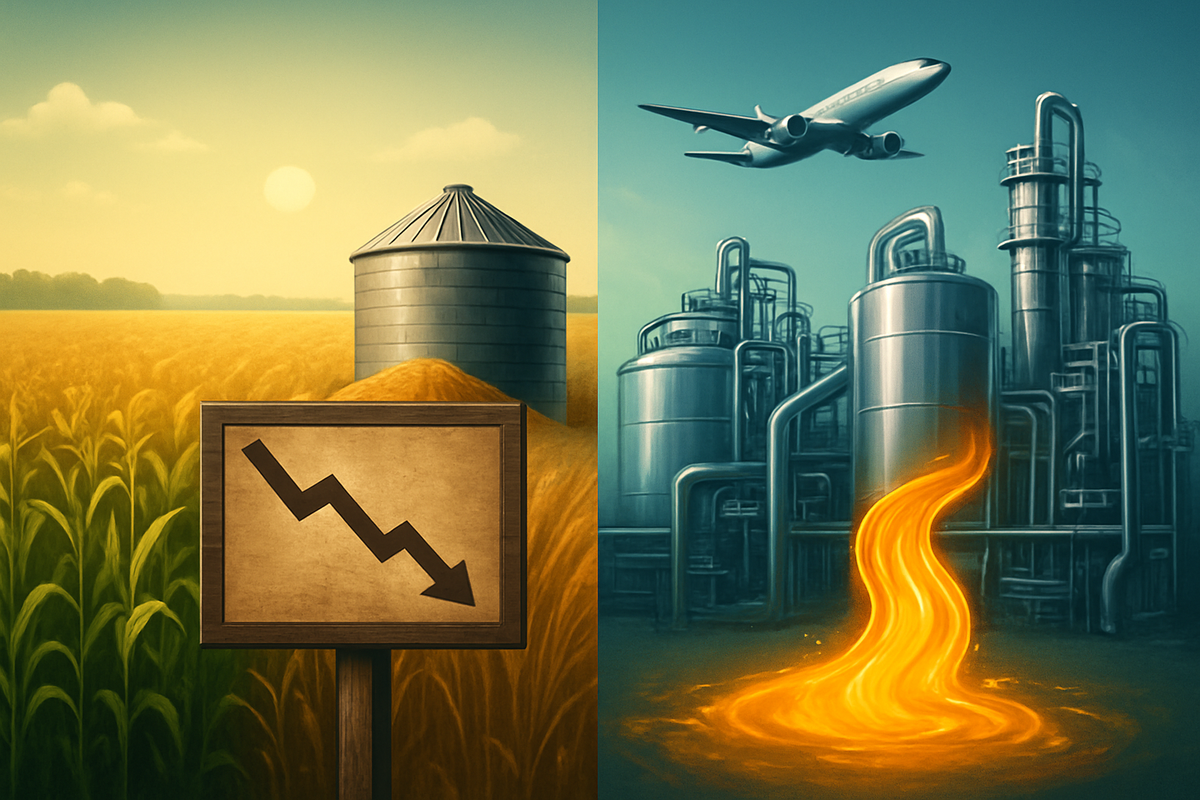
As of February 18, 2026, the global agricultural landscape is witnessing a historic "decoupling" of commodities. While corn and wheat prices languish near multi-year lows under the weight of record-breaking global harvests, soybean oil has defied the gravity of the grain markets, surging a staggering 43% year-to-date. This divergence has created a two-tiered economy in the fields of the American Midwest and the trading floors of Chicago, where the demand for food is being rapidly overtaken by an insatiable appetite for green energy.
The immediate implications are profound for both the energy and consumer sectors. While the "wall of soy" from a projected 180 million metric ton (MMT) harvest in Brazil anchors global prices for meal and livestock feed, a structural "biofuel premium" has insulated the U.S. domestic market. For refiners and renewable fuel producers, the surge represents a race for feedstock at any cost; for consumer-packaged goods giants, it is a margin-crushing headwind that threatens to keep grocery inflation sticky even as other raw material costs plummet.
A Perfect Storm of Policy and Innovation
The 43% rally in soybean oil prices since January 1, 2026, is not the result of a traditional crop failure, but rather a legislative and industrial pivot. The primary catalyst was the full implementation of the 45Z Clean Fuel Production Credit, which went into effect at the start of the year. This policy shift fundamentally changed the economics of soybean oil by removing the "Indirect Land Use Change" (ILUC) penalty from carbon intensity calculations. Consequently, the value of the tax credit for soy-based renewable diesel effectively doubled from approximately $0.32 per gallon to over $0.64 per gallon, making domestic soybean oil the most attractive feedstock for North American refiners.
Simultaneously, the Environmental Protection Agency (EPA) finalized its Renewable Volume Obligations (RVOs) for 2026, mandating a massive jump in biomass-based diesel to 5.61 billion gallons—up from 3.35 billion in 2025. This "policy floor" forced major energy players to secure their soybean oil supplies early in the year, sparking a domestic bidding war. The situation was further tightened by the rapid expansion of Sustainable Aviation Fuel (SAF) capacity. Facilities like the Port Arthur refinery, operated by a joint venture between Valero Energy (NYSE: VLO) and Darling Ingredients (NYSE: DAR), have begun shifting significant portions of their output toward SAF to meet new 2% blending mandates in Europe and the UK, which requires significantly more raw oil per gallon of finished fuel than standard renewable diesel.
As these factors converged in the first six weeks of 2026, a "feedstock squeeze" emerged. Despite a record global crop, trade policies favoring "USMCA-originated" oils have effectively cordoned off the U.S. market from the cheaper international supplies sitting in Brazilian ports. The result is a domestic price for soybean oil near 53 cents per pound, even as its sister commodities, corn and wheat, remain trapped in a bear market.
Winners and Losers in the New Bio-Economy
The clear frontrunners in this environment are the vertically integrated renewable fuel producers. Darling Ingredients (NYSE: DAR) has emerged as a standout performer, with its stock rising nearly 24% in the first seven weeks of 2026. The company’s Diamond Green Diesel venture reported record sales volumes, capitalizing on the higher margins provided by the 45Z credit and its strategic positioning in the SAF market. Likewise, Valero Energy (NYSE: VLO) has seen its refining margins bolstered by its early pivot toward renewable diesel, insulating it from the volatility seen in traditional petroleum refining.
Agricultural giants like Bunge Global SA (NYSE: BG) and Archer-Daniels-Midland (NYSE: ADM) occupy a more complex position. Bunge, having recently fully integrated its acquisition of Viterra, is benefiting from record crush volumes and the massive 180 MMT Brazilian harvest. However, both firms have issued conservative guidance for 2026, citing the unpredictability of U.S. policy and the divergence between high domestic costs and low global export margins. While they win on volume, the "margin squeeze" in their domestic food-grade oil divisions remains a challenge.
The most significant "losers" in this divergence are the consumer-packaged goods (CPG) companies. PepsiCo (NASDAQ: PEP) and General Mills (NYSE: GIS) are currently navigating a treacherous financial landscape. While cheap wheat prices—trading near $4.90 per bushel—help the bottom line for cereals and crackers, the 43% spike in soybean oil has ravaged the margins for snacks and frozen foods. General Mills recently warned that its adjusted operating profit could decline by as much as 20% this fiscal year, largely due to the rising cost of edible oils. PepsiCo has responded by aggressively cutting prices on core brands and reducing its product variety (SKUs) by 20% to simplify supply chains and offset the "biofuel premium" they are now forced to pay for frying oil.
The Broad Shift: From Food to Fuel
This divergence marks a pivotal moment in the "Food vs. Fuel" debate, signaling that the energy transition has reached a scale where it can permanently decouple related agricultural commodities. Historically, soybean oil, corn, and wheat moved in a loose correlation as part of the broader "grain complex." In 2026, that correlation has shattered. The significance lies in the fact that the U.S. soybean acre is no longer just a source of protein for livestock or oil for cooking; it is a strategic energy asset.
The ripple effects are being felt globally. Brazil’s record 180 MMT crop, while anchoring global food security, is finding fewer buyers in the U.S. due to domestic protectionist tax credits. This has created a "two-tier" global market: a cheap, oversupplied international market for food and feed, and an expensive, scarcity-driven domestic market for energy feedstock. Regulatory bodies are now facing pressure from food processors to reconsider the 45Z eligibility requirements, as the high cost of oil begins to impact the "affordability war" on grocery shelves.
Furthermore, this event mirrors the ethanol boom of the mid-2000s but with a critical difference. While ethanol competed primarily with corn, the renewable diesel and SAF revolution is targeting the oilseed market, which has a much tighter supply-demand balance and more direct implications for the global vegetable oil market, including palm and canola oil.
Looking Ahead: The 2027 Horizon
In the short term, market participants expect the volatility to persist as refiners continue to lock in feedstock for the second half of 2026. The agricultural industry will be watching for any signs of a "strategic pivot" from CPG companies, such as a shift toward alternative oils or further price hikes. However, with consumer sentiment already fragile, further price increases at the grocery store may be untenable.
Longer-term, the focus will shift to the 2027 RVO mandates and the sustainability of the 45Z credit. If the EPA continues to move the goalposts higher for SAF and renewable diesel, the soybean market may never return to its historical price relationship with corn and wheat. Market opportunities may emerge for "cover crops" and alternative feedstocks like camelina or pennycress, which could relieve the pressure on soybean oil. For now, the "soybean oil premium" appears to be a structural fixture of the new green economy.
Summary and Investor Takeaways
The 43% surge in soybean oil year-to-date represents a landmark divergence in the financial markets. Driven by the 45Z tax credit and an aggressive push for Sustainable Aviation Fuel, soybean oil has separated itself from the broader agricultural downturn. While a record 180 MMT harvest in Brazil ensures a global supply of soy, U.S. domestic policy has created a high-priced environment that favors energy producers over food processors.
Key takeaways for investors:
- Watch the Feedstock Plays: Companies like Darling Ingredients (NYSE: DAR) and Valero (NYSE: VLO) are currently the primary beneficiaries of the "biofuel premium."
- CPG Vulnerability: Monitor the margins of PepsiCo (NASDAQ: PEP) and General Mills (NYSE: GIS) as they struggle to pass on the high cost of oil to price-sensitive consumers.
- The Brazil Factor: Despite the U.S. surge, the 180 MMT crop in Brazil remains a massive "overhang" on global grain prices, keeping corn and wheat suppressed.
The coming months will be a test of whether the U.S. consumer can absorb the costs of the energy transition at the dinner table, or if the government will be forced to intervene to balance the competing needs of the fuel tank and the food pantry.
This content is intended for informational purposes only and is not financial advice.