AUSTIN, Texas — In a quarterly earnings report that may be remembered as the moment the world’s most famous electric vehicle company formally shed its automotive skin, Tesla (NASDAQ: TSLA) has signaled a radical shift in its corporate DNA. On January 28, 2026, the company reported its fourth-quarter 2025 financial results, but the numbers—while significant—were overshadowed by a strategic declaration: Tesla is no longer just a car company; it is becoming a "Physical AI" and robotics powerhouse.
The financial data painted a picture of a company in transition. Tesla reported Q4 revenue of $24.9 billion, a 3% decrease from the previous year, yet managed to beat earnings expectations with a non-GAAP EPS of $0.50. Most notably, the company’s GAAP gross margin climbed to 20.1%, its highest level in two years. This suggests that while vehicle sales volume is cooling—down 16% this quarter—Tesla’s aggressive cost-reduction strategies are successfully shoring up the bottom line.
The End of an Era: Sunsetting the Model S and Model X
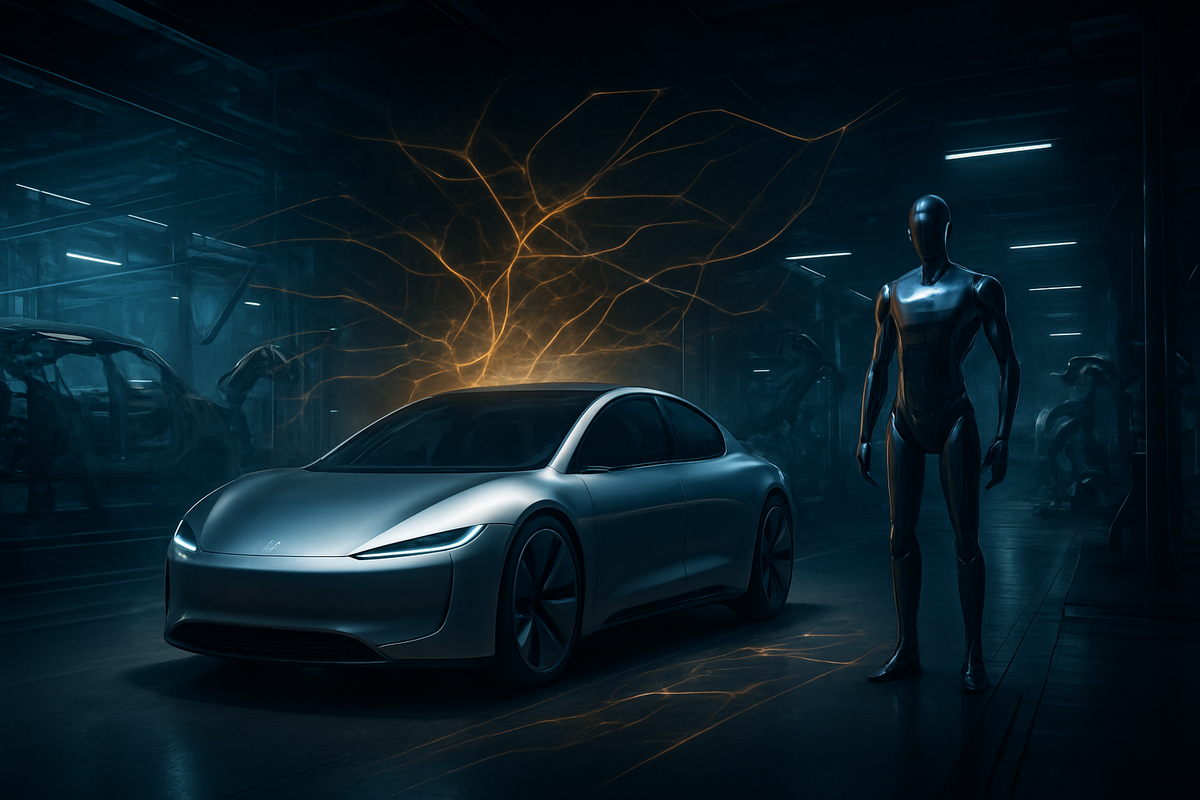
The most jarring news for automotive purists came during the earnings call, when CEO Elon Musk announced the "honorable discharge" of the Model S and Model X. Production for these flagship luxury vehicles will officially cease in Q2 2026. In a move that symbolizes the company's new direction, the manufacturing space currently dedicated to these models at the Fremont plant will be immediately repurposed for the assembly of the Optimus humanoid robot.
This pivot is backed by a massive capital expenditure (Capex) plan. Tesla has guided for a 2026 Capex exceeding $20 billion—nearly double its 2025 spending. This war chest is aimed squarely at AI infrastructure, the scaling of the Optimus program, and the launch of the "Cybercab." The Cybercab, a dedicated two-seater autonomous vehicle designed with no steering wheel or pedals, is slated to begin initial production in April 2026 using the company’s revolutionary "Unboxed" manufacturing process.
Market Ripples: Winners, Losers, and the 'Physical AI' Sector
The market's reaction to Tesla’s news was a study in contrast. While Tesla's stock initially faced pressure due to the high Capex forecast and the sunsetting of established revenue-generating models, its rivals saw significant movement.
- Rivian Automotive (NASDAQ: RIVN): Shares of the adventure-EV maker surged over 26% following the report. As Tesla exits the high-end luxury sedan and SUV space, investors see a massive opportunity for Rivian to capture that premium market share. Rivian’s recent achievement of positive gross margins has made it an attractive "safety play" for those wary of Tesla's high-stakes robotics gamble.
- BYD (OTC: BYDDY): The Chinese giant, having officially overtaken Tesla as the world’s largest BEV manufacturer by volume in 2025, continues to win on pure operational efficiency. While Tesla looks toward a future of humanoid robots, BYD is using AI to achieve 97% factory automation, allowing them to undercut competitors on price while expanding aggressively into Europe.
- Lucid Motors (NASDAQ: LCID): Lucid is holding firm on its commitment to hardware excellence. To counter the robotaxi narrative, Lucid announced a partnership with Uber to deploy 20,000 autonomous Gravity SUVs over the next six years, leveraging their superior battery efficiency to remain relevant in the fleet market.
The Broader Impact: A Paradigm Shift in Tech
Tesla’s transition has catalyzed the emergence of "Physical AI" as a distinct and formidable investment sector. This isn't just about software; it’s about AI that perceives, reasons, and acts within the physical world. This shift has massive implications for the entire tech ecosystem.
Companies providing the "nervous system" for these machines are seeing renewed interest. Nvidia (NASDAQ: NVDA), now valued near $4.6 trillion, is increasingly viewed not just as a data center company, but as the foundational infrastructure for the robotics age. Similarly, sensor manufacturers like Hesai and edge-computing leaders like Qualcomm and ARM are being re-rated by analysts who see them as the "picks and shovels" of the Physical AI gold rush.
This pivot also places Tesla in a direct "arms race" with traditional robotics firms like Boston Dynamics (owned by Hyundai) and startups like Figure AI. The stakes have moved from "who can build the most cars" to "who can build the most capable autonomous workforce."
What Comes Next: The Road to 2027
The remainder of 2026 will be a gauntlet for Tesla. The company must prove it can execute on the Cybercab’s April production start and meet its goal of a nationwide "unsupervised" FSD rollout by year-end. Experts suggest that reaching the "10 billion mile" data threshold—expected around July 2026—will be the critical technical milestone for this achievement.
Furthermore, the highly anticipated $25,000 "Project Redwood" vehicle (often dubbed the Model 2) remains on the horizon. While low-volume production is expected to start at Giga Texas by the end of 2026, high-volume deliveries for the general public are not anticipated until early 2027. This vehicle will be the ultimate test of whether Tesla can balance its high-tech robotics future with its original mission of mass-market EV adoption.
Conclusion
Tesla's Q4 2025 earnings report was far more than a financial statement; it was a manifesto for the next decade of the company. By choosing to sacrifice legacy models like the S and X to make room for robots and autonomous cabs, Elon Musk has doubled down on a vision of the future that is as risky as it is ambitious.
Investors must now decide if they are comfortable with Tesla’s transition from a profitable car manufacturer to a high-burn, high-growth AI powerhouse. In the coming months, the progress of the Optimus Gen 3 and the regulatory path for the Cybercab will be the primary drivers of the stock. The EV market has entered its second wave, and Tesla is betting $20 billion that the future doesn't belong to the car, but to the intelligence that drives it.
This content is intended for informational purposes only and is not financial advice.