PHOENIX, AZ – In what market analysts are calling the most dramatic corporate turnaround of the decade, Carvana (NYSE: CVNA) reported a staggering set of fourth-quarter and full-year 2025 financial results on Wednesday evening. The online used-vehicle retailer, which narrowly avoided insolvency just three years ago, has silenced skeptics by delivering a massive earnings beat that propelled its stock significantly higher in after-hours trading.
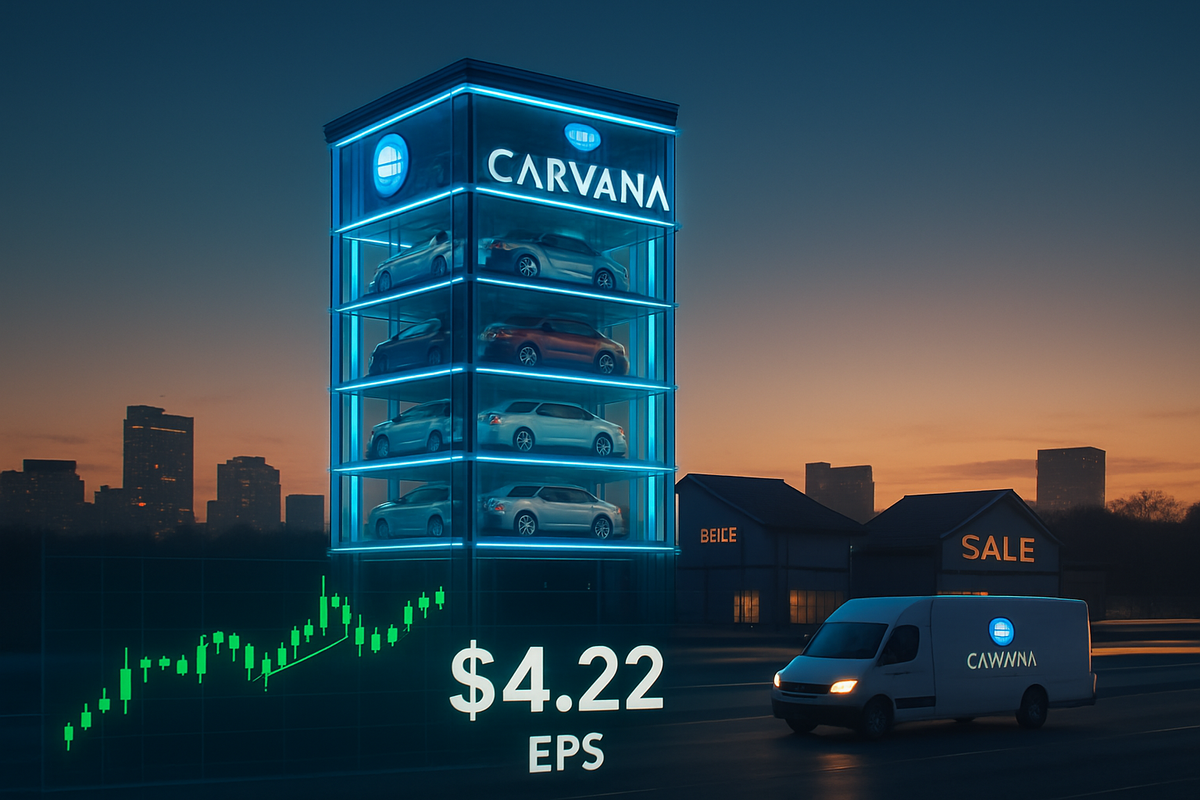
The company reported a fourth-quarter diluted earnings per share (EPS) of $4.22, nearly four times the consensus Wall Street estimate of $1.13. This bottom-line performance was supported by quarterly revenue of $5.6 billion, signaling that Carvana’s lean, high-margin operating model has reached a scale few thought possible during the industry's 2022-2023 downturn.
A Record-Breaking Year of Operational Efficiency
Carvana’s performance in the final quarter of 2025 capped off a historic year for the "Online Auto Superstore." The company reported a record 596,641 retail units sold throughout 2025, representing a massive 43% year-over-year growth in volume. This surge in sales comes despite a broader used car market that has been characterized by "cautious stabilization" and high consumer interest rates, which often exceeded 10% for used vehicle loans throughout the year.
The timeline of this recovery is critical to understanding the magnitude of today’s announcement. In 2023, Carvana focused on survival, executing a complex debt restructuring that provided a $878 million one-time gain but left lingering questions about its long-term viability. By 2024, the focus shifted to "profitable growth," utilizing the infrastructure gained from its 2022 acquisition of ADESA to streamline reconditioning and logistics. Today’s report confirms that those investments have paid off; Carvana achieved an industry-leading 9.1% Adjusted EBITDA margin in Q4, driven by AI-enabled customer tools and a sophisticated national logistics network that has slashed SG&A expenses per unit.
Winners and Losers in the New Automotive Landscape
As Carvana (NYSE: CVNA) surges, the traditional "omni-channel" and brick-and-mortar players are feeling the pressure of this digital-first efficiency. CarMax (NYSE: KMX), formerly the undisputed king of used car retail, has had a difficult 2025, with retail unit volumes declining by approximately 8% as it struggles with high overhead costs and a slower transition to fully online transactions. CarMax is currently undergoing a leadership transition and a $150 million cost-cutting initiative in a defensive bid to protect its dwindling market share.
Conversely, diversified automotive giants like AutoNation (NYSE: AN) have managed to weather the Carvana storm by leaning heavily into high-margin segments that digital retailers cannot yet touch: parts and service. While AutoNation’s vehicle sales remained relatively flat compared to Carvana’s explosive growth, its "after-sales" division hit record profitability in 2025. However, for pure-play retailers who rely solely on used vehicle sales and financing, Carvana's aggressive expansion and superior unit economics present an existential threat to their traditional lot-based business models.
Industry Trends and the Path to Three Million Units
The significance of Carvana’s 2025 performance extends beyond its own balance sheet; it marks the definitive maturation of automotive e-commerce. As of early 2026, roughly 20% of all car buyers now prefer a fully online transaction, up from single digits just five years ago. Carvana is riding a wave of digital adoption that has seen the global automotive e-commerce market reach $116.2 billion. Furthermore, the company is positioning itself as a leader in the used Electric Vehicle (EV) market. With used EV supply growing to 11% of the total market in 2026, Carvana’s centralized inventory model has allowed it to move these specialized units more efficiently than local dealers.
Perhaps most ambitious is Carvana's reaffirmed long-term goal of selling 3 million units per year. While reaching nearly 600,000 units in 2025 is a milestone, the 3-million-unit target would require the company to capture roughly 8-10% of the entire U.S. used car market. This objective signals that Carvana no longer views itself as a "disruptive startup," but as the eventual dominant player in the $800 billion U.S. used car industry, aiming for a scale that would dwarf the historical peaks of any predecessor.
The Road Ahead: From Growth to Sustenance
Looking forward, the primary challenge for Carvana will be navigating the end of its "PIK" (Payment-In-Kind) interest period. A legacy of its 2023 debt restructuring, the company was allowed to add interest to its principal debt rather than paying in cash for two years. That period is expiring in early 2026, meaning Carvana must now prove it can sustain its record growth while servicing significant cash interest payments.
The market will also be watching Carvana’s strategic partnership with a major national logistics firm, aimed at reducing delivery times by another 30% in 2026. If Carvana can maintain its $4.00+ EPS levels while moving to a cash-interest environment, it could potentially achieve a "Blue Chip" status that seemed impossible during the dark days of 2022. Strategic pivots into commercial fleet management or expanded third-party marketplace services could provide the next leg of growth as it marches toward its 3-million-unit North Star.
A Transformative Moment for Investors
The February 18, 2026, earnings call will likely be remembered as the moment Carvana transitioned from a speculative turnaround story to an earnings powerhouse. The $4.22 EPS beat is not just a numerical victory; it is a validation of the company's vertically integrated model and its ability to squeeze profit out of a notoriously low-margin industry.
Investors should keep a close eye on the company’s net income relative to its cash interest obligations over the next two quarters. While the record-breaking sales of 2025 have provided a massive capital cushion, the high-interest environment of 2026 remains a headwind for the broader industry. Nevertheless, with a 43% growth rate in a "stabilizing" market, Carvana has proven that its "vending machine" model is no longer a gimmick—it is the new gold standard for automotive retail.
This content is intended for informational purposes only and is not financial advice.