As of January 9, 2026, the market for US-listed Chinese equities has entered a period of "volatile recovery," characterized by a tug-of-war between aggressive domestic stimulus from Beijing and a fragile geopolitical "trade truce" with Washington. Alibaba Group Holding Limited (NYSE: BABA), the traditional bellwether for the sector, is currently trading in the $150–$155 range—a significant rebound from the doldrums of 2024, yet nearly 20% below its October 2025 peak of $192. This price action underscores a broader trend: while the "China trade" has regained its pulse, it remains highly sensitive to every policy shift and diplomatic whisper.
The immediate implications for investors are a mix of opportunity and caution. The massive 75% rally seen in Alibaba throughout 2025, fueled by a pivot in Chinese regulatory sentiment and an emerging AI boom, has cooled into a period of consolidation. The market is now grappling with the "January 2026 Reset," where new Chinese regulations targeting predatory pricing in the e-commerce sector are clashing with the optimism surrounding the upcoming 15th Five-Year Plan. For BABA and its peers, the volatility is no longer just about survival, but about defining their roles in a "technologically sovereign" China.
A Year of Rebound and Resistance
The journey to Alibaba’s current valuation has been a rollercoaster. Throughout 2025, the stock benefited from a "bazooka" of liquidity support from the People’s Bank of China (PBOC), which injected over 1.1 trillion yuan into the economy. This stimulus specifically allowed institutional investors and tech giants like Alibaba to fund massive stock buybacks, providing a much-needed floor for ADRs. By mid-2025, the narrative had shifted from regulatory crackdowns to "state-supported growth," as Beijing identified AI and cloud computing as national security pillars.
However, this momentum faced a severe test in late 2025. As the US administration escalated tariff rhetoric, reaching 145% on certain Chinese goods during the summer, BABA and its peers saw weekly swings of 10% to 15%. This period of "tariff trauma" only abated in November 2025, when a tentative diplomatic agreement was signed. The "November Truce" saw reciprocal tariffs lowered to roughly 30% for the US and 10% for China, providing a temporary sigh of relief for the markets.
Key players in this saga have extended beyond just corporate executives. The primary stakeholders now include the PCAOB (Public Company Accounting Oversight Board), which has confirmed that major firms like Alibaba and JD.com (NASDAQ: JD) are in full compliance with US auditing standards, effectively removing the immediate threat of mass delisting. Despite this, the market remains on edge as the administration signals a move toward "financial decoupling" for firms linked to the Chinese military, keeping the volatility index for Chinese tech (KWEB) at elevated levels.
Winners and Losers in the New Order
In the current landscape, the divide between winners and losers is increasingly defined by AI integration and regulatory alignment. Alibaba has emerged as a leader in this new era, primarily through its Cloud Intelligence Group. With a 35.8% share of China's AI cloud market, BABA’s cloud revenue surged 34% year-over-year in late 2025. Its "Qwen" AI model family has achieved nearly 18% of enterprise-grade AI usage in China, positioning the company as the "infrastructure provider of choice" for the domestic ecosystem.
Conversely, JD.com (NASDAQ: JD) has struggled to keep pace, with its stock lagging behind the sector in 2025, down roughly 7-15%. JD is currently viewed as a "value play," as it burns significant capital on its "Double Hundred Plan" to dominate the on-demand delivery market. While its logistics-heavy model is expected to scale profitably by late 2026, it remains a "loser" in terms of current investor sentiment compared to the high-flying AI plays. PDD Holdings (NASDAQ: PDD), the operator of Temu, is also facing a "normalization" of its hyper-growth. While it remains the most profitable per-order player, it faces mounting regulatory risks in the US regarding the ending of the "de minimis" duty-free exemption.
Other notable winners include Tencent Holdings (OTC: TCEHY), which saw its stock rise over 56% in 2025 due to a resurgence in its gaming division and the successful integration of its Hunyuan AI model. On the losing side, Meituan (HKG: 3690) is currently embroiled in a government probe into "cutthroat pricing" launched on January 7, 2026. This regulatory salvo has cast a shadow over the "instant commerce" sector, affecting any firm—including Alibaba—that is currently burning cash to gain market share in food delivery.
The 15th Five-Year Plan and Geopolitical Ripples
The wider significance of the current volatility lies in China’s 15th Five-Year Plan (2026-2030), which was released earlier this month. The plan prioritizes "New Quality Productive Forces" and "Technological Self-Reliance." This policy shift essentially guarantees state support and R&D tax breaks for Alibaba’s cloud and semiconductor divisions, insulating them from US export curbs. This represents a historical precedent where the Chinese government is no longer just a regulator, but a strategic partner for its tech giants.
This shift has profound ripple effects on global competitors. As Alibaba and Baidu (NASDAQ: BIDU) accelerate their AI capabilities, they are creating a bifurcated global tech market. Baidu, for instance, has re-emerged as a major player through its Apollo Go robotaxi business and its upcoming IPO of the AI chip subsidiary, Kunlunxin. The competition is no longer just about e-commerce GMV; it is a race for "tech sovereignty" that mirrors the Cold War-era space race.
Regulatory implications are also evolving. The "January 2026 Reset" in Beijing indicates that while the government wants these companies to lead in AI, it will not tolerate "irrational competition" in the consumer sector. This dual-track regulatory approach—supporting the "hard tech" while policing the "platform economy"—is a complex tightrope for investors to walk, contributing to the persistent "China discount" in valuations despite strong earnings growth.
The Road Ahead: The April Summit and Beyond
Looking forward, the next major catalyst for Alibaba and the broader sector is the high-profile summit between US and Chinese leaders scheduled for April 2026 in Beijing. This meeting is expected to address the long-term status of the November 2025 truce and could lead to a significant re-rating of "China risk." In the short term, investors should expect continued volatility as the market digests the impact of the new predatory pricing rules on e-commerce margins.
Strategically, Alibaba is expected to continue its pivot away from being a pure retail play. The company’s $19 billion buyback authorization provides a floor for the stock, but the real growth will come from its ability to monetize its AI infrastructure. A potential scenario for 2026 involves Alibaba spinning off its Cloud Intelligence Group into a separate public entity, a move that was previously shelved but is now back on the table as the regulatory environment stabilizes.
Market opportunities may also emerge in the "Quick Commerce" space. If the current price wars are successfully quelled by government intervention, margins for Alibaba’s local services could rebound faster than anticipated. However, the challenge remains the intense competition from ByteDance (the parent of Douyin), which continues to aggressively integrate shopping and delivery into its short-video platform.
Conclusion: Navigating the New Normal
The current state of Alibaba and US-listed Chinese tech is a testament to the resilience of the sector in the face of unprecedented geopolitical and regulatory pressure. The key takeaway for the start of 2026 is that the "easy money" from the 2025 stimulus rally has been made. Moving forward, the market will differentiate between companies that are merely "surviving" and those that are "essential" to China’s national tech strategy.
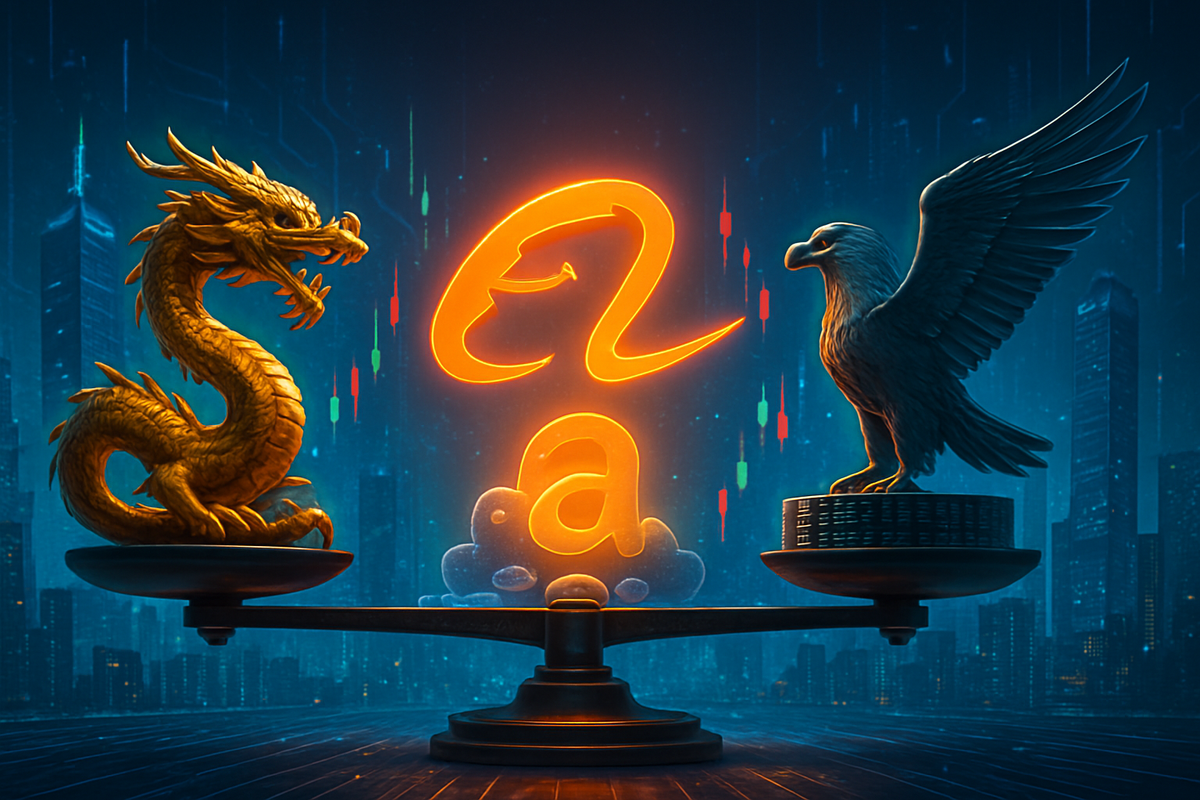
Investors should watch closely for three things in the coming months: the specific outcomes of the April 2026 trade summit, the quarterly margin performance of Alibaba’s Cloud Intelligence Group, and any further regulatory probes into the "platform economy." While the volatility can be stomach-churning, the underlying fundamentals of firms like Alibaba—backed by massive cash reserves and a dominant position in the AI infrastructure of the world’s second-largest economy—suggest that the "Dragon’s Seesaw" may eventually find a higher point of equilibrium.
This content is intended for informational purposes only and is not financial advice.