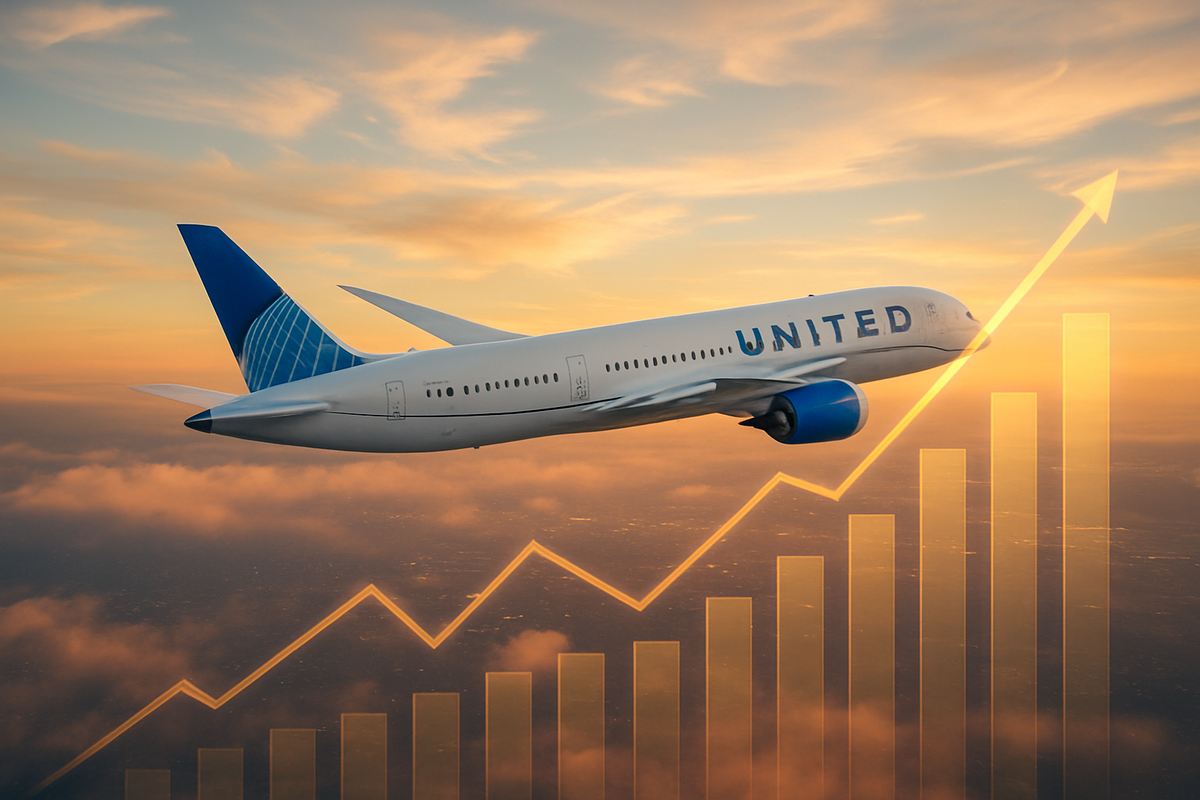
United Airlines (NASDAQ: UAL) sent a clear signal to the market this week that the "golden era" of premium travel is far from over. Reporting its fourth-quarter 2025 results after the closing bell on Tuesday, January 20, 2026, the Chicago-based carrier delivered a resounding beat on both the top and bottom lines. Shares of United rose more than 3% in the subsequent trading sessions, as investors brushed off the lingering effects of a late-2025 government shutdown and embraced the airline's bullish outlook for the year ahead.
The performance serves as a stark contrast to the broader volatility seen across the industrial sector in early 2026. By posting an adjusted earnings per share (EPS) of $3.10—comfortably ahead of the $2.92 Wall Street consensus—United has cemented its position as a leader in a bifurcated aviation market. As of January 22, 2026, the stock remains one of the top performers in the S&P 500 for the week, reflecting growing confidence that the airline's pivot toward high-margin business and premium-leisure travel is yielding tangible results.
United’s Record Revenue Amidst Macro Turbulence
The fourth quarter of 2025 was a period defined by resilience for United Airlines. The company reported record-breaking quarterly revenue of $15.4 billion, a 4.8% increase over the same period in 2024. This achievement is particularly notable given the significant headwinds faced in the final months of the year. United confirmed a $250 million pre-tax hit resulting from the U.S. government shutdown in late 2025, which disrupted federal travel and caused a temporary softening in demand during the critical Thanksgiving holiday corridor. Despite this drag, United's net income for the quarter reached $1.04 billion, bringing its full-year 2025 profits to a robust $3.4 billion.
The timeline leading up to this earnings beat was marked by strategic caution. Throughout 2025, United focused on its "United Elevate" initiative, a massive capital investment program aimed at retrofitting its fleet with more premium seating and improved in-flight technology. CEO Scott Kirby noted during the earnings call that the first two weeks of January 2026 have already set all-time records for ticketing and corporate bookings, suggesting that the momentum from Q4 has carried over seamlessly into the new year. Stakeholders, including institutional investors and major credit card partners, have praised the airline's ability to maintain high load factors while simultaneously increasing its average fare through "premium-ization."
Winners and Losers in the 2026 Aviation Landscape
United’s success highlights a growing divide in the aviation industry, where the "supermajors" are increasingly outperforming their low-cost peers. Delta Air Lines (NYSE: DAL), which reported its earnings earlier in the month, also beat EPS expectations but saw its stock falter after trimming its 2026 guidance due to tariff uncertainties. In contrast, United’s optimistic 2026 projection of $12.00 to $14.00 EPS suggests it may be better positioned to navigate the current geopolitical landscape. Meanwhile, American Airlines (NASDAQ: AAL) is scheduled to report next week; analysts are bracing for a much narrower margin, as American continues to struggle with its transition to a higher-yield revenue model.
The clear "losers" in this environment are the ultra-low-cost carriers (ULCCs). As United and Delta capture the lion's share of profits through premium cabins and lucrative loyalty programs, budget airlines are facing intense pressure from rising labor costs and a consumer base that is increasingly prioritizing comfort over the absolute lowest price. This shift has also created a favorable environment for Boeing (NYSE: BA), as United confirmed plans to take delivery of 20 ultra-premium Boeing 787-9 aircraft throughout 2026. These new jets, featuring the "Polaris Studio" cabins, are expected to further widen the revenue gap between United and its competitors.
Loyalty Programs: The Secret Engine of Modern Aviation
The wider significance of United’s Q4 beat lies in a fundamental shift in how airlines generate profit. Industry data from early 2026 suggests that the traditional model of making money from "selling seats" is being replaced by "selling points." While the operational cost of flying passengers has risen 11% year-over-year due to new pilot contracts and localized fuel spikes, the bottom-line profits for carriers like United are almost entirely underpinned by loyalty programs and credit card remuneration. This "Loyalty over Luggage" trend has turned airlines into fintech-adjacent entities, where the value of the MileagePlus program often outweighs the value of the physical fleet.
This event also fits into a broader trend of "premium-leisure" dominance. Since the pandemic recovery began years ago, the line between business and leisure travel has blurred, with affluent travelers willing to pay for upgrades even on personal trips. United’s ability to capture this market has set a new benchmark for the industry. However, regulatory oversight remains a potential hurdle; the FAA has intensified its scrutiny of airline compliance following the late 2025 operational disruptions, and any future policy changes regarding hidden fees or passenger rights could impact the revenue streams that United has so successfully tapped into.
The Road Ahead: 2026 and Beyond
Looking forward, United Airlines faces a strategic crossroads. In the short term, the company must execute its aggressive 2026 delivery schedule for new widebody aircraft. Any delays from Boeing (NYSE: BA) or Airbus (OTC:EADSY) could jeopardize United’s ability to meet the surging demand for international premium travel. Furthermore, the airline is projecting capital expenditures to remain below $8 billion for 2026, a disciplined approach that aims to maximize free cash flow and potentially pave the way for increased shareholder returns or debt reduction.
The potential for market volatility remains high as 2026 progresses. Investors will be closely watching for signs of economic cooling that could dampen the current "travel at any cost" sentiment. If corporate travel continues its "meaningful bounce" as Kirby predicts, United is well-positioned to maintain its lead. However, if energy prices spike or tariff disputes escalate, the airline's high-cost base could become a liability. The next six months will be a critical test of whether United’s premium-heavy strategy is a sustainable long-term model or a high-beta bet on continued global prosperity.
A New Benchmark for the Skies
United Airlines’ Q4 earnings beat is more than just a financial milestone; it is a validation of the industry’s shift toward high-end services and integrated financial ecosystems. By outperforming expectations in the face of a government shutdown and rising operational costs, United has demonstrated a level of institutional resilience that has largely eluded its competitors. For the market, the message is clear: the airlines that can successfully monetize loyalty and premium experiences are the ones that will define the next decade of travel.
As we move further into 2026, investors should keep a close eye on quarterly unit costs and the pace of aircraft deliveries. While United has set a high bar, the aviation sector remains notoriously sensitive to external shocks. For now, however, United Airlines is flying high, proving that even in a year of "profitable turbulence," there is plenty of room at the top for those who can deliver a premium product to a demanding global audience.
This content is intended for informational purposes only and is not financial advice.