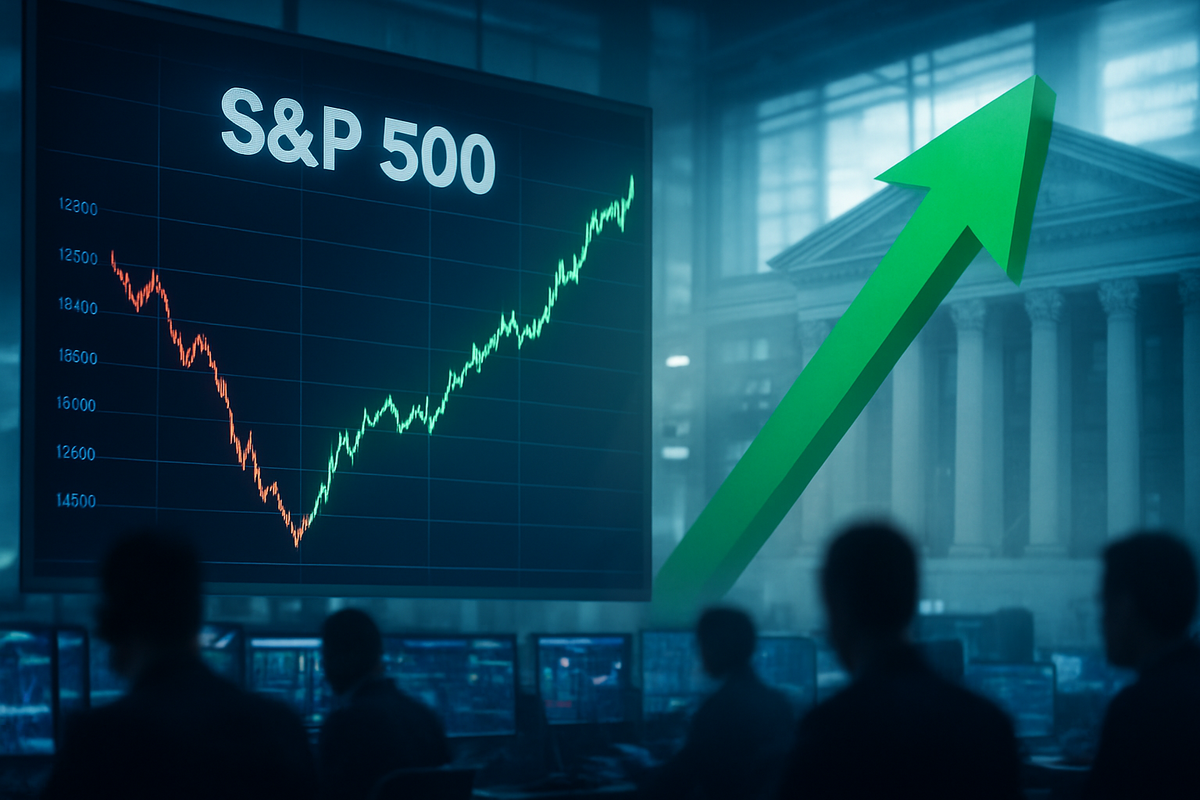
The S&P 500 index demonstrated remarkable intraday resilience on Monday, January 12, 2026, clawing back from early session lows triggered by a sudden Department of Justice (DOJ) investigation into Federal Reserve Chair Jerome Powell. Despite a pre-market sell-off that threatened to derail the ongoing "Freedom Rally," the benchmark index found significant technical support, finishing the day nearly flat as investors weighed political headlines against robust sector-specific growth.
The volatility underscores a growing tension between the executive branch and the nation's central bank, a conflict that briefly sparked a "Sell America" trade across equities and Treasuries. However, the market’s ability to stabilize near its recent record highs suggests that while political uncertainty remains a potent risk factor, the underlying appetite for risk—particularly in the technology and energy sectors—remains the dominant force in the current market regime.
Political Turbulence and the 'Powell Probe'
The primary catalyst for the day’s turbulence was the revelation that the DOJ has opened a criminal probe into Jerome Powell concerning his June 2025 testimony before the Senate Banking Committee. The investigation focuses on a $2.5 billion renovation of the Federal Reserve’s Washington headquarters, with investigators reportedly looking into whether the Chair provided misleading information regarding the project's costs and contractor selection. Powell responded swiftly with a video statement, characterizing the probe as a "pretext" for political intimidation aimed at forcing the Fed to abandon its independent mandate in favor of more aggressive interest rate cuts.
The news broke over the weekend of January 11, 2026, leading to a sharp 0.75% drop in S&P 500 futures during the Asian and European sessions. By the time the New York cash market opened, the index hit an intraday low of 6,937 points, down roughly 0.43% from the previous Friday’s record close of 6,966.28. The early panic was exacerbated by a spike in safe-haven assets, with gold hitting a new all-time high of $4,630 per ounce as traders braced for a potential constitutional showdown.
However, the panic proved short-lived. By midday, the S&P 500 had recovered to trade near 6,961, effectively erasing the morning's losses. The recovery was led by a rotation into industrial and technology stocks that are seen as insulated from—or even beneficiaries of—the current administration’s broader economic policies. While the political drama provided the noise, technical traders noted that the index successfully defended its 4-hour 50-period moving average, providing a "buy the dip" signal that many institutional desks were quick to follow.
Sector Winners and Losers: A Market Divided
The day’s price action created a stark divide between winning and losing sectors. The hardest hit were the financial services giants, particularly credit card issuers. Shares of Synchrony Financial (NYSE: SYF) plummeted 8.5%, while Capital One (NYSE: COF) and American Express (NYSE: AXP) fell 7.5% and 5%, respectively. This sector-wide retreat was fueled by a separate policy announcement from President Trump proposing a 10% cap on credit card interest rates, a move that analysts say could severely squeeze margins for consumer lenders. Even banking heavyweights like JPMorgan Chase (NYSE: JPM) and Citigroup (NYSE: C) saw declines ranging from 1% to 3.5% as the Powell probe added a layer of systemic uncertainty to the financial sector.
Conversely, the technology and energy sectors provided the necessary buoyancy to lift the broader market. Intel (NASDAQ: INTC) emerged as a standout performer, surging 10.8% following a high-profile meeting between CEO Lip-Bu Tan and the President, signaling a potential expansion of domestic semiconductor subsidies. In the energy space, Vistra Corp (NYSE: VST) jumped 10.5% after announcing a landmark nuclear power agreement with Meta Platforms (NASDAQ: META) to provide dedicated carbon-free energy for the social media giant's expanding AI data center footprint.
Retail also saw significant dispersion. While Walmart (NYSE: WMT) advanced 2% on news of its upcoming inclusion in the Nasdaq 100 and a new AI partnership with Google, Abercrombie & Fitch (NYSE: ANF) suffered a catastrophic 19% decline. The apparel retailer’s slump followed a narrowing of its full-year sales guidance, proving that even in a resilient market, companies with weakening fundamentals have nowhere to hide.
Broader Implications: Institutional Stability vs. Market Momentum
The "Powell Probe" represents a significant escalation in the ongoing struggle over the Federal Reserve's independence, a cornerstone of U.S. monetary policy for over a century. Market historians are drawing parallels to the pressure campaigns of the 1970s, but the current investigation marks a more aggressive legal approach. If the probe is perceived by the global community as a purely political maneuver, it could lead to a sustained "Sell America" trade, where international investors reduce exposure to U.S. assets due to eroding institutional stability.
From a broader perspective, the market's quick recovery suggests that investors are becoming desensitized to political volatility. This "normalization of noise" allows the S&P 500 to maintain its upward trajectory as long as corporate earnings and economic data remain strong. However, the shift into safe havens like gold and silver indicates that while equity traders are optimistic, there is a growing hedge against a potential currency or sovereign debt crisis if the Fed-Executive relationship reaches a breaking point.
Furthermore, the regulatory environment is shifting rapidly. The proposed 10% cap on credit card interest rates indicates a more populist approach to financial regulation that could disrupt traditional banking models. This fits into a wider trend of "interventionist" policies that pick winners and losers based on national strategic priorities—such as domestic chip manufacturing and AI infrastructure—rather than traditional free-market principles.
The Road Ahead: Support, Resistance, and Strategic Pivots
In the short term, traders are laser-focused on the 7,000 psychological level for the S&P 500. A decisive close above this resistance would likely signal a continuation of the "Freedom Rally," potentially targeting the 7,050 "key control zone." On the downside, the 6,899 to 6,910 range remains a critical demand zone. Should the Powell probe lead to actual legal charges or a resignation, the 50-day moving average at 6,818 will be the "line in the sand" for the medium-term uptrend.
Strategic pivots are already underway in the C-suite. Companies like Meta Platforms and Intel are increasingly aligning their capital expenditures with national policy goals to secure regulatory favor and subsidies. Investors should expect more of these "public-private partnerships" as a way for corporations to mitigate the risks of a volatile political landscape.
The coming months will likely see increased volatility as the DOJ investigation proceeds. If the Federal Reserve maintains its hawkish stance despite the probe, the friction between monetary and fiscal policy could lead to a "policy collision" that tests the 2026 market highs. Conversely, if the Fed pivots toward cuts, the market may ignore the legal drama entirely, focusing instead on the resulting liquidity injection.
Market Outlook: Resilience Amid the Noise
The events of January 12, 2026, serve as a masterclass in market psychology. The S&P 500’s ability to absorb the shock of a criminal investigation into the world’s most powerful central banker and still finish the day near flat is a testament to the current market’s bullish momentum. While the financial sector faces headwinds from populist interest rate caps, the tech and energy sectors are providing enough fuel to keep the broader index afloat.
The key takeaway for investors is the importance of technical levels in an era of high-frequency news cycles. The successful defense of the 6,937 level provided the foundation for the afternoon rally, proving that even in the face of unprecedented political drama, the "charts" still provide a roadmap for institutional capital.
Moving forward, the focus will remain on the Federal Reserve’s independence and the 7,000 mark on the S&P 500. Investors should watch for any signs of a "constitutional discount" being applied to U.S. equities and stay diversified across sectors that benefit from the current administration's industrial policies. The market has proven it can bend without breaking, but the durability of this resilience will be tested as the "Powell Probe" unfolds in the weeks ahead.
This content is intended for informational purposes only and is not financial advice.