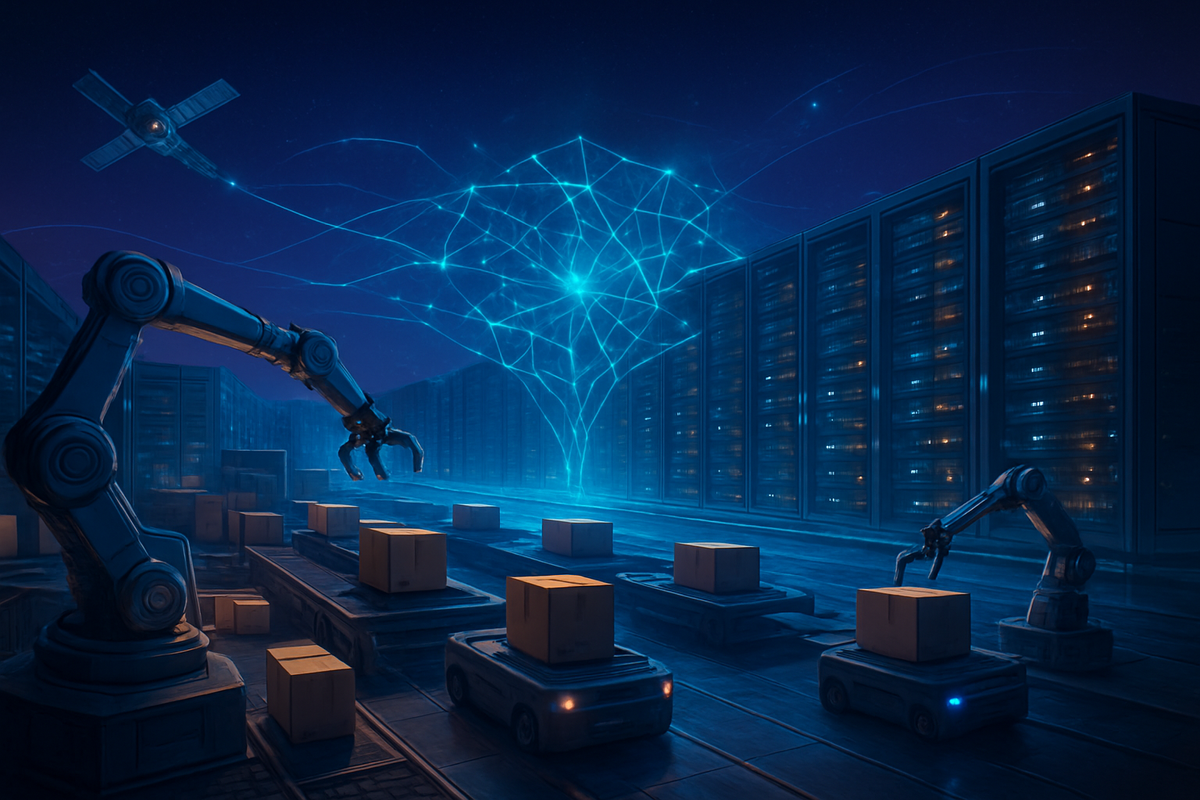
As the sun sets on 2025, Amazon.com (NASDAQ: AMZN) finds itself at a historic crossroads, navigating a volatile transition that could redefine the company for the next decade. On one side, a $6 billion contract deadlock with the U.S. Postal Service (USPS) threatens to upend the logistics model that built the Prime empire. On the other, a massive, multi-billion-dollar pivot toward generative AI and custom silicon is positioning the company as the primary architect of the "agentic AI" era.
This dual-track evolution is more than just a corporate strategy; it is a fundamental shift in identity. For years, Amazon was viewed primarily as a retail and logistics juggernaut that happened to own a cloud business. Heading into 2026, the roles are reversing. With capital expenditure for AI infrastructure now dwarfing logistics spending by a factor of six, Amazon is signaling to the market that its future lies in cognitive computing and autonomous systems, even if it means severing ties with its oldest delivery partners.
The $6 Billion Deadlock and the AI Surge
The immediate tension centers on a high-stakes standoff with the USPS. As of late December 2025, negotiations for a four-year contract extension have hit a total impasse. The current agreement, which funnels approximately $6 billion in annual revenue to the USPS—representing nearly 7.5% of the postal service's total intake—is set to expire on October 1, 2026. The conflict escalated when Postmaster General David Steiner proposed a "reverse auction" model, intending to open mail facility access to the highest bidder among major carriers. Amazon has flatly refused to participate, viewing the model as a source of unacceptable volatility for its "last-mile" delivery guarantees.
While the logistics battle rages, Amazon’s tech division is moving at a blistering pace. At the recent re:Invent conference in early December 2025, AWS unveiled the Nova 2 model family, featuring the "Nova 2 Omni," a multimodal model capable of simultaneous text, video, and audio processing. Perhaps more shocking were the confirmed reports of a $38 billion multi-year cloud deal with OpenAI, which includes a rumored $10 billion equity investment. This move effectively breaks the exclusive grip Microsoft (NASDAQ: MSFT) once held over the AI pioneer, as OpenAI begins migrating significant workloads to Amazon’s custom Trainium and Inferentia chips.
Winners and Losers in the New Infrastructure War
The primary winner in this strategic pivot appears to be Amazon Web Services (AWS). By diversifying its AI offerings and securing a massive partnership with OpenAI, AWS has re-accelerated its growth toward 20% for the 2026 fiscal year. Furthermore, Amazon’s $50 billion commitment to building specialized government AI data centers—adding 1.3 gigawatts of capacity—secures its position as a "sovereign cloud" provider for federal agencies.
Conversely, the U.S. Postal Service stands as the potential biggest loser. A full "divorce" from Amazon would leave a $6 billion hole in its budget, likely forcing further rate hikes for the general public and other commercial shippers. Rural customers may also face challenges; while Amazon has pledged $4 billion to expand its own rural delivery network by late 2026, the transition period could see slower delivery times in remote zip codes as the company scales its independent fleet to replace USPS coverage.
A Structural Shift in Global Logistics and Intelligence
This event fits into a broader industry trend where "Big Tech" is increasingly internalizing its most critical dependencies. Just as Amazon once built its own servers to avoid relying on third-party hardware, it is now building its own intelligence (AI models) and its own physical delivery network to avoid the pricing whims of quasi-governmental entities. The shift in Capital Expenditure (CapEx) is telling: Amazon is projected to spend over $125 billion in 2025, with a staggering $86 billion dedicated to AI and cloud infrastructure, compared to just $14.6 billion for logistics.
The regulatory implications are also profound. By pivoting so aggressively toward AI, Amazon is creating a new "moat" that may be harder for antitrust regulators to penetrate than its retail business. While the FTC continues its "monopoly" trial regarding Amazon’s marketplace practices, the company is effectively outrunning the litigation by transforming into an AI-first utility. This mirrors historical precedents like IBM’s shift from hardware to services, though Amazon is attempting to maintain dominance in both bits and boxes simultaneously.
The 2026 Outlook: Agents and Autonomy
Looking toward 2026, the short-term challenge for Amazon will be managing the "cost to serve" as it decouples from the USPS. To mitigate rising shipping costs, the company is deploying "Proteus" autonomous robots across its fulfillment centers at scale. These AI-driven systems have already reduced internal fulfillment costs by an estimated 15-20% in upgraded facilities, providing a necessary buffer against the inflationary pressures of an independent delivery network.
In the long term, the focus will shift to Amazon Bedrock AgentCore, a suite designed for "agentic AI." This technology allows enterprises to deploy fleets of autonomous AI agents that handle complex business workflows like procurement and threat detection. If successful, this will move Amazon beyond being a provider of "chatbots" to being the operating system for the autonomous economy. The market will be watching closely to see if AWS can maintain this momentum as enterprise AI pilots move into full-scale production.
Final Assessment: The Road Ahead for Investors
Amazon enters 2026 as a company in the midst of a radical metamorphosis. The $6 billion USPS standoff is the final act of a decade-long effort to control its physical destiny, while the massive AWS AI pivot is the first act of its digital future. The key takeaway for investors is the sheer scale of the CapEx shift; Amazon is betting the house on the idea that AI infrastructure will be the most valuable commodity of the next twenty years.
As we move into the first quarter of 2026, market participants should watch for two critical indicators: the progress of the rural delivery expansion and the integration of OpenAI workloads onto AWS Trainium chips. If Amazon can successfully navigate the USPS "divorce" without a spike in shipping costs, and if AWS continues to steal AI market share from rivals, the "crossroads" of 2025 will be remembered as the moment Amazon truly became an AI sovereign.
This content is intended for informational purposes only and is not financial advice.