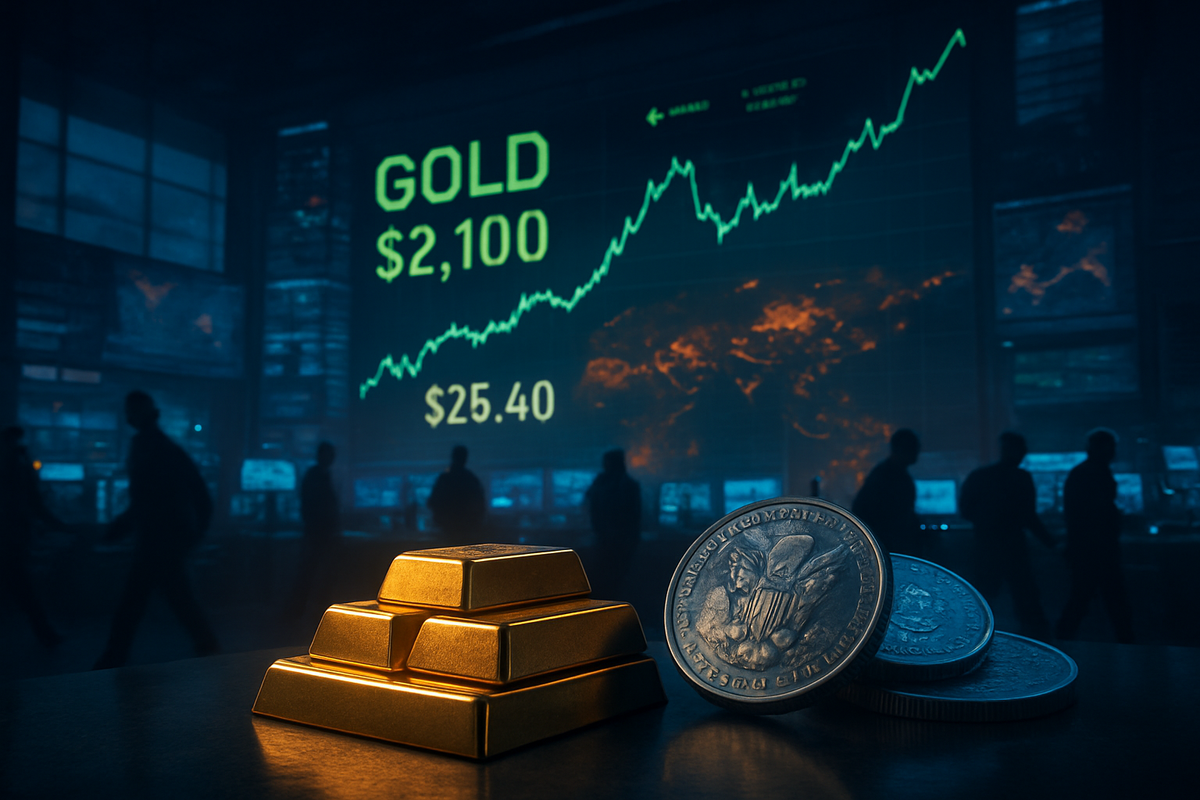
As of December 23, 2025, the global financial landscape is witnessing a historic realignment as gold and silver prices shatter all previous records. In a year defined by volatility, the final weeks of 2025 have seen a "perfect storm" of factors converge, propelling spot gold toward the $4,500 per ounce mark and silver past the psychological $70 barrier. This unprecedented surge is being driven by a combination of escalating geopolitical tensions in South America and the Middle East, alongside a decisive shift in U.S. monetary policy that has seen the Federal Reserve pivot toward aggressive interest rate cuts.
The immediate implications for the market are profound. Investors are fleeing traditional equities and currencies in favor of hard assets, leading to massive capital rotations. In India, the Multi Commodity Exchange (MCX) has mirrored this global frenzy, with gold and silver futures reaching staggering new heights that have left analysts and retail investors alike scrambling to adjust their portfolios. The surge represents more than just a price hike; it is a signal of deep-seated anxiety regarding global stability and the future purchasing power of the U.S. dollar.
A Perfect Storm: The Path to Record Highs
The rally reached its crescendo this week, but the foundation was laid throughout a tumultuous 2025. On December 23, 2025, spot gold reached a peak of $4,497.73 per ounce, an annual gain of approximately 70% and its strongest performance in over four decades. Silver, often the more volatile sibling, outperformed on a percentage basis, touching an intra-day high of $70.15. In India, the MCX saw February gold futures hit ₹1,38,381 per 10 grams, while silver futures surged to a record ₹2,16,596 per kilogram. This vertical price action was catalyzed by a sudden escalation in the U.S.-Venezuela blockade, where the seizure of oil tankers in early December sparked fears of a broader regional conflict and a permanent disruption to energy supplies.
Simultaneously, the Federal Reserve provided the necessary macroeconomic fuel for this fire. Following a year of cooling labor markets and rising unemployment—which hit 4.6% in November—the Federal Open Market Committee (FOMC) moved to lower the target interest rate range to 3.50%–3.75% during their December 10 meeting. This third rate cut of the year signaled to the markets that the era of "higher-for-longer" was officially over. The resulting drop in real yields made non-yielding assets like gold and silver far more attractive to institutional funds, which have been aggressively accumulating bullion throughout the fourth quarter.
Central bank activity has also played a pivotal role in this timeline. Throughout 2025, led by the People’s Bank of China and other emerging market institutions, central banks purchased an estimated 850 to 1,000 tons of gold. This move toward "de-dollarization" was accelerated by renewed trade frictions and tit-for-tat sanctions over critical minerals. By the time the December price surge began, the supply-demand balance was already tightly wound, leaving the market highly sensitive to the geopolitical shocks that defined the month.
The Winners and Losers of the Bullion Boom
The primary beneficiaries of this price explosion are the major mining corporations, which are currently enjoying extreme operating leverage. Barrick Gold (NYSE: GOLD) has emerged as a standout performer, with its share price reflecting the massive free cash flow generated by $4,400 gold. Similarly, Newmont Corporation (NYSE: NEM) has seen significant appreciation as its vast reserves are revalued in real-time by a hungry market. These companies, which struggled with inflationary cost pressures in previous years, are now seeing their margins expand at a record pace as the price of their primary product outstrips the rise in mining inputs.
The silver sector has seen even more dramatic gains. Hecla Mining (NYSE: HL) has reportedly seen its stock price skyrocket nearly 300% over the course of 2025, benefiting from its position as a primary silver producer during a period of acute scarcity. Coeur Mining (NYSE: CDE) and First Majestic Silver (NYSE: AG) have also posted triple-digit year-to-date returns. These companies were further bolstered by the late-2025 decision to include silver on the U.S. Critical Minerals List, which has improved the strategic valuation of their domestic operations and provided potential for government-backed infrastructure support.
Conversely, the losers in this scenario include industrial manufacturers and the jewelry industry. Companies reliant on silver for electronics and solar panel production are facing a massive spike in input costs, which may lead to narrowed margins or price hikes for consumers. In the jewelry sector, particularly in price-sensitive markets like India and China, the record-high MCX and local prices have led to a noticeable cooling in retail demand, forcing jewelers to pivot toward lower-karat options or synthetic alternatives to maintain sales volumes.
Wider Significance and Global Ripple Effects
This event fits into a broader trend of global fragmentation and the search for "monetary sovereignty." The move toward gold by central banks is a clear indication that the weaponization of the dollar in international sanctions has reached a tipping point. As nations seek to insulate themselves from U.S. financial influence, gold has regained its status as the ultimate neutral reserve asset. This shift has profound implications for the global financial architecture, potentially leading to a more multi-polar currency system where the dollar's dominance is increasingly challenged by a basket of commodities and regional currencies.
Furthermore, silver's rally highlights the growing tension between its role as a financial safe haven and its necessity in the green energy transition. As governments worldwide push for decarbonization, the demand for silver in photovoltaic cells and electric vehicles continues to rise. The current price surge creates a paradox where the very metals needed to save the planet are becoming prohibitively expensive, potentially slowing the pace of the energy transition unless new mining projects are fast-tracked or recycling technologies improve significantly.
Historically, such dramatic moves in precious metals have often preceded periods of significant economic restructuring. Comparisons are already being drawn to the late 1970s, a period of high inflation, geopolitical instability, and a major shift in Fed policy. However, the current situation is unique due to the digital nature of modern markets and the speed at which capital can move, leading to higher volatility and more rapid price discovery than witnessed in previous decades.
The Road Ahead: What to Expect in 2026
Looking forward, the short-term outlook remains bullish as long as geopolitical tensions remain unresolved. Markets are currently pricing in at least two additional quarter-point rate cuts from the Federal Reserve in early 2026, which would likely provide further support for gold and silver. However, a potential strategic pivot may be required for investors if a diplomatic breakthrough occurs in either South America or Eastern Europe, which could lead to a rapid "risk-on" shift and a sharp correction in metal prices.
In the long term, the challenge for mining companies will be to sustain production levels amidst rising environmental and regulatory scrutiny. While current prices justify high-cost projects, the cyclical nature of the industry means that companies like Agnico Eagle Mines (NYSE: AEM) must remain disciplined in their capital allocation to avoid the pitfalls of over-expansion. Investors should also watch for potential regulatory interventions, such as windfall taxes on mining profits or government-mandated stockpiling of silver for industrial use, which could alter the profitability landscape for the sector.
Summary and Investor Outlook
The record-breaking surge in gold and silver prices in December 2025 marks a historic moment for global markets. Driven by a combination of the Fed's dovish pivot and a fracturing geopolitical order, precious metals have reclaimed their throne as the preferred hedge against uncertainty. The jump in MCX prices to all-time highs underscores the global nature of this rally, affecting everyone from Wall Street institutionalists to retail buyers in Mumbai.
As we move into 2026, the market appears poised for continued volatility. Investors should closely monitor the Federal Reserve's dot plot and any signs of de-escalation in international conflicts. While the current highs are exhilarating for bulls, the rapid ascent suggests that the market is currently priced for a "worst-case" geopolitical scenario. Any deviation from that path could lead to significant profit-taking. For now, the focus remains on whether gold can sustain its position above $4,500 and if silver’s new role as a critical mineral will keep it permanently elevated above historical norms.
This content is intended for informational purposes only and is not financial advice.