Survey of over 2,000 Java professionals also reveals: 92% are concerned about Oracle Java pricing and 81% are migrating all or some of their Oracle Java to OpenJDK as cost concerns mount
Azul, the only company 100% focused on Java, today announced the results of its 2026 State of Java Survey & Report. The annual study, based on responses from more than 2,000 Java professionals worldwide, reveals a dual trend shaping the enterprise landscape: a strategic pivot toward using Java as a foundational language for AI development, and an acceleration in the growing migration away from Oracle Java due to pricing and licensing concerns.
This press release features multimedia. View the full release here: https://www.businesswire.com/news/home/20260210972138/en/
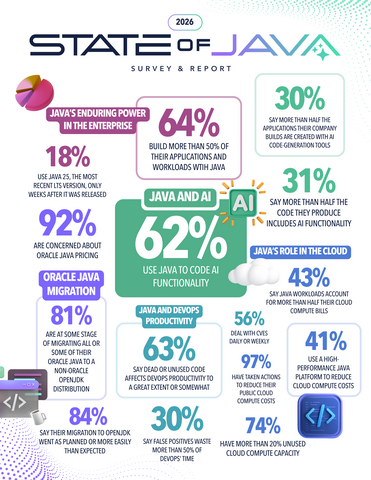
Azul's 2026 State of Java Survey & Report's key metrics
Java’s Critical Role in the AI Era
While Java has long been the backbone of enterprise applications, the 2026 report highlights its growing significance in modern AI stacks thanks to its reliability, performance, security, and ability to run AI-enhanced services at scale. The 2026 State of Java Survey & Report shows that 62% of organizations now use Java to code AI functionality — up from 50% last year — reflecting a shift toward integrating machine learning models with existing Java applications. As enterprises move AI from experimentation to production, Java is becoming indispensable for scaling AI workloads.
In addition, 31% of respondents say more than half of the Java applications they build now contain AI functionality, supported by a mature ecosystem of Java-friendly AI libraries such as JavaML and Deep Java Library (DJL). The top capabilities survey participants say will be important for Java to remain competitive in an AI-enabled development landscape include long-term support for modern Java versions (35%), built-in security features (34%), observability insights (32%), support for large data access (30%), and integration with large language models (30%).
The Acceleration of Oracle Java Migration
Since Oracle introduced its employee-based pricing model in 2023, frustration across the Java community has only intensified. This year’s State of Java Survey & Report reflects just how quickly concern is escalating: an overwhelming 92% of respondents report being concerned, while only 7% of respondents say they are “not at all concerned” about Oracle’s pricing, nearly half the level recorded last year. Satisfaction in Oracle’s Java licensing approach is eroding, prompting organizations to reassess whether maintaining Oracle Java aligns with their financial and operational strategies.
In response, enterprises are moving decisively. Eighty-one percent (81%) have migrated, are migrating, or plan to migrate at least part of their Oracle Java to a non-Oracle OpenJDK distribution, while a significant 63% intend to migrate their entire Java estate. Cost remains the number one driver (37%) for migrating away from Oracle. Additional reasons enterprises migrate include: a preference for open source (31%), uncertainty created by ongoing changes (29%) and Oracle Java audit risk (26%). Twenty-one percent of survey respondents have already been subjected to an Oracle Java audit.
Optimizing Cloud Costs with a High-Performance Java Platform
As enterprises intensify their focus on cloud deployment efficiency, Java continues to play a central role in shaping their cost-optimization strategies. Java’s longstanding strengths – reliability at scale, mature performance tuning capabilities and ongoing advancements in start-up, warm-up, and runtime efficiency – make it one of the most productive and cost-effective development languages to operate in cloud environments.
The 2026 State of Java Survey & Report reveals that 97% of survey participants have taken actions to reduce their public cloud costs, and using a high-performance Java platform (41%) is one of the top five strategies they’ve implemented. By utilizing faster, more efficient Java runtimes, businesses are able to process more transactions with fewer resources, translating to savings which directly impact their bottom line or help fund more strategic initiatives.
Despite clear momentum toward optimization however, most enterprises still struggle with significant waste – 74% percent of organizations report more than 20% unused compute capacity in their public cloud environments, a strong indicator that many overprovision to compensate for inconsistent or unpredictable runtime behavior, slow start-up times, and prolonged warm-up cycles. The survey also shows that of those enterprises most invested in Java, where at least 90% of their applications run on Java, the number using a high-performance Java platform to improve application performance jumps from 61% to 81%.
Hidden Threats Draining DevOps Productivity — Dead/Unused Code and CVE Noise
Developer and DevOps productivity continues to be hamstrung by one of the industry’s most persistent issues: dead and unused code. According to the 2026 State of Java Survey & Report, 63% of respondents say that dead and unused code affects their team’s productivity, while only 6% report no impact at all. This hidden technical debt forces teams to work around legacy components they’re afraid to remove, slowing development cycles and increasing operational risk. Security noise adds another layer of complexity, with 56% percent of enterprises now dealing with Java-related CVEs on a daily or weekly basis – a sharp rise from 41% in 2025. In addition, 30% of survey respondents said their teams waste more than half their time chasing false positives. These issues often stem from scanners flagging vulnerabilities in code paths that never actually run in production.
“Java continues to prove its durability and strategic importance as enterprises navigate one of the most transformative periods in modern computing,” said Scott Sellers, co-founder and CEO at Azul. “From powering the next generation of AI-driven applications to helping organizations regain control of cloud spend and modernize their estates, Java remains at the center of innovation and operational excellence. This year’s State of Java Survey & Report shows a community that is evolving quickly, embracing open technologies, accelerating cloud optimization and removing the friction that slows DevOps productivity. Azul exists to help organizations realize the full potential of Java, and we’re proud to support this ecosystem as it enters a new era defined by intelligence, performance and choice.”
To access Azul’s full 2026 State of Java Survey & Report, visit here.
FAQs
1. Why are enterprises migrating away from Oracle Java in 2026?
Enterprises are migrating away from Oracle Java primarily due to rising licensing and support costs, pricing uncertainty, and restrictive subscription models. Azul’s 2026 State of Java Survey found that 81% of organizations are currently migrating all or part of their Oracle Java estates to non-Oracle OpenJDK distributions, while 92% express concern about Oracle Java pricing. As a result, enterprises are prioritizing cost predictability, vendor independence, and long-term stability—driving widespread adoption of supported OpenJDK alternatives.
2. Is Java still relevant for AI development in 2026?
Absolutely—Java remains highly relevant for AI development in 2026, particularly in enterprise environments. The Azul survey shows that 62% of organizations use Java to code AI functionality. While other popular languages like Python are often used for rapid prototyping and model building, enterprises rely on Java to run AI in production due to its proven scalability, stability, security, and performance in production environments.
3. Why are enterprises choosing OpenJDK over Oracle Java?
Enterprises are choosing OpenJDK over Oracle Java because it offers the same core Java capabilities and compatibility without restrictive licensing or unpredictable costs. OpenJDK is the open-source project where Java is developed and is widely supported by commercial vendors.
4. How are companies using Java to reduce cloud computing costs?
Companies are using high-performance Java platforms to reduce cloud computing costs by improving application efficiency. The Azul 2026 State of Java Survey & Report found that 41% of enterprises leverage high-performance Java platforms specifically to lower cloud spend. Faster execution, reduced memory usage, and improved garbage collection allow organizations to run the same workloads on fewer cloud resources, directly reducing infrastructure and operating costs.
5. What are the most important Java trends enterprises should know in 2026?
The most important Java trends for enterprises in 2026 include an increased use of Java for AI workloads, widespread migration from Oracle Java to OpenJDK, and a growing focus on performance-driven cloud cost optimization. Enterprises are prioritizing predictable licensing, and high-performance Java platforms that support both traditional applications and modern AI-driven systems. These trends position Java as a foundational technology for scalable, cost-efficient enterprise innovation.
About the Report
Dimensional Research, a leading market research firm, administered the electronic survey and Azul authored the report based on the survey results. The report data was compiled from Java professionals and those who use or deploy Java-based applications and infrastructure at all seniority levels. Participants from companies of all sizes were invited to take part in this survey on their company’s adoption and use of Java. A total of 2,039 qualified respondents from five continents completed the survey. All respondents had direct or managerial Java application responsibilities and were offered token compensation for their participation.
About Azul
Headquartered in Sunnyvale, California, Azul is the only company 100% dedicated to advancing Java for the modern enterprise, and the trusted leader in commercially supported Java. Its open-source–based Java platform delivers industry-leading security, efficiency, performance, and cost effectiveness, backed by the most comprehensive end-to-end Java portfolio — from high-performance runtimes and application servers to Java intelligence — helping organizations build, run, and modernize Java applications with confidence. Azul powers mission-critical systems for 36% of the Fortune 100, 50% of the Forbes Top Ten World’s Most Valuable Brands, all of the world’s top 10 financial trading companies, and many of the world’s leading brands including Mastercard, BMW, Deutsche Telekom and Workday. Learn more at azul.com and follow @azulsystems.
View source version on businesswire.com: https://www.businesswire.com/news/home/20260210972138/en/
“From powering the next generation of AI-driven applications to helping organizations regain control of cloud spend and modernize their estates, Java remains at the center of innovation and operational excellence."
Contacts
Media Contact for Azul:
Treble
Josh Georgiou
azul@treblepr.com