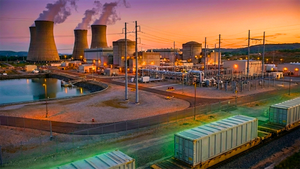
As the race for artificial intelligence dominance reaches a fever pitch in early 2026, OpenAI has pivoted from being a mere software pioneer to a primary architect of global energy infrastructure. The company’s "Stargate" project, once a conceptual blueprint for a $100 billion supercomputer, has evolved into a massive $500 billion infrastructure venture known as Stargate LLC. This new entity, a joint venture involving SoftBank Group Corp (OTC: SFTBY), Oracle (NYSE: ORCL), and the UAE-backed MGX, represents a radical departure from traditional tech scaling, focusing on "Energy Sovereignty" to bypass the aging and overtaxed public utility grids that have become the primary bottleneck for AI development.
The move marks a historic transition in the tech industry: the realization that the "intelligence wall" is actually a "power wall." By funding its own dedicated energy generation, storage, and proprietary transmission lines, OpenAI is attempting to decouple its growth from the limitations of the national grid. With a goal to deploy 10 gigawatts (GW) of US-based AI infrastructure by 2029, the Stargate initiative is effectively building a private, parallel energy system designed specifically to feed the insatiable demand of next-generation frontier models.
Engineering the Gridless Data Center
Technically, the Stargate strategy centers on a "power-first" architecture rather than the traditional "fiber-first" approach. This involves a "Behind-the-Meter" (BTM) strategy where data centers are physically connected to power sources—such as nuclear plants or dedicated gas turbines—before that electricity ever touches the public utility grid. This allows OpenAI to avoid the 5-to-10-year delays typically associated with grid interconnection queues. In Saline Township, Michigan, a 1.4 GW site developed with DTE Energy (NYSE: DTE) utilizes project-funded battery storage and private substations to ensure the massive draw of the facility does not cause local rate hikes or instability.
The sheer scale of these sites is unprecedented. In Abilene, Texas, the flagship Stargate campus is already scaling toward 1 GW of capacity, utilizing NVIDIA (NASDAQ: NVDA) Blackwell architectures in a liquid-cooled environment that requires specialized high-voltage infrastructure. To connect these remote "power islands" to compute blocks, Stargate LLC is investing in over 1,000 miles of private transmission lines across Texas and the Southwest. This "Middle Mile" investment ensures that energy-rich but remote locations can be harnessed without relying on the public transmission network, which is currently bogged down by regulatory and physical constraints.
Furthermore, the project is leveraging advanced networking technologies to maintain low-latency communication across these geographically dispersed energy hubs. By utilizing proprietary optical interconnects and custom silicon, including Microsoft (NASDAQ: MSFT) Azure’s Maia chips and SoftBank-led designs, the Stargate infrastructure functions as a singular, unified super-cluster. This differs from previous data center models that relied on local utilities to provide power; here, the data center and the power plant are designed as a singular, integrated machine.
A Geopolitical and Corporate Realignment
The formation of Stargate LLC has fundamentally shifted the competitive landscape. By partnering with SoftBank (OTC: SFTBY), led by Chairman Masayoshi Son, and Oracle (NYSE: ORCL), OpenAI has secured the massive capital and land-use expertise required for such an ambitious build-out. This consortium allows OpenAI to mitigate its reliance on any single cloud provider while positioning itself as a "nation-builder." Major tech giants like Alphabet (NASDAQ: GOOGL) and Amazon (NASDAQ: AMZN) are now being forced to accelerate their own energy investments, with Amazon recently acquiring a nuclear-powered data center campus in Pennsylvania to keep pace with the Stargate model.
For Microsoft (NASDAQ: MSFT), the partnership remains symbiotic yet complex. While Microsoft provides the cloud expertise, the Stargate LLC structure allows for a broader base of investors to fund the staggering $500 billion price tag. This strategic positioning gives OpenAI and its partners a significant advantage in the "AI Sovereignty" race, as they are no longer just competing on model parameters, but on the raw physical ability to sustain computation. The move essentially commoditizes the compute layer by controlling the energy input, allowing OpenAI to dictate the pace of innovation regardless of utility-level constraints.
Industry experts view this as a move to verticalize the entire AI stack—from the fusion research at Helion Energy (backed by Sam Altman) to the final API output. By owning the power transmission, OpenAI protects itself from the rising costs of electricity and the potential for regulatory interference at the state utility level. This infrastructure-heavy approach creates a formidable "moat," as few other entities on earth possess the capital and political alignment to build a private energy grid of this magnitude.
National Interests and the "Power Wall"
The wider significance of the Stargate project lies in its intersection with national security and the global energy transition. In January 2025, the U.S. government issued Executive Order 14156, declaring a "National Energy Emergency" to fast-track energy infrastructure for AI development. This has enabled OpenAI to bypass several layers of environmental and bureaucratic red tape, treating the Stargate campuses as essential national assets. The project is no longer just about building a smarter chatbot; it is about establishing the industrial infrastructure for the next century of economic productivity.
However, this "Power Sovereignty" model is not without its critics. Concerns regarding the environmental impact of such massive energy consumption remain high, despite OpenAI's commitment to carbon-free baseload power like nuclear. The restart of the Three Mile Island reactor to power Microsoft and OpenAI operations has become a symbol of this new era—repurposing 20th-century nuclear technology to fuel 21st-century intelligence. There are also growing debates about "AI Enclaves," where the tech industry enjoys a modernized, reliable energy grid while the public continues to rely on aging infrastructure.
Comparatively, the Stargate project is being likened to the Manhattan Project or the construction of the U.S. Interstate Highway System. It represents a pivot toward "Industrial AI," where the success of a technology is measured by its physical footprint and resource throughput. This shift signals the end of the "asset-light" era of software development, as the frontier of AI now requires more concrete, steel, and copper than ever before.
The Horizon: Fusion and Small Modular Reactors
Looking toward the late 2020s, the Stargate strategy expects to integrate even more advanced power technologies. OpenAI is reportedly in advanced discussions to purchase "vast quantities" of electricity from Helion Energy, which aims to demonstrate commercial fusion power by 2028. If successful, fusion would represent the ultimate goal of the Stargate project: a virtually limitless, carbon-free energy source that is entirely independent of the terrestrial power grid.
In the near term, the focus remains on the deployment of Small Modular Reactors (SMRs). These compact nuclear reactors are designed to be built on-site at data center campuses, further reducing the need for long-distance power transmission. As the AI Permitting Reform Act of 2025 begins to streamline nuclear deployment, experts predict that the "Lighthouse Campus" in Wisconsin and the "Barn" in Michigan will be among the first to host these on-site reactors, creating self-sustaining islands of intelligence.
The primary challenge ahead lies in the global rollout of this model. OpenAI has already initiated "Stargate Norway," a 230 MW hydropower-driven site, and "Stargate Argentina," a $25 billion project in Patagonia. Successfully navigating the diverse regulatory and geopolitical landscapes of these regions will be critical. If OpenAI can prove that its "Stargate Community Plan" actually lowers costs for local residents by funding grid upgrades, it may find a smoother path for global expansion.
A New Era of Intelligence Infrastructure
The evolution of the Stargate project from a supercomputer proposal to a $500 billion global energy play is perhaps the most significant development in the history of the AI industry. It represents the ultimate recognition that intelligence is a physical resource, requiring massive amounts of power, land, and specialized infrastructure. By funding its own transmission lines and energy generation, OpenAI is not just building a computer; it is building the foundation for a new industrial age.
The key takeaway for 2026 is that the competitive edge in AI has shifted from algorithmic efficiency to energy procurement. As Stargate LLC continues its build-out, the industry will be watching closely to see if this "energy-first" model can truly overcome the "Power Wall." If OpenAI succeeds in creating a parallel energy grid, it will have secured a level of operational independence that no tech company has ever achieved.
In the coming months, the focus will turn to the first major 1 GW cluster going online in Texas and the progress of the Three Mile Island restart. These milestones will serve as a proof-of-concept for the Stargate vision. Whether this leads to a universal boom in energy technology or the creation of isolated "data islands" remains to be seen, but one thing is certain: the path to AGI now runs directly through the power grid.
This content is intended for informational purposes only and represents analysis of current AI developments.
TokenRing AI delivers enterprise-grade solutions for multi-agent AI workflow orchestration, AI-powered development tools, and seamless remote collaboration platforms.
For more information, visit https://www.tokenring.ai/.