In the first two weeks of 2026, the artificial intelligence landscape has reached a pivotal inflection point. Alphabet Inc. (NASDAQ: GOOGL), through its latest model Google Gemini 3, has fundamentally disrupted the competitive hierarchy of the AI market. Data from the start of the year reveals that Gemini’s desktop user base is currently expanding at a rate of 44%—nearly seven times faster than the 6% growth reported by its primary rival, ChatGPT. This surge marks a significant shift in the "AI Wars," as Google leverages its massive ecosystem to move beyond simple chat interfaces into the era of fully autonomous agents.
The immediate significance of this development lies in the "zero-friction" adoption model Google has successfully deployed. By embedding Gemini 3 directly into the Chrome browser, the Android operating system, and the newly rebranded "AI Inbox" within Gmail, the company has bypassed the need for users to seek out a separate AI destination. As of January 13, 2026, Gemini 3 has amassed over 650 million monthly active users, rapidly closing the gap with OpenAI’s 810 million, and signaling that the era of conversational chatbots is being replaced by proactive, agentic workflows.
The Architecture of Reasoning: Inside Gemini 3
Gemini 3 represents a radical departure from the linear token-generation models of previous years. Built on a Sparse Mixture of Experts (MoE) architecture, the model boasts a staggering 1 trillion parameters. However, unlike earlier monolithic models, Gemini 3 is designed for efficiency; it only activates approximately 15–20 billion parameters per query, allowing it to maintain a blistering processing speed of 128 tokens per second. This technical efficiency is coupled with what Google calls "Deep Think" mode, a native reasoning layer that allows the AI to pause, self-correct, and verify its logic before presenting a final answer. This feature propelled Gemini 3 to a record 91.9% score on the GPQA Diamond benchmark, a test specifically designed to measure PhD-level reasoning capabilities.
The most transformative technical specification is the expansion of the context window. Gemini 3 Pro now supports a standard 1-million-token window, while the "Ultra" tier offers an unprecedented 10-million-token capacity. This allows the model to ingest and analyze years of professional correspondence, massive codebases, or entire legal archives in a single session. This "long-term memory" is the backbone of the Gmail Proactive Assistant, which can now cross-reference a user’s five-year email history to answer complex queries like, "Based on my last three contract negotiations with this vendor, what are the recurring pain points I should address in today’s meeting?"
Industry experts have praised the model’s "agentic autonomy." Unlike previous versions that required step-by-step prompting, Gemini 3 is capable of multi-step task execution. Researchers in the AI community have noted that Google’s move toward "Vibe Coding"—where non-technical users can build functional applications using natural language—has been supercharged by Gemini 3’s ability to understand intent rather than just syntax. This capability has effectively lowered the barrier to entry for software development, allowing millions of non-engineers to automate their own professional workflows.
Ecosystem Dominance and the "Code Red" at OpenAI
The rapid ascent of Gemini 3 has sent shockwaves through the tech industry, placing significant pressure on Microsoft (NASDAQ: MSFT) and its primary partner, OpenAI. While OpenAI’s ChatGPT maintains a larger absolute user base, the momentum has clearly shifted. Internal reports from late 2025 suggest OpenAI issued a "Code Red" memo as Google’s desktop traffic surged 28% month-over-month. The strategic advantage for Google lies in its integrated ecosystem; while ChatGPT remains a destination-based platform that requires users to "visit" the AI, Gemini 3 is an invisible layer that assists users within the tools they already use for work and communication.
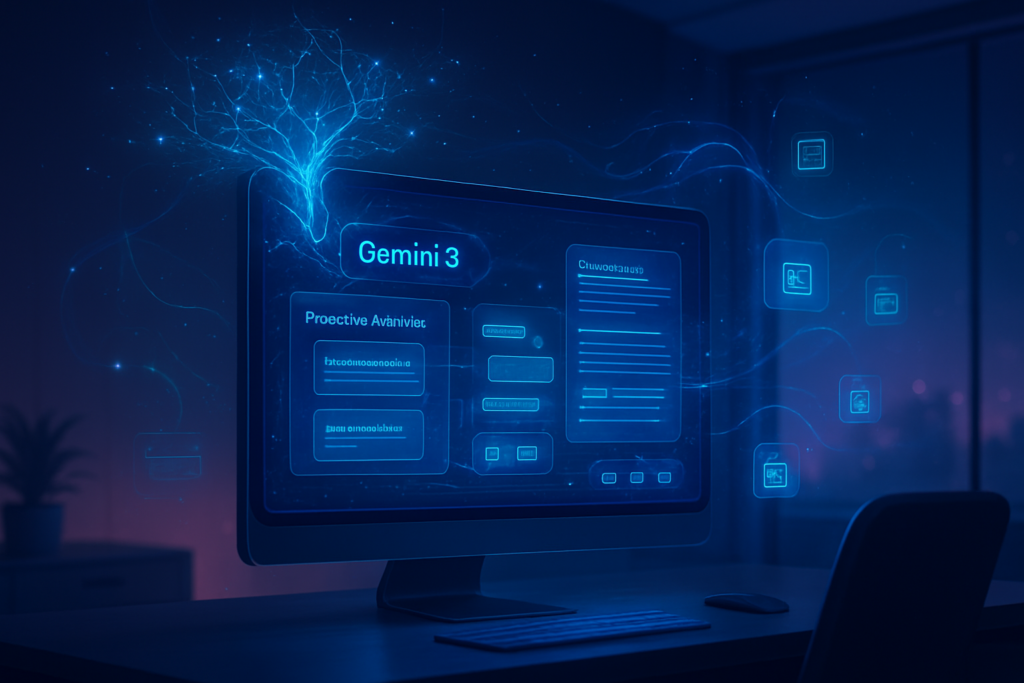
Large-scale enterprises are the primary beneficiaries of this integration. The Gmail Proactive Assistant, or "AI Inbox," has replaced the traditional chronological list of emails with a curated command center. It uses semantic clustering to organize messages into "To-Dos" and "Topic Summaries," effectively eliminating the "unread count" anxiety that has plagued digital communication for decades. For companies already paying for Google Workspace, the move to Gemini 3 is an incremental cost with exponential productivity gains, making it a difficult proposition for third-party AI startups to compete with.
Furthermore, Salesforce (NYSE: CRM) and other CRM providers are feeling the competitive heat. As Gemini 3 gains the ability to autonomously manage project workflows and "read" across Google Sheets, Docs, and Drive, it is increasingly performing tasks that were previously the domain of specialized enterprise software. This consolidation of services under the Google umbrella creates a "walled garden" effect that provides a massive strategic advantage, though it has also sparked renewed interest from antitrust regulators regarding Google's dominance in the AI-integrated office suite market.
From Chatbots to Agents: The Broader AI Landscape
The success of Gemini 3 marks the definitive arrival of the "Agentic Era." For the past three years, the AI narrative was dominated by "Large Language Models" that could write essays or code. In 2026, the focus has shifted to "Large Action Models" (LAMs) that can do work. This transition fits into a broader trend of AI becoming an ambient presence in daily life. No longer is the user's primary interaction with a text box; instead, the AI proactively suggests actions, drafts replies in the user’s "voice," and prepares briefing documents before a meeting even begins.
However, this shift is not without its concerns. The rise of the "Proactive Assistant" has reignited debates over data privacy and the potential for "hallucination-driven" errors in critical professional workflows. As Gemini 3 gains the power to act on a user's behalf—such as responding to clients or scheduling financial transactions—the consequences of a mistake become far more severe than a simple factual error in a chatbot response. Critics argue that we are entering a period of "Invisible AI," where users may become overly dependent on an algorithmic curator to filter their reality, potentially leading to echo chambers within corporate decision-making.
When compared to previous milestones like the launch of GPT-4 in 2023, the Gemini 3 rollout is seen as a more mature evolution. While GPT-4 provided the "intelligence," Gemini 3 provides the "utility." The integration of AI into the literal fabric of the internet's most-used tools represents the fulfillment of the promise made during the early generative AI hype—that AI would eventually become as ubiquitous and necessary as the internet itself.
The Horizon: What’s Next for the Google AI Ecosystem?
Looking ahead, experts predict that Google will continue to lean into "cross-app orchestration." The next phase of development, expected in late 2026, will likely involve even tighter integration with hardware through the Gemini Nano 2 chip, allowing for offline, on-device agentic tasks that preserve user privacy while maintaining the speed of the cloud-based Gemini 3. We are likely to see the Proactive Assistant expand beyond Gmail into the broader web through Chrome, acting as a "digital twin" that can handle complex bookings, research projects, and travel planning without human intervention.
The primary challenge remains the "Trust Gap." For Gemini 3 to achieve total market dominance, Google must prove that its agentic systems are robust enough to handle high-stakes tasks without supervision. We are already seeing the emergence of "AI Audit" startups that specialize in verifying the actions of autonomous agents, a sector that is expected to boom throughout 2026. The competition will also likely heat up as OpenAI prepares its own anticipated "GPT-5" or "Strawberry" successors, which are rumored to focus on even deeper logical reasoning and long-term planning.
A New Era of Productivity
The surging growth of Google Gemini 3 and the introduction of the Gmail Proactive Assistant represent a historic shift in human-computer interaction. By moving away from the "prompt-and-response" model and toward an "anticipate-and-act" model, Google has effectively redefined the role of the personal assistant for the digital age. The key takeaway for the industry is that integration is the new innovation; having the smartest model is no longer enough if it isn't seamlessly embedded where the work actually happens.
As we move through 2026, the significance of this development will be measured by how it changes the fundamental nature of work. If Gemini 3 can truly deliver on its promise of autonomous productivity, it could mark the end of the "busywork" era, freeing human workers to focus on high-level strategy and creative problem-solving. For now, all eyes are on the upcoming developer conferences in the spring, where the next generation of agentic capabilities is expected to be unveiled.
This content is intended for informational purposes only and represents analysis of current AI developments.
TokenRing AI delivers enterprise-grade solutions for multi-agent AI workflow orchestration, AI-powered development tools, and seamless remote collaboration platforms.
For more information, visit https://www.tokenring.ai/.