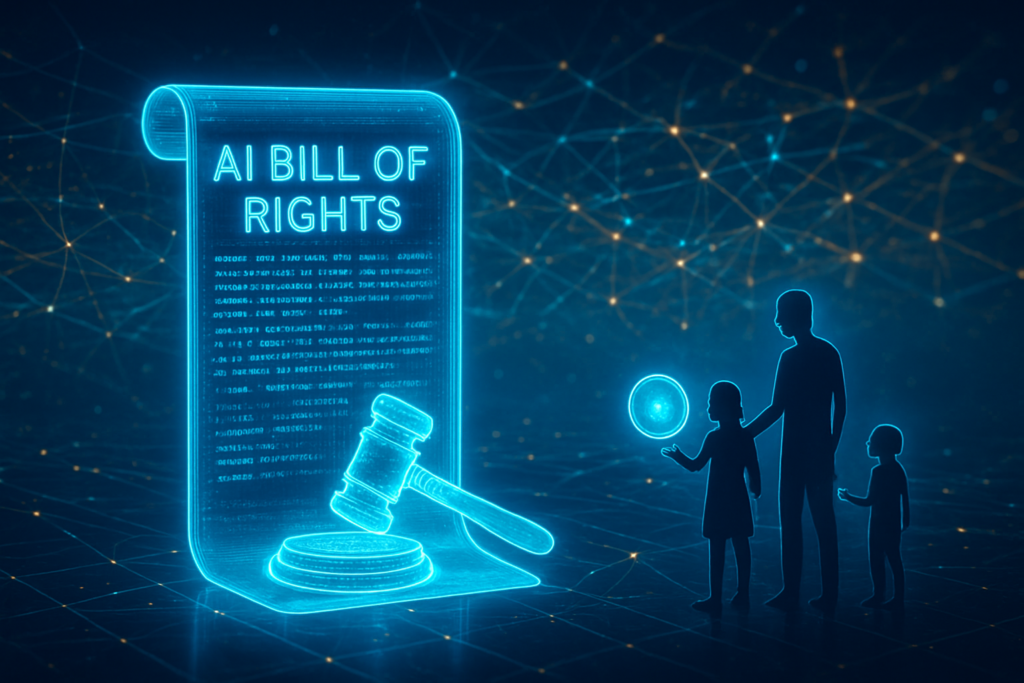
In a move that sets the stage for a monumental legal showdown over the future of American technology regulation, Florida Governor Ron DeSantis has proposed a comprehensive 'Citizen Bill of Rights for Artificial Intelligence.' Announced on December 4, 2025, and formally filed as Senate Bill 482 on December 22, the legislation introduces some of the nation’s strictest privacy protections and parental controls for AI interactions. By asserting state-level control over large language models (LLMs) and digital identity, Florida is directly challenging the federal government’s recent efforts to establish a singular, unified national standard for AI development.
This legislative push comes at a critical juncture, as the current date of December 29, 2025, finds the United States grappling with the rapid integration of generative AI into every facet of daily life. Governor DeSantis’ proposal is not merely a regulatory framework; it is a political statement on state sovereignty. By mandating unprecedented transparency and giving parents the power to monitor their children’s AI conversations, Florida is attempting to build a "digital fortress" that prioritizes individual and parental rights over the unhindered expansion of Silicon Valley’s most powerful algorithms.
Technical Safeguards and Parental Oversight
The 'Citizen Bill of Rights for AI' (SB 482) introduces a suite of technical requirements that would fundamentally alter how AI platforms operate within Florida. At the heart of the bill are aggressive parental controls for LLM chatbots. If passed, platforms would be required to implement "parental dashboards" allowing guardians to review chat histories, set "AI curfews" to limit usage hours, and receive mandatory notifications if a minor exhibits concerning behavior—such as mentions of self-harm or illegal activity—during an interaction. Furthermore, the bill prohibits AI "companion bots" from communicating with minors without explicit, verified parental authorization, a move that targets the growing market of emotionally responsive AI.
Beyond child safety, the legislation establishes robust protections for personal identity and professional integrity. It codifies "Name, Image, and Likeness" (NIL) rights against AI exploitation, making it illegal to use an individual’s digital likeness for commercial purposes without prior consent. This is designed to combat the rise of "deepfake" endorsements that have plagued social media. Technically, this requires companies like Meta Platforms, Inc. (NASDAQ: META) and Alphabet Inc. (NASDAQ: GOOGL) to implement more rigorous authentication and watermarking protocols for AI-generated content. Additionally, the bill mandates that AI cannot be the sole decision-maker in critical sectors; for instance, insurance claims cannot be denied by an algorithm alone, and AI is prohibited from serving as a sole provider for licensed mental health counseling.
Industry Disruption and the Compliance Conundrum
The implications for tech giants and AI startups are profound. Major players such as Microsoft Corporation (NASDAQ: MSFT) and Amazon.com, Inc. (NASDAQ: AMZN) now face a fragmented regulatory landscape. While these companies have lobbied for a "one-rule" federal framework to streamline operations, Florida’s SB 482 forces them to build state-specific compliance engines. Startups, in particular, may find the cost of implementing Florida’s mandatory parental notification systems and human-in-the-loop requirements for insurance and health services prohibitively expensive, potentially leading some to geofence their services away from Florida residents.
The bill also takes aim at the physical infrastructure of AI. It prevents "Hyperscale AI Data Centers" from passing utility infrastructure costs onto Florida taxpayers and grants local governments the power to block their construction. This creates a strategic hurdle for companies like Google and Microsoft that are racing to build out the massive compute power needed for the next generation of AI. By banning state agencies from using AI tools developed by "foreign countries of concern"—specifically targeting Chinese models like DeepSeek—Florida is also forcing a decoupling of the AI supply chain, benefiting domestic AI labs that can guarantee "clean" and compliant data lineages.
A New Frontier in Federalism and AI Ethics
Florida’s move represents a significant shift in the broader AI landscape, moving from theoretical ethics to hard-coded state law. It mirrors the state’s previous "Digital Bill of Rights" from 2023 but scales the ambition to meet the generative AI era. This development highlights a growing tension between the federal government’s desire for national competitiveness and the states' traditional "police powers" to protect public health and safety. The timing is particularly contentious, coming just weeks after a federal Executive Order aimed at creating a "minimally burdensome national standard" to ensure U.S. AI dominance.
Critics argue that Florida’s approach could stifle innovation by creating a "patchwork" of conflicting state laws, a concern often voiced by industry groups and the federal AI Litigation Task Force. However, proponents see it as a necessary check on "black box" algorithms. By comparing this to previous milestones like the EU’s AI Act, Florida’s legislation is arguably more focused on individual agency and parental rights than on broad systemic risk. It positions Florida as a leader in "human-centric" AI regulation, potentially providing a blueprint for other conservative-leaning states to follow, thereby creating a coalition that could force federal policy to adopt stricter privacy standards.
The Road Ahead: Legal Battles and Iterative Innovation
The near-term future of SB 482 will likely be defined by intense litigation. Legal experts predict that the federal government will challenge the bill on the grounds of preemption, arguing that AI regulation falls under interstate commerce and national security. The outcome of these court battles will determine whether the U.S. follows a centralized model of tech governance or a decentralized one where states act as "laboratories of democracy." Meanwhile, AI developers will need to innovate new "privacy-by-design" architectures that can dynamically adjust to varying state requirements without sacrificing performance.
In the long term, we can expect to see the emergence of "federated AI" models that process data locally to comply with Florida’s strict privacy mandates. If SB 482 becomes law in the 2026 session, it may trigger a "California effect" in reverse, where Florida’s large market share forces national companies to adopt its parental control standards as their default setting to avoid the complexity of state-by-state variations. The next few months will be critical as the Florida Legislature debates the bill and the tech industry prepares its formal response.
Conclusion: A Defining Moment for Digital Sovereignty
Governor DeSantis’ 'Citizen Bill of Rights for AI' marks a pivotal moment in the history of technology regulation. It moves the conversation beyond mere data privacy and into the realm of cognitive and emotional protection, particularly for the next generation. By asserting that AI must remain a tool under human—and specifically parental—supervision, Florida is challenging the tech industry's "move fast and break things" ethos at its most fundamental level.
As we look toward 2026, the significance of this development cannot be overstated. It is a test case for how constitutional rights will be interpreted in an era where machines can mimic human interaction. Whether this leads to a more protected citizenry or a fractured digital economy remains to be seen. What is certain is that the eyes of the global tech community will be on Tallahassee in the coming weeks, as Florida attempts to rewrite the rules of the AI age.
This content is intended for informational purposes only and represents analysis of current AI developments.
TokenRing AI delivers enterprise-grade solutions for multi-agent AI workflow orchestration, AI-powered development tools, and seamless remote collaboration platforms.
For more information, visit https://www.tokenring.ai/.