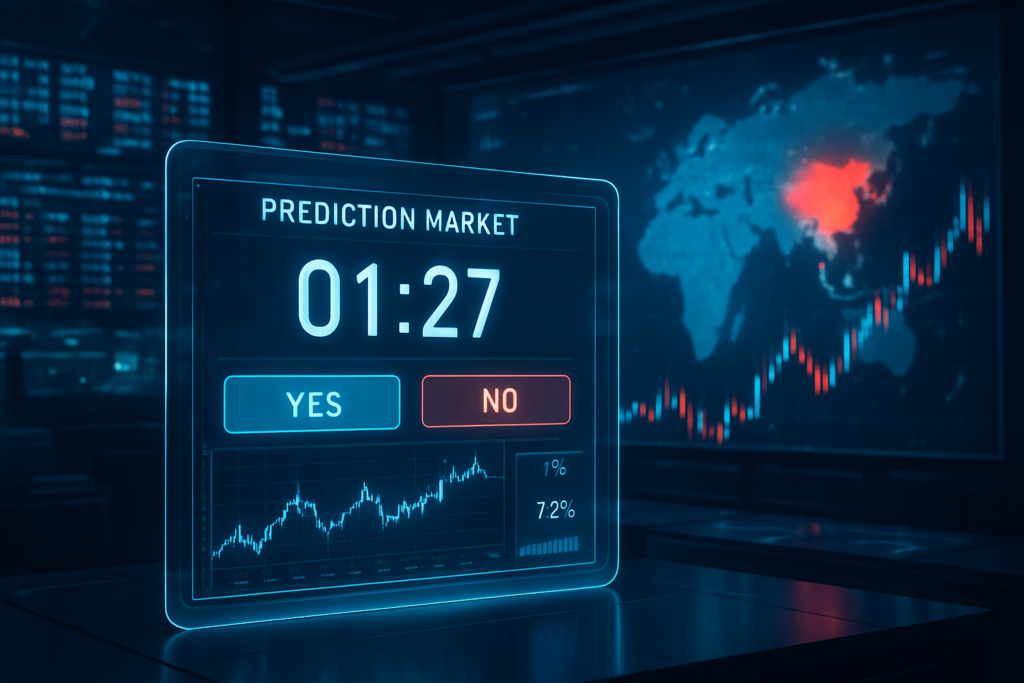
As of January 19, 2026, the global financial landscape is increasingly dominated by a controversial new asset class: geopolitical instability. Following the chaotic start to the year—marked by the capture of Nicolás Maduro in Venezuela on January 3 and a subsequent hypersonic missile test by Pyongyang on January 4—prediction markets have seen an unprecedented surge in activity. These "disaster markets," which allow traders to bet on everything from nuclear tests to regime changes, are no longer just niche corners of the internet; they have become a multi-billion-dollar "parallel intelligence" infrastructure.
On platforms like Polymarket and Kalshi, the volume of bets regarding North Korean aggression and potential U.S. diplomatic breakthroughs has reached a fever pitch. Currently, the market for a face-to-face summit between Donald Trump and Kim Jong-un in 2026 is trading at a robust 42% probability, while more extreme "invasion" contracts are seeing high-frequency fluctuations as traders attempt to price in the risk of a global kinetic conflict. This shift has transformed prediction markets into a leading indicator of real-world volatility, often moving faster than traditional news cycles.
The Market: What's Being Predicted
The focus of the early 2026 trading season has been the Korean Peninsula. On the decentralized platform Polymarket, cumulative volume for 2025 reached nearly $40 billion, with a significant portion dedicated to "North Korean provocation" contracts. Specifically, the market for "North Korea to launch a ballistic missile by January 31, 2026" saw a massive spike in liquidity following the January 4 test. Before the launch was even officially confirmed by the Pentagon, "Yes" contracts reached near-parity, suggesting that traders with localized intelligence or advanced satellite monitoring were front-running the official news.
On the regulated U.S. exchange Kalshi, the focus is more diplomatic but no less high-stakes. Traders are currently eyeing the "Kim Jong-un to visit the U.S. in 2026" contract. While the odds remain lower at 18%, the volume has increased tenfold since the start of the year. Unlike the "wild west" markets on offshore platforms, Kalshi’s contracts are strictly defined, requiring a physical presence in the 50 U.S. states to resolve.
In Asia, a new Binance-backed platform named Opinion has gained massive traction, specifically targeting South Korean retail investors. This platform hosts hyper-local markets, such as "DMZ skirmish before March" and "Cyberattack on Seoul infrastructure." Weekly volumes on Opinion have reportedly exceeded 2 trillion won ($1.5 billion), highlighting a regional obsession with hedging against the very real possibility of local disaster.
Why Traders Are Betting
The motivations for these bets are shifting from speculative gambling to strategic hedging. Institutional players, once wary of the "death pool" optics, are now the primary drivers of volume. Goldman Sachs (NYSE: GS) recently acknowledged that it tracks a "Basket of Geopolitical Risk Stocks" that directly correlates with the odds seen on these prediction platforms. For a hedge fund manager, a "Yes" bet on a North Korean missile launch acts as a protective hedge against their long positions in South Korean equities or global tech manufacturing.
"We aren't just looking at what CNN says anymore," noted one anonymous high-volume trader on Polymarket. "We are looking at where the $500,000 'whale' positions are moving at 3:00 AM. When a whale bets $30,000 at 7-cent odds on a regime change and wins, like we saw with the Maduro removal in early January, you realize these markets are being fed by people with boots-on-the-ground information."
Furthermore, the "Trump Factor" remains a primary catalyst. The market's 42% odds for a Trump-Kim summit reflect a belief in the return of "personal diplomacy" and the President's penchant for grand, televised summits. Traders are betting on the President's unpredictability, using historical patterns from the 2018-2019 period to gauge the likelihood of a sudden de-escalation that would see Kim Jong-un on U.S. soil.
Broader Context and Implications
The rise of these markets has ignited a firestorm of ethical debate. Critics argue that allowing individuals to profit from war and suffering is inherently "ghoulish." In response, Representative Ritchie Torres introduced the Public Integrity in Financial Prediction Markets Act of 2026 earlier this month. The bill aims to prevent federal officials from trading on outcomes they might influence, treating prediction markets with the same scrutiny as the equities market to prevent "government insider trading."
The ethical concern extends to moral hazard: could a high-stakes bet on an assassination or a terrorist attack actually incentivize the event? While no such link has been proven, the sheer amount of money—over $10 billion in monthly volume in late 2025—makes the possibility a central concern for regulators at the CFTC.
Despite the controversy, the accuracy of these markets is difficult to ignore. Throughout 2025, prediction markets consistently outperformed traditional think tanks and intelligence agencies in forecasting regional skirmishes. The correlation between these markets and the stock prices of major defense contractors is now nearly 1:1. For instance, Hanwha Aerospace (KRX: 000880) and LIG Nex1 (KRX: 079550) saw their stock prices surge by 25.4% and 15.2% respectively in the first week of 2026, perfectly mirroring the rising "conflict odds" on Polymarket. Similar movements were seen in U.S. giants like Lockheed Martin (NYSE: LMT) and Northrop Grumman (NYSE: NOC).
What to Watch Next
The coming weeks will be a critical litmus test for these disaster markets. All eyes are on the upcoming vote for the 2026 U.S. defense budget, which President Trump has proposed at a record $1.5 trillion. If the budget passes with its current focus on "Pacific Deterrence," expect the odds for a diplomatic summit to drop while "Missile Launch" and "Satellite Deployment" contracts see increased action.
Key dates to monitor include the late-February anniversary of the founding of the Korean People’s Army. Traditionally a time for military parades, traders are already positioning themselves for a "spectacular" missile demonstration. Additionally, any movement in the stock of Korea Aerospace Industries (KRX: 047810) will be closely watched; the company’s stock has recently moved in tandem with markets predicting the detection of new North Korean submarine-launched ballistic missile (SLBM) capabilities.
Bottom Line
The emergence of "geopolitical disaster" markets represents a fundamental shift in how the world processes risk. What was once considered a morally questionable hobby has matured into a vital instrument for financial hedging and information aggregation. Whether it is the 42% chance of a Trump-Kim summit or the split-second reaction to a missile launch, these markets provide a raw, unfiltered look at public and institutional sentiment that traditional polls cannot match.
However, the legal landscape is shifting. As the Torres Bill makes its way through Congress and the ethical debate over "profiting from chaos" intensifies, the future of these platforms may depend on their ability to self-regulate. For now, they remain the most accurate—and perhaps the most unsettling—barometer of a world on the edge.
This article is for informational purposes only and does not constitute financial or betting advice. Prediction market participation may be subject to legal restrictions in your jurisdiction.
PredictStreet focuses on covering the latest developments in prediction markets. Visit the PredictStreet website at https://www.predictstreet.ai/.