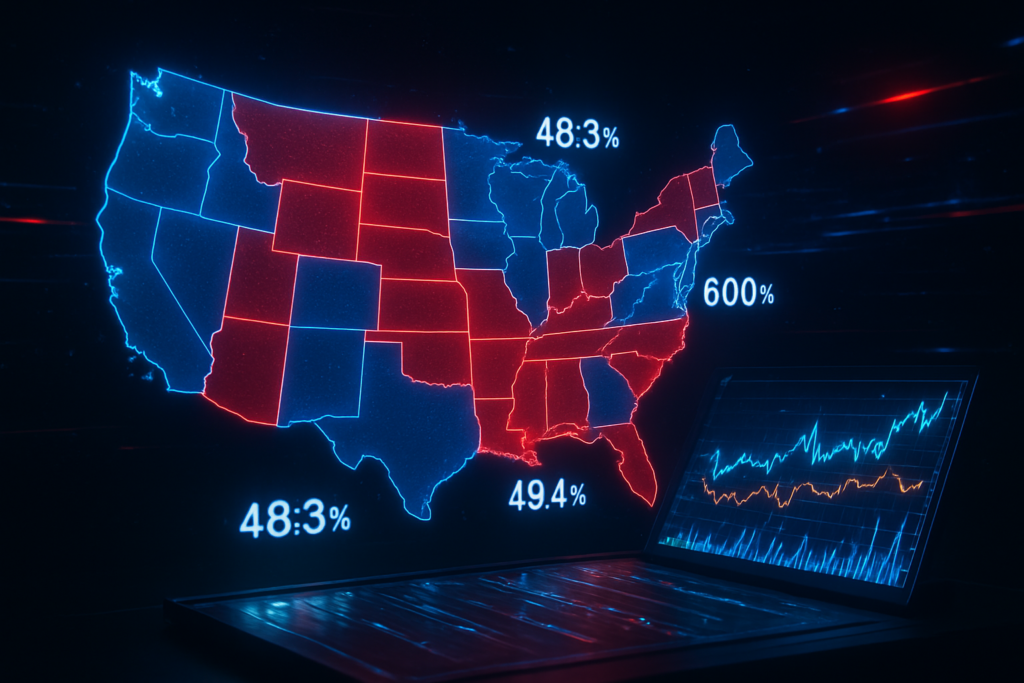
When the dust finally settled on the 2024 U.S. Presidential Election, the biggest winner wasn't just on the ballot; it was the platform that saw the outcome coming long before the first cable news network called a single swing state. Polymarket, the decentralized prediction platform, didn't just participate in the election cycle—it dominated the narrative, processing nearly $19 billion in cumulative volume across its various election-related contracts and correctly calling the outcome in all 50 states.
While traditional polling aggregators and mainstream media outlets spent the final weeks of the campaign describing the race as a "dead heat" or a "coin flip," Polymarket’s traders were already pricing in a decisive shift. The platform reached a staggering 95% probability for a Donald Trump victory at 11:43 p.m. ET on Election Night—nearly six hours before the Associated Press made its official call at 5:34 a.m. ET. This massive divergence has fundamentally altered how political outcomes are forecasted, moving the needle from subjective opinion polling toward the "liquid truth" of incentivized markets.
The Market: What's Being Predicted
At the heart of the 2024 frenzy was a suite of over 50 individual state-level markets and a flagship "Presidential Election Winner 2024" contract. This primary market alone saw a cumulative volume of approximately $3.7 billion, but when including markets for House and Senate control, popular vote margins, and candidate-specific milestones, the total ecosystem volume surged toward the $19 billion mark. This liquidity provided a level of stability and signal clarity that smaller, regulated U.S. competitors were only beginning to match at the time.
The resolution criteria were binary: which candidate would secure the majority of electoral votes as certified by the states. Throughout October 2024, as polls showed the candidates within the margin of error, Polymarket consistently priced Trump as a 60/40 favorite. This "spread" represented a significant departure from traditional forecasting models, which stayed locked in a 50/50 toss-up narrative until the early hours of Wednesday morning.
The success of these markets caught the attention of major financial players. Robinhood Markets, Inc. (NASDAQ: HOOD) and Interactive Brokers Group, Inc. (NASDAQ: IBKR) both launched their own "event contracts" in late October 2024, following a landmark court ruling involving the exchange Kalshi. However, Polymarket’s early lead in liquidity and its crypto-native user base allowed it to remain the primary reference point for "real-time" probability during the most critical hours of the election.
Why Traders Were Right
The accuracy of Polymarket in 2024 is largely attributed to the "Wisdom of Crowds" and the concept of "skin in the game." Unlike poll respondents, who may experience "social desirability bias"—telling pollsters what they think is the "correct" or "polite" answer—prediction market traders face immediate financial consequences for being wrong. This financial incentive filters out noise and forces participants to find the most accurate information available, including obscure county-level data and early voting trends that traditional models often lag behind.
A significant factor in the market’s movements was the presence of high-conviction "whales." One notable trader, a French national identified as "Théo," reportedly bet upwards of $30 million on a Trump victory. While critics initially feared this was a "market manipulation" attempt to skew perception, post-election analysis revealed it was a sophisticated data-driven play based on "neighbor polls"—a method that asks respondents who they think their neighbors will vote for, which historically captures hidden support more accurately.
Furthermore, the markets were faster to react to major campaign catalysts. For instance, when President Joe Biden withdrew from the race in July 2024, Polymarket odds had already priced the probability of his exit at over 70% weeks in advance, while many political pundits were still dismissing the possibility. This speed allowed institutions like Bloomberg to integrate Polymarket data directly into their terminals, providing professional traders with a faster volatility gauge than any poll could offer.
Broader Context and Implications
The 2024 cycle has marked a permanent shift in the relationship between prediction markets and the financial sector. Since the election, the "event contract" asset class has exploded. By early 2026, Intercontinental Exchange, Inc. (NYSE: ICE), the parent company of the New York Stock Exchange, made a landmark investment in the sector, signaling that prediction data is now viewed as an essential alternative data set for hedging political and economic risk.
The regulatory landscape has also shifted dramatically. Following the success of the 2024 markets, the CFTC has faced increased pressure to provide a clearer framework for event contracts. This has paved the way for more mainstream adoption, with Coinbase Global, Inc. (NASDAQ: COIN) acquiring prediction-infrastructure firms to scale these offerings to their millions of retail users. Even the sports betting giants DraftKings Inc. (NASDAQ: DKNG) and Flutter Entertainment plc (NYSE: FLUT) have launched dedicated "prediction" verticals to capture the growing demand for non-sports wagering.
Historically, prediction markets were seen as a niche interest for crypto enthusiasts. However, the 2024 results—specifically the Brier score of 0.0296, which significantly outperformed Nate Silver’s "Silver Bulletin" model—have validated them as a superior forecasting tool. This success has sparked a broader debate about the "death of polling," as organizations like the New York Times face questions about why their sophisticated polling models failed to capture the "clean sweep" that the markets were already pricing in.
What to Watch Next
As we look toward the 2026 midterm elections, prediction markets are no longer a "side-show" but the main event. Analysts expect cumulative volumes for the 2026 cycle to exceed $25 billion, as institutional participation grows and more brokerages offer direct access to political contracts. The focus is now shifting toward "Micro-Prediction Markets," where traders can bet on specific policy outcomes, such as the likelihood of corporate tax rate changes or the passage of specific healthcare legislation.
Key milestones to monitor include the upcoming SEC and CFTC rulings on the cross-listing of event contracts on traditional equity exchanges. If approved, we could see a future where political "odds" are traded as easily as shares of Alphabet Inc. (NASDAQ: GOOGL) or Meta Platforms, Inc. (NASDAQ: META). Furthermore, the integration of AI-driven trading bots into these markets is expected to increase liquidity even further, though it may also introduce new challenges regarding market manipulation and flash volatility.
Bottom Line
Polymarket’s performance in the 2024 election was a watershed moment for decentralized finance and political science. By correctly calling every state and providing a high-certainty victory signal hours before official media calls, the platform proved that markets can process complex, disparate information more efficiently than traditional institutions. The $19 billion in volume wasn't just a figure of speculation; it was a figure of participation in a new era of "liquid democracy."
As we move into 2026, the era of the "unpredictable" election may be coming to an end. While polling remains a useful tool for understanding voter sentiment, prediction markets have established themselves as the definitive tool for understanding voter outcomes. For investors and political observers alike, the lesson of 2024 is clear: follow the money, not the polls.
This article is for informational purposes only and does not constitute financial or betting advice. Prediction market participation may be subject to legal restrictions in your jurisdiction.
PredictStreet focuses on covering the latest developments in prediction markets.
Visit the PredictStreet website at https://www.predictstreet.ai/.