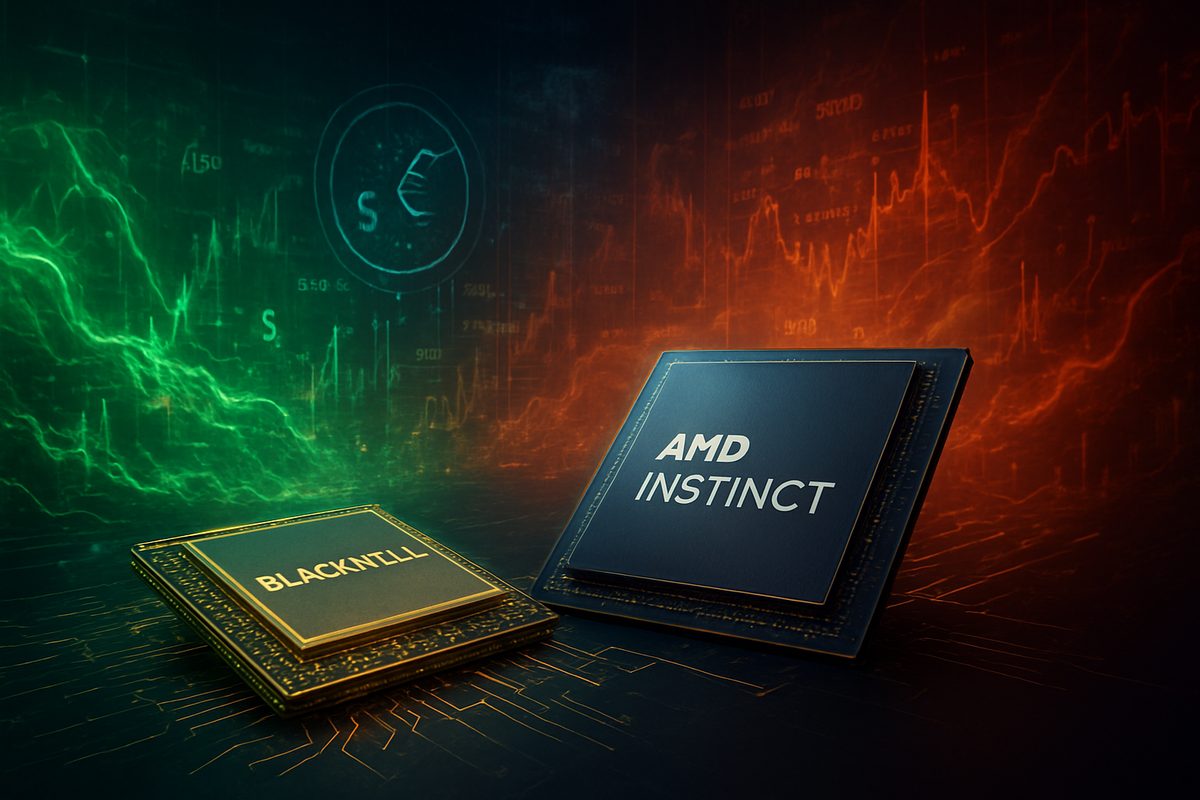
As the calendar turns to March 2026, the initial euphoria of the artificial intelligence revolution has given way to a more cold-eyed assessment of the semiconductor landscape. Advanced Micro Devices, Inc. (NASDAQ: AMD), once the darling of the 2024-2025 AI surge, finds itself at a crossroads. Despite a staunchly bullish outlook from analysts at UBS, the company's stock has faced significant headwinds in recent weeks, trading in a cautious range between $188 and $196. This weakness comes even as the broader market remains hungry for AI compute, highlighting a growing divergence between the "pure-play" leaders and those still fighting to prove their long-term scale.
The current malaise surrounding AMD reflects a broader market transition—a shift from the speculative "infrastructure buildout" to what analysts are calling the "discerning phase" of AI investment. While the demand for high-performance GPUs remains robust, investors are no longer rewarding potential alone. They are now scrutinizing specific execution milestones, competitive positioning against dominant incumbents, and the tangible return on investment (ROI) that these multi-billion-dollar hardware spends are generating for hyperscale customers.
A Bullish Signal Meets Market Skepticism
The primary catalyst for recent discussions around AMD was a high-profile research note from UBS analyst Timothy Arcuri on March 2, 2026. While Arcuri reiterated a Buy rating, he significantly adjusted his price target downward from $330 to $310. This move was a "canary in the coal mine" for investors, signaling that even the most optimistic observers are recalibrating their expectations for the chipmaker. The adjustment was driven by a confluence of factors, including persistent weakness in the traditional gaming hardware segment and newly emerged macro concerns regarding U.S. export caps. Reports of a 75,000-chip limit per customer for high-end AI accelerators have cast a shadow over the immediate growth trajectory of AMD’s Instinct MI325 and MI350 series.
Historically, the timeline leading to this moment was defined by AMD's rapid ascent as the primary alternative to the Nvidia "monopoly." Throughout 2025, AMD successfully carved out a niche by offering superior memory capacity in its chips, targeting customers who prioritized large-language model (LLM) inference. However, as 2026 began, the market reaction soured as quarterly reports revealed that while AI revenue was growing, it wasn't yet enough to offset the cyclical downturn in the PC and console markets. Key players like Microsoft Corp (NASDAQ: MSFT) and Meta Platforms, Inc. (NASDAQ: META) remain deeply committed to AMD’s ecosystem, but the stock's performance suggests that institutional investors are waiting for a more definitive "second-half story."
The immediate reaction on the trading floor has been a flight to quality, or rather, a flight to the perceived "certainty" of the market leader. While AMD trades at a forward price-to-earnings (P/E) ratio of roughly 30x–40x—a valuation that implies high growth—its primary competitor, Nvidia Corp (NASDAQ: NVDA), continues to trade at a more modest 23x–25x despite its significantly larger market cap. This "valuation gap" has made AMD a higher-beta play, prone to sharper pullbacks whenever the macro environment or sector sentiment wavers.
The Widening Gap: Winners vs. Laggards
The semiconductor sector is currently experiencing a stark stratification. On one side are the "Alpha Winners" like Nvidia and Broadcom Inc. (NASDAQ: AVGO). Nvidia has successfully transitioned from being a component supplier to a full-stack "AI Factory" provider. Its Blackwell architecture, integrated into the GB200 NVL72 rack-scale systems, has become the gold standard for frontier model training. Broadcom, similarly, has flourished by dominating the custom ASIC (Application-Specific Integrated Circuit) and networking markets, providing the "glue" that holds these massive AI clusters together. For these companies, the discerning phase has been a boon, as their integrated ecosystems offer the clearest path to rapid deployment and monetization.
On the other end of the spectrum are the "Laggards" and those in transition. Intel Corp (NASDAQ: INTC) continues to struggle with its foundry pivot, failing to capture significant AI accelerator market share despite aggressive branding. Meanwhile, specialized memory makers like Micron Technology, Inc. (NASDAQ: MU) and South Korea’s SK Hynix have emerged as essential winners due to the insatiable demand for High Bandwidth Memory (HBM). AMD sits in a unique, somewhat precarious middle ground. It is far ahead of the laggards, possessing the only credible alternative to Nvidia's high-end GPUs, but it lacks the full-stack networking dominance that has allowed Nvidia to lock in the largest hyperscale budgets.
For companies like Taiwan Semiconductor Manufacturing Company (NYSE: TSM), the divergence is less critical, as they manufacture for both the winners and the challengers. However, for the end-users—the "Magnificent Seven" tech giants—the struggle between AMD and Nvidia is vital. If AMD cannot close the performance gap or provide a more compelling economic proposition, the hyperscalers face a future of total reliance on a single vendor, a scenario that would likely compress their own margins as AI infrastructure costs continue to balloon.
The Shift Toward AI ROI and Ecosystem Dominance
The current market dynamic fits into a larger historical trend often seen during major technological shifts. Much like the early days of the internet or the mobile revolution, the initial phase is characterized by a "land grab" where any company with a viable product sees its valuation soar. We have now moved into the "Execution Era." Investors are increasingly focused on software ecosystems, such as Nvidia’s CUDA platform, which creates high switching costs for developers. AMD has made strides with its open-source ROCm software stack, but the market is now demanding proof that this software parity is translating into broader enterprise adoption beyond a few key hyperscale partners.
The ripple effects of this "discerning phase" are felt most acutely by secondary and tertiary players. Mid-cap chip design firms that cannot show a direct tie to generative AI compute are seeing their multiples contract. Furthermore, regulatory implications are beginning to bite. The aforementioned export caps on advanced AI silicon represent a new geopolitical reality where the total addressable market (TAM) is no longer a simple global calculation. For AMD, which has historically relied on a wide geographic footprint, these restrictions create a "ceiling" that requires them to extract more value from a smaller pool of domestic customers.
Historically, this period echoes the mid-2000s transition in the networking space. At that time, many companies produced routers, but Cisco emerged as the dominant winner because it controlled the software and the standards. Today, the "AI Factory" is the new networking rack. The significance of AMD's recent weakness is not just about a few points of stock price; it is a signal that the market is questioning whether "good enough" hardware is sufficient to compete with a proprietary, integrated ecosystem in a high-stakes, high-cost environment.
Looking Ahead: The Second-Half Recovery Thesis
Despite the recent turbulence, the road ahead for AMD is far from bleak. The strategic pivot required involves doubling down on its "Memory Supremacy" strategy. The upcoming Instinct MI355X and the highly anticipated MI450 series—the latter of which is rumored to have secured massive volume orders from OpenAI for late 2026—could provide the necessary catalyst for a stock recovery. By offering significantly higher HBM3e capacity and bandwidth than current Nvidia offerings, AMD is positioning itself as the "Inference King," optimized for running the world's increasingly complex and long-context AI models.
In the short term, investors should prepare for continued volatility. The upcoming earnings season will be a "show me" moment where management must demonstrate that AI revenue is scaling fast enough to cover the gaps in their gaming and client divisions. A key scenario to watch is the potential for a "third gigawatt-scale customer" beyond Microsoft and Meta. If AMD can announce a tier-one partnership with a major cloud provider like Amazon or Google, it would go a long way toward alleviating fears of an Nvidia-only future.
In the long term, the opportunity for AMD lies in the diversification of AI. As the industry moves toward "Edge AI" and localized inference on PCs and mobile devices, AMD’s combined expertise in CPUs and GPUs gives it a unique advantage that Nvidia lacks. The challenge will be surviving the current "discerning phase" of the data center market without losing the R&D momentum needed to win the next battle at the edge.
Conclusion: A Market in Search of Proof
The recent weakness in AMD’s stock is a sobering reminder that even in a secular bull market, the path to dominance is rarely a straight line. The AI boom has entered a more mature stage where the "Nvidia tax" is being weighed against the cost of building out a secondary, AMD-based infrastructure. For AMD, the mission is clear: it must move beyond being the "budget alternative" and prove it can offer a superior hardware-software package for the next generation of generative AI applications.
Moving forward, the semiconductor market will likely remain bifurcated. Investors should expect the "winners vs. laggards" theme to intensify, with capital concentrating in companies that can prove sustainable, recurring AI revenue. The core takeaway is that the AI trade is no longer a "rising tide lifts all boats" scenario; it is now a battle of ecosystems, execution, and economic efficiency.
In the coming months, watchers of the sector should keep a close eye on HBM supply chains and any shifts in capital expenditure (CapEx) guidance from the major hyperscalers. If the "second-half 2026" recovery thesis for AMD holds true, the current price weakness may eventually be viewed as a classic entry point. However, until the company can bridge the valuation and execution gap with its larger rival, it remains a high-stakes bet on the future of an open AI ecosystem.
This content is intended for informational purposes only and is not financial advice