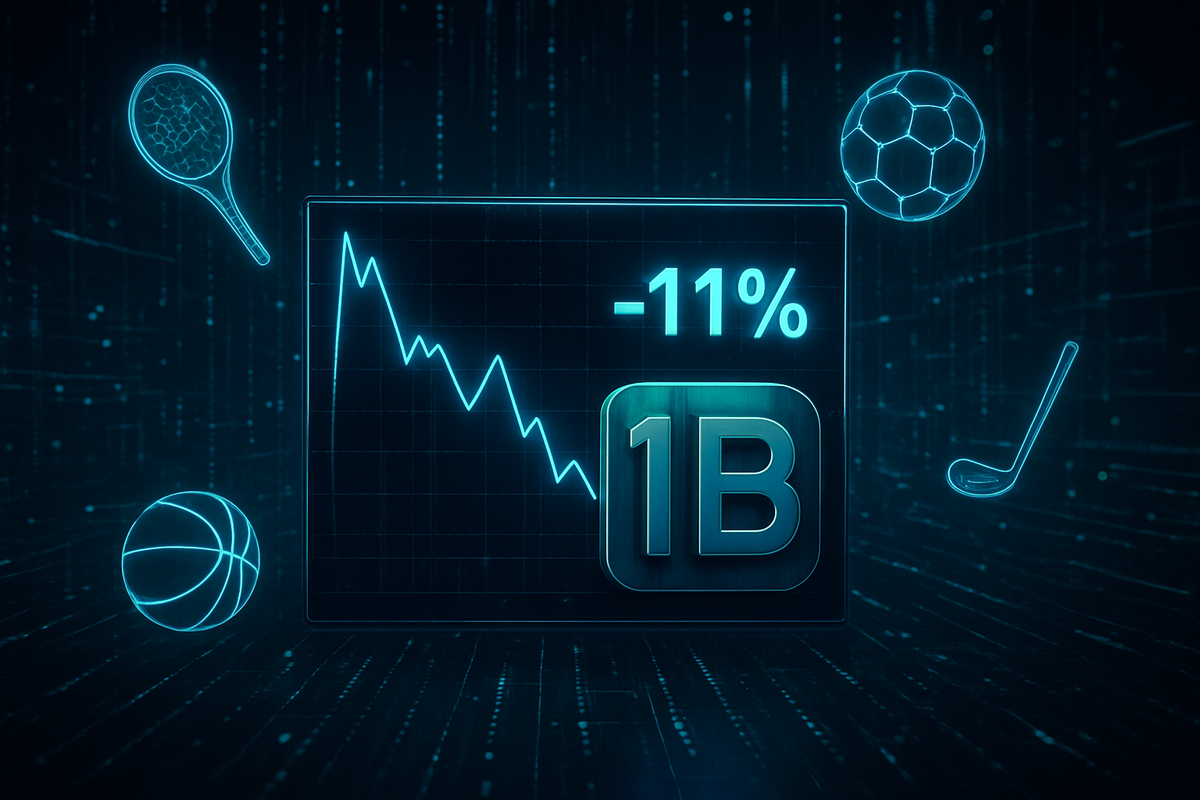
ST. GALLEN, Switzerland — Sportradar (NASDAQ: SRAD) finds itself in a paradoxical position today, March 3, 2026, after reporting record-breaking financial results for the 2025 fiscal year while simultaneously watching its market valuation contract. Despite achieving an all-time high revenue of €1.29 billion and announcing a massive expansion of its share buyback program to $1 billion, the company’s stock plummeted 11% in early trading. The selloff appears to be driven by a cautious outlook for 2026 that failed to satisfy high-flying analyst expectations.
The divergent signals from the company’s headquarters—aggressive capital return paired with a "wait-and-see" approach to next year’s growth—have left investors questioning the immediate trajectory of the sports data giant. While the acquisition of IMG ARENA has significantly bolstered Sportradar’s rights portfolio, the integration costs and a disciplined approach to 2026 guidance have created a temporary rift between management’s long-term confidence and Wall Street’s short-term demands.
Record Revenues Meet Cautious Forecasts
The financial highlights for Sportradar’s 2025 fiscal year were, by almost any standard, exceptional. The company reported total revenue of €1.289.9 billion ($1.4 billion), marking a 17% increase over 2024. This growth was anchored by a surge in the U.S. betting market and the successful initial folding of IMG ARENA into its operations. Adjusted EBITDA also saw a healthy climb, rising 33% to €296.8 million, with margins expanding to 23%. However, the headline-grabbing €1.29 billion revenue figure was overshadowed by the company’s 2026 guidance, which projected revenue growth in the range of 23% to 25%.
While 25% growth is robust for most industries, it represents a "conservative" posture in the high-stakes world of sports technology, where investors had baked in more aggressive acceleration following the IMG ARENA deal. Management’s decision to provide a wider-than-usual guidance range suggested potential headwinds in the integration of global rights or a cooling of the frantic pace of new market entries. To counter the negative sentiment, the Board of Directors authorized a massive increase in its share repurchase program, tripling it from $300 million to $1 billion. This move signals that Sportradar believes its own stock is currently undervalued, effectively betting on its own ability to outperform its cautious projections.
A Tale of Two Titans: Winners and Losers
Sportradar’s (NASDAQ: SRAD) current predicament highlights a widening gap in the sports data sector. The primary winner in the long term remains Sportradar itself, which now controls a staggering portfolio of over 1 million matches annually. By acquiring IMG ARENA from Endeavor Group (NYSE: EDR) in a deal that saw the seller actually pay Sportradar to take over the assets, SRAD has secured premium rights for Wimbledon, the PGA Tour, and the ATP without the debt burden typically associated with such expansion. This "asset-heavy, debt-light" strategy puts them in a superior financial position compared to peers.
Conversely, Genius Sports (NYSE: GENI) is facing its own set of challenges. While Genius reported a 31% revenue jump for 2025, its recent $1.2 billion acquisition of the Legend media network was funded by significant new debt. As interest rates remain a concern for high-growth tech, the market has punished Genius more severely, with its shares dropping over 30% recently. The "losers" in this environment appear to be the mid-tier data providers who lack the scale to compete for "Big Four" league rights, as Sportradar and Genius continue to consolidate the market into a duopoly.
Consolidation and Capital Allocation Trends
The events of March 2026 underscore a broader shift in the sports betting ecosystem: the era of "growth at any cost" has officially ended, replaced by a focus on capital allocation and margin expansion. Sportradar’s $1 billion buyback is a defensive masterstroke that reflects a trend seen across the tech sector, where profitable companies use their cash flow to support stock prices during periods of guidance-induced volatility. By remaining debt-free, Sportradar has the luxury of returning capital to shareholders, a feat many of its competitors cannot replicate.
Furthermore, the integration of IMG ARENA represents the final stages of a massive consolidation wave in sports rights. With Sportradar now managing data for major entities like the NBA, MLS, and ATP, the industry is moving toward a utility-like model where data providers act as the essential backbone for every sportsbook globally. This high barrier to entry creates a moat that is nearly impossible for new entrants to cross, though it also subjects these companies to intense regulatory scrutiny regarding data monopolies and integrity fees.
The Road to 2027: Execution Risk vs. Strategic Opportunity
Looking ahead, the next 12 to 18 months will be defined by Sportradar’s ability to extract "revenue synergies" from the IMG ARENA acquisition. Management has teased a 25% synergy target for the 2026 fiscal year, but achieving this will require flawless execution in upselling data packages to existing sportsbook partners. The market’s 11% selloff is a clear signal that investors are skeptical of this "conservative" guidance being a floor rather than a ceiling. If Sportradar can beat its own estimates in the first half of 2026, a massive valuation recovery could be on the horizon.
However, challenges remain. The cost of renewing data rights with major leagues continues to escalate, and any friction in the integration of IMG ARENA’s 70+ rights holders could weigh on margins. Investors should watch for the pace of the $1 billion buyback; if the company aggressively repurchases shares at these depressed prices, it will provide a significant boost to Earnings Per Share (EPS) in the coming quarters, potentially setting the stage for a dramatic turnaround in late 2026.
Investor Takeaway: A High-Margin Future
In summary, Sportradar’s current market turbulence is a classic "good news, bad news" scenario. The company is fundamentally stronger than ever, with record revenues and a fortress balance sheet that allows for a $1 billion capital return. The 11% stock drop is an emotional reaction to a disciplined management team that refuses to over-promise in a volatile global economy. For long-term investors, the focus should remain on the company's expanding margins and its ironclad grip on the world's most valuable sports data.
Moving forward, the key metrics to monitor will be the Adjusted EBITDA margin—currently at 23%—and the successful conversion of the IMG ARENA rights into high-margin betting products. If Sportradar proves that its "conservative" guidance was merely a baseline, the current selloff may eventually be viewed as a generational buying opportunity. For now, the ball is in management’s court to prove that their $1 billion bet on themselves was the right call.
This content is intended for informational purposes only and is not financial advice.