The geopolitical landscape of the Middle East underwent a seismic shift over the weekend as the United States and Israel launched a massive, coordinated military campaign against the Islamic Republic of Iran. Labeled "Operation Epic Fury," the offensive began in the early hours of February 28, 2026, targeting Iran’s supreme leadership, nuclear infrastructure, and the strategic capabilities of the Islamic Revolutionary Guard Corps (IRGC). By the time global markets opened on Monday, March 2, the scale of the conflict had become clear, triggering a "flight to safety" that sent shockwaves through every major asset class.
The immediate implications are staggering: the Strait of Hormuz, a vital artery for 20% of the world's oil supply, has been declared effectively closed by Tehran, and the reported death of Supreme Leader Ayatollah Ali Khamenei in a "decapitation strike" has left a power vacuum in the region. As investors scrambled to price in the risk of a protracted regional war, the March 2nd market opening was defined by historic volatility, record-breaking gold prices, and a double-digit surge in crude oil that threatens to derail global disinflation efforts.
The Dawn of Operation Epic Fury: A Timeline of Escalation
The military campaign was executed with surgical precision, beginning with a wave of stealth strikes on high-level command centers in Tehran. Intelligence reports suggest that the initial salvo utilized approximately 200 Israeli fighter jets and U.S. B-2 stealth bombers to bypass Iranian air defenses. The primary objective was the neutralization of Iran’s nuclear enrichment sites and ballistic missile facilities, which Western intelligence claimed were on the verge of producing weaponized uranium. The intensity of the strikes—over 2,000 targets hit within 48 hours—marks the most significant military engagement in the region since the 2003 invasion of Iraq.
The Iranian retaliation was swift but met with varying degrees of success. Hundreds of ballistic missiles and suicide drones were launched toward U.S. military installations in Kuwait, Qatar, and Jordan, as well as civilian population centers in Israel and the United Arab Emirates. While many were intercepted by advanced missile defense systems, the psychological impact on the shipping industry was total. By Sunday evening, Iran officially announced the closure of the Strait of Hormuz, prompting marine insurers to immediately withdraw coverage for tankers in the Persian Gulf, effectively halting the flow of millions of barrels of oil per day.
Initial market reactions on Monday morning were chaotic. European markets opened significantly lower, and U.S. futures pointed to a triple-digit loss for the Dow Jones Industrial Average. However, the narrative quickly shifted as the opening bell on Wall Street rang at 9:30 AM ET. While broad indices slumped, specific sectors—namely defense and energy—saw unprecedented buying pressure. The "fear gauge," or VIX, spiked to its highest level since the early days of the 2020 pandemic, reflecting a market that is currently struggling to find a floor amidst the fog of war.
Defense Titans and Energy Giants Lead a Bifurcated Market
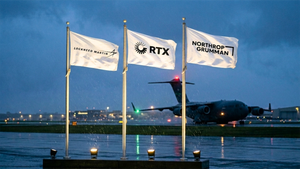
In the wake of the kinetic conflict, defense contractors have seen a massive influx of capital. Lockheed Martin (NYSE: LMT) saw its shares surge by 3.35% at the open, hitting an all-time high of $692.00. The company's F-35 Lightning II was prominently featured in combat footage released by CENTCOM, reinforcing expectations for a multi-year surge in international procurement orders. Similarly, Northrop Grumman (NYSE: NOC) jumped 4.13% to reach $768.02. Investors are betting heavily on Northrop’s B-21 Raider and B-2 Spirit platforms, which were instrumental in striking Iran's hardened underground nuclear facilities. These companies are viewed not just as beneficiaries of the current conflict, but as essential pillars of a new, high-readiness Western defense posture.
The energy sector experienced even more dramatic moves. Brent Crude oil spiked 13% at the Monday open, briefly touching $82.00 per barrel. While prices stabilized near $78.00 as the day progressed, the risk premium remains elevated. Major integrated oil firms like Exxon Mobil (NYSE: XOM) and Chevron (NYSE: CVX) saw gains as traders anticipated higher margins, despite the logistical nightmare of the Hormuz closure. Conversely, the airline industry faced a "dark Monday." International Consolidated Airlines Group (LSE: IAG), the parent of British Airways, saw its stock tumble by over 5% as thousands of flights across the Middle East were canceled, and the prospect of soaring fuel costs began to eat into 2026 earnings projections.
Safe-haven assets provided the only true refuge for conservative capital. Spot gold prices surged 2.5%, reaching an eye-watering $5,377 per ounce, with futures briefly hitting $5,400. This rally solidifies gold’s year-long climb from $3,000, as the escalation in Iran removes any remaining doubt about the metal's role as a hedge against systemic geopolitical collapse. Investors are increasingly viewing gold not just as a commodity, but as a necessary currency in an era where traditional geopolitical boundaries are being redrawn by force.
A New Era of Geopolitical Risk and Inflationary Pressure
The escalation in the Middle East fits into a broader global trend of "fractured globalization," where regional conflicts have immediate and severe impacts on global supply chains. The closure of the Strait of Hormuz is the most critical factor for the global economy; if the blockade persists for more than a few weeks, economists warn that Brent Crude could easily exceed $100 per barrel. This would inject a fresh wave of inflation into a global economy that had only recently begun to stabilize after years of post-pandemic price volatility.
The policy implications are equally profound. The U.S. administration’s decision to move from "containment" to "active degradation" of Iranian capabilities suggests a permanent shift in Middle Eastern policy. This move likely forces regional players like Saudi Arabia and the UAE to accelerate their own defense spending, benefiting the aforementioned contractors like Northrop Grumman (NYSE: NOC) and Lockheed Martin (NYSE: LMT) even further. Historically, this event draws comparisons to the 1973 oil embargo, but with a modern twist: the speed of information and the sophistication of 21st-century weaponry have compressed the market's reaction time from weeks to minutes.
Regulatory bodies and central banks are now in a precarious position. The Federal Reserve, which had been contemplating a series of interest rate cuts in 2026, may now be forced to keep rates "higher for longer" to combat the inflationary pressure of rising energy costs. Furthermore, the maritime industry faces a regulatory crisis as "War Risk" insurance premiums for the Persian Gulf have made shipping economically unviable for all but the most essential government-backed cargoes.
Looking Ahead: The Fog of War and Strategic Pivots
In the short term, the market will remain hyper-sensitive to any news regarding Iranian "sleeper cell" retaliation or the potential involvement of other regional powers like Hezbollah or Russia. If the conflict remains contained to the Iranian mainland, we may see a "relief rally" in broad equities as the initial shock fades. However, the long-term strategic pivot for the corporate world will be a move toward "energy reshoring" and a further decoupling from volatile regional supply chains.
The primary challenge for investors in the coming weeks will be distinguishing between a temporary spike and a structural shift in prices. If the U.S. and Israel can successfully secure the Strait of Hormuz within the next fourteen days, the $10 premium on oil may evaporate quickly. Conversely, if the IRGC manages to deploy minefields or conduct persistent drone strikes against tankers, the energy market could enter a period of sustained "super-contango," where future prices are significantly higher than current spot prices, reflecting extreme scarcity.
Potential scenarios range from a rapid Iranian collapse and a subsequent "peace dividend" to a grinding, multi-front war that draws in surrounding nations. For the defense sector, the current environment is a catalyst for the "re-industrialization of the West," as manufacturing capacity for munitions and advanced aerospace platforms is pushed to its limits. Investors should keep a close eye on the backlog of orders for Lockheed Martin (NYSE: LMT) and other prime contractors as new defense budgets are drafted in Washington and Tel Aviv.
Summary: A Monday for the History Books
The market opening on March 2, 2026, will be remembered as the moment geopolitical risk returned to the forefront of global finance with a vengeance. "Operation Epic Fury" has fundamentally altered the trajectory of the Middle East, leaving Iran’s leadership in tatters and the world's most critical energy chokepoint in jeopardy. The surge in defense stocks and the historic spike in gold prices are clear indicators that the "peace dividend" of the late 20th century has officially expired.
Moving forward, the market is likely to remain in a state of high-alert volatility. While the initial "shock and awe" of the military campaign has been priced in, the "grind" of the aftermath—insurance hikes, supply chain re-routing, and potential retail energy price surges—is only just beginning. The resilience of the global consumer will be tested as energy costs trickle down into every aspect of the economy, from freight to manufacturing.
For investors, the coming months require a focus on "fortress balance sheets" and assets that provide protection against both inflation and geopolitical instability. Watch for the weekly U.S. petroleum status reports and any statements from the newly formed Iranian provisional councils. The Middle East has entered a new chapter, and the financial markets are currently writing the first, very expensive, pages of that story.
This content is intended for informational purposes only and is not financial advice.