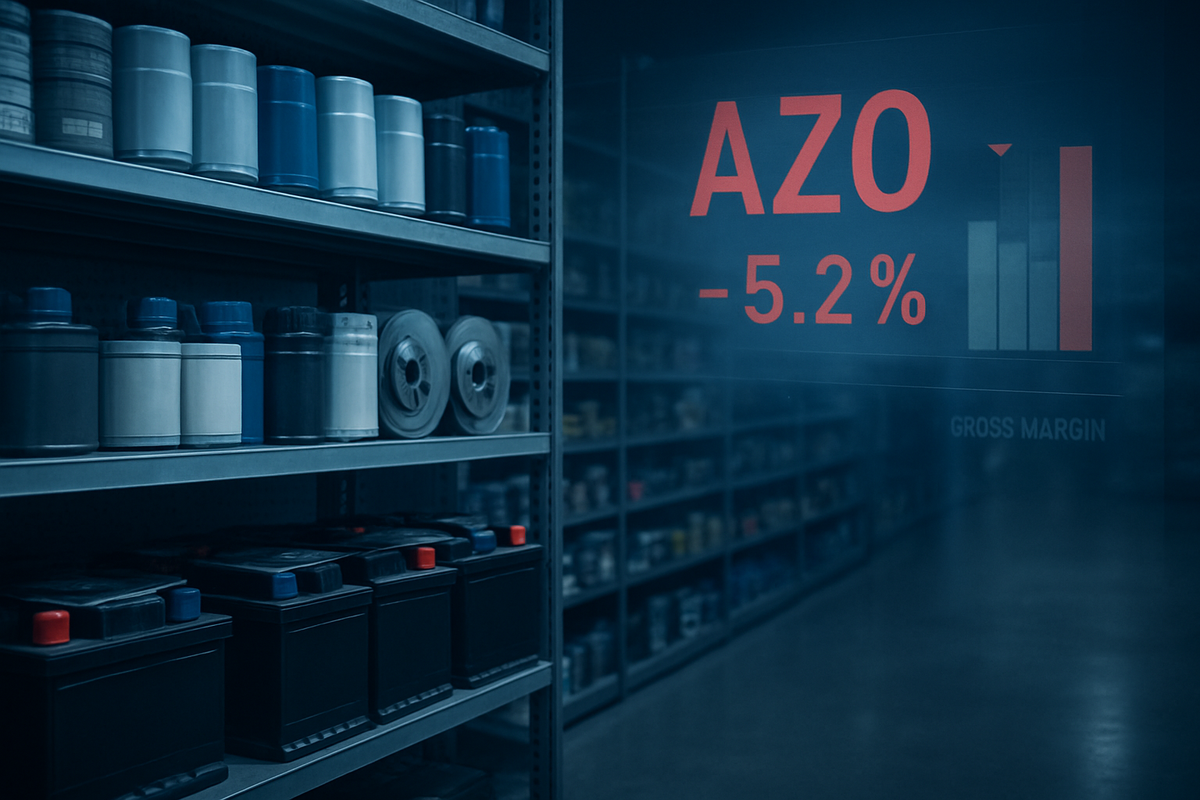
In a fiscal second quarter that highlighted the tug-of-war between resilient consumer demand and rising operational costs, AutoZone, Inc. (NYSE: AZO) reported earnings that both impressed and unsettled Wall Street. While the automotive parts giant managed to surpass analyst expectations for earnings per share (EPS), reporting a solid $27.63 against a consensus estimate of $27.40, the victory was short-lived for investors. The company’s stock price tumbled more than 5% in early trading on March 3, 2026, as the market reacted to a significant contraction in gross margins and a slight miss on top-line revenue targets.
The primary culprit for the investor retreat was a 137-basis-point decline in gross margin, which fell to 52.5%. This compression was driven almost entirely by non-cash LIFO (Last-In, First-Out) charges and persistent inventory inflation, signaling that the "higher-for-longer" inflationary environment is continuing to seep into the balance sheets of even the most reliable retail performers. Despite these accounting headwinds, the company’s core business remained robust, posting a healthy 3.3% increase in total same-store sales, underscoring the non-discretionary nature of the automotive aftermarket.
A Technical Miss Amidst Resilient Demand
The fiscal second quarter, which ended February 14, 2026, was a period of operational complexity for AutoZone. Net sales rose 8.1% year-over-year to $4.27 billion, but this figure fell short of the $4.31 billion to $4.35 billion range that analysts had projected. The market's sharp reaction, however, was less about the revenue miss and more about the quality of the earnings. The 137-basis-point drop in gross margin was a direct result of a 138-basis-point non-cash LIFO charge. Under LIFO accounting, the most recently acquired—and typically more expensive—inventory is recognized as sold first, which spiked the Cost of Goods Sold (COGS) as the company navigated a 13.1% year-over-year increase in merchandise inventory value.
Management attributed much of this inflation to rising tariff-related costs on imported components, particularly those sourced from Mexico and China. Throughout the quarter, the company faced a delicate balancing act: maintaining high in-stock levels to meet demand while managing the escalating costs of those very goods. While the professional (commercial) segment continued to show strength, domestic same-store sales grew by a modest 3.4%, trailing the more aggressive estimates of nearly 5% that some analysts had penciled in. This suggests a slight cooling in the "Do-It-Yourself" (DIY) segment as lower-income households face tightening budgets.
Winners and Losers in a Fragmented Market
The ripple effects of AutoZone’s earnings are being felt across the automotive retail landscape. O’Reilly Automotive, Inc. (NASDAQ: ORLY) saw its shares trade lower in sympathy, as investors fear that the LIFO and inflationary pressures cited by AutoZone are industry-wide systemic issues rather than company-specific hurdles. O’Reilly, known for its premium valuation and consistent execution, may face similar scrutiny regarding its margin preservation strategies in the coming weeks. If the industry leader is feeling the pinch of inventory inflation, its peers are likely to follow suit.
Conversely, Advance Auto Parts, Inc. (NYSE: AAP) remains in a unique position. Currently navigating a multi-year turnaround strategy aimed at consolidating its supply chain and closing underperforming stores, Advance might actually benefit from a broader industry focus on margin health rather than pure sales volume. However, the pressure on AutoZone suggests that the margin for error for Advance is even slimmer. Meanwhile, discount retailers and private-label manufacturers may emerge as "winners" as consumers look for cheaper alternatives to brand-name parts to offset the rising costs of essential vehicle maintenance.
The Aging Fleet and Macroeconomic Realities
The current environment for the automotive aftermarket is shaped by a historical anomaly: the average age of light vehicles in the United States has reached a record 12.8 years. This aging fleet provides a powerful "floor" for demand, as older cars require more frequent and more expensive repairs to remain roadworthy. This trend is a secular tailwind for AutoZone and its competitors, ensuring that even in a cooling economy, consumers are more likely to "repair than replace" their existing vehicles.
However, the Q2 results highlight a shift in how this demand is serviced. The resilience of the professional segment—sales to repair shops and mechanics—indicates that while DIY enthusiasts might be deferring some "discretionary" maintenance, "failure-based" repairs (like alternators, brakes, and starters) remain non-negotiable. The broader significance of the LIFO charge also points to a persistent inflationary cycle in the global supply chain. This marks a departure from the historical precedent where retailers could eventually pass all cost increases to consumers; in early 2026, it appears that pricing power is hitting a ceiling, forcing companies to absorb some of the pain in their margins.
Navigating the Inflationary "Deferral Wall"
Looking ahead, AutoZone faces a strategic pivot as it enters the second half of fiscal 2026. Management has noted that many consumers have hit a "deferral wall," where maintenance that was postponed in 2025 can no longer be ignored. This could lead to a surge in high-ticket failure-based repairs in the spring and summer months. To capitalize on this, AutoZone is expected to continue its aggressive expansion, having opened 64 net new stores this past quarter, with a particular focus on high-growth international markets like Mexico and Brazil, where constant-currency same-store sales surged 17.1%.
The short-term challenge remains the mitigation of LIFO volatility. If inflation begins to stabilize, these non-cash charges could reverse or diminish, leading to an outsized recovery in reported earnings later in the year. Investors will be watching closely to see if the company leans further into its share repurchase program—having bought back $310.8 million in stock this quarter—as a way to support the stock price while the operational "noise" from inventory accounting clears.
Conclusion: A Test of Durability
The Q2 2026 earnings report for AutoZone is a classic tale of a fundamentally strong business operating in a challenging macroeconomic environment. The headline EPS beat demonstrates the company’s ability to generate cash and manage operations effectively, but the margin compression serves as a stark reminder that no company is immune to the pressures of global inflation and supply chain friction. For the market, the takeaway is clear: while demand for auto parts remains recession-resistant, the profitability of that demand is under siege.
Moving forward, investors should keep a close eye on upcoming earnings from O'Reilly and Advance Auto Parts to determine if AutoZone's margin struggles are an isolated incident or the new normal for the sector. The long-term thesis for the automotive aftermarket remains intact, supported by an aging vehicle fleet and essential service needs, but the "easy gains" of the post-pandemic era have clearly transitioned into a more disciplined, cost-conscious phase of the market cycle.
This content is intended for informational purposes only and is not financial advice.