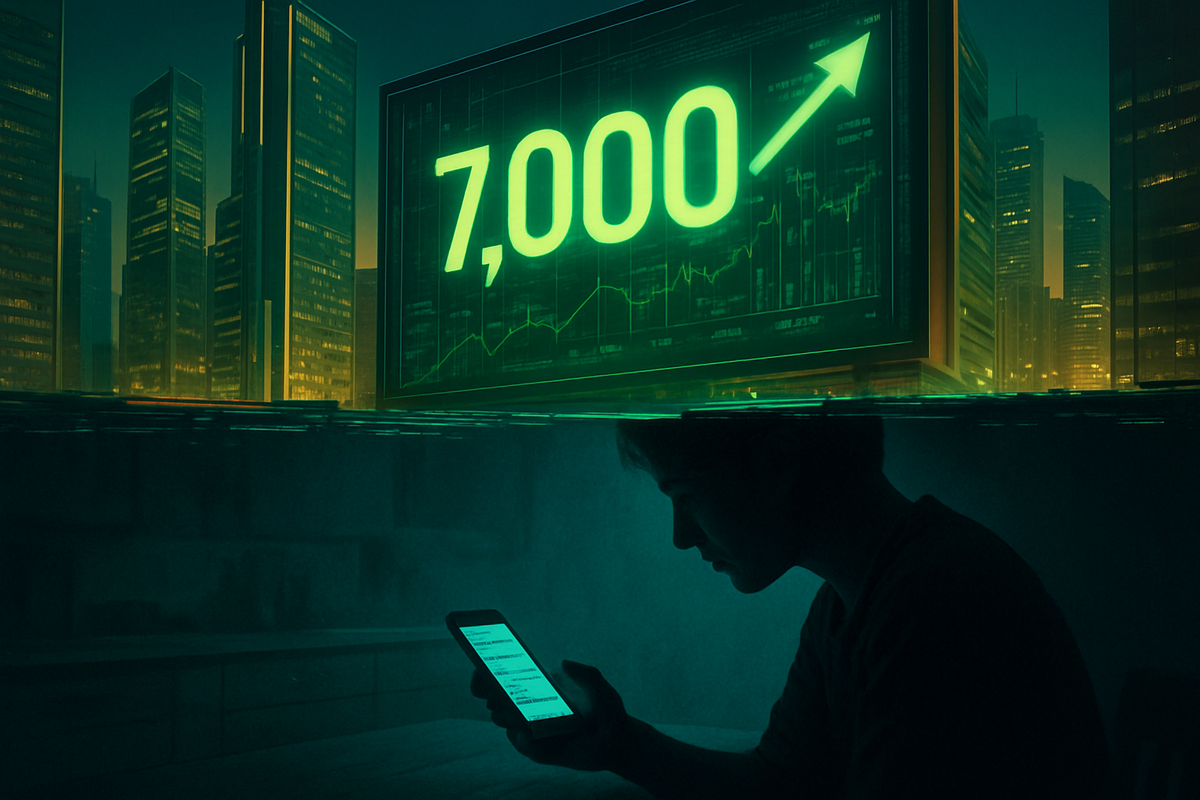
As of March 2, 2026, the American financial landscape has fractured into two distinct realities. On one side, the S&P 500 index has crossed the psychological threshold of 7,000, fueled by an unprecedented surge in artificial intelligence monetization and a regulatory environment favoring corporate expansion. For the investor class, the current market represents a "golden era" of wealth creation, with portfolio values swelling to historic proportions and earnings per share for the index's heavyweights growing at double-digit rates.
However, beneath the surface of this record-breaking rally lies a profound and widening disconnect. While the tickers on Wall Street flash green, the "Main Street" mood remains decidedly gray. The University of Michigan Consumer Sentiment Index has stagnated at a reading of 56.6—a level historically reserved for the depths of a recession. This "vibecession," as economists have dubbed it, highlights a "K-shaped" recovery where the wealth effect for the top 10% of households is failing to trickle down to a middle class squeezed by record household debt and the inflationary sting of new global trade policies.
The AI Engine and the Policy Pivot: A Timeline of the 7,000 S&P 500
The journey to 7,000 began in earnest during the "AI Implementation" phase of late 2024 and 2025. Unlike the speculative fever of previous years, the gains seen in early 2026 are backed by tangible results. Companies like NVIDIA Corp. (NASDAQ: NVDA) and Microsoft Corp. (NASDAQ: MSFT) have transitioned from selling AI infrastructure to reporting massive service-based revenues, proving that the multi-billion dollar capital expenditure cycles were not in vain. By the start of 2026, the information technology sector reported year-over-year earnings growth of 25%, providing the fundamental floor for the S&P 500's ascent.
The rally was further accelerated by the "Trump 2.0" policy shift following the 2024 election. Initial market reactions were jubilant as the administration moved to lower corporate tax rates and slash federal regulations, sparking a "deregulation boom" in the industrial and financial sectors. This helped offset the initial shock of a 10% global tariff implemented under Section 122 of the Trade Act. While corporations managed their margins through these shifts, the market priced in a "soft landing" that many analysts now believe is more of a "permanent plateau" for the stock market, even as consumers struggle.
Despite the index’s success, the disconnect became undeniable in February 2026. While the S&P 500 gained 12% in the first two months of the year, consumer inflation expectations spiked to 4.9%. The implementation of tariffs has been perceived by the public as a direct tax on essential imported goods, leading to a pervasive sense of gloom that contradicts the "all-time high" headlines on the news. This divergence has left policymakers at the Federal Reserve in a precarious position, balancing a booming equity market against a public that feels increasingly impoverished.
The Winners and Losers of the Great Disconnect
The current market environment has created a clear divide between "Tech Enablers" and "Consumer Discretionary" firms. The primary winners remain the architects of the physical AI economy. Caterpillar Inc. (NYSE: CAT) and Eaton Corp. (NYSE: ETN) have seen their stocks soar as they provide the heavy machinery and electrical infrastructure required for massive new AI data centers. These firms are less sensitive to short-term consumer sentiment because their order books are filled by corporate and sovereign investments that span the next decade.
In the retail space, a "trade-down" phenomenon has turned value-focused giants into defensive stalwarts. Walmart Inc. (NYSE: WMT) recently hit a $1 trillion market capitalization, as even middle-to-high income households migrate to its aisles to mitigate the rising cost of groceries and household essentials. Similarly, Costco Wholesale Corp. (NASDAQ: COST) has reported record membership renewals, acting more like a consumer staple than a discretionary retailer. These companies win by capturing the "cautious intentionality" of the gloomy consumer.
The losers in this scenario are mid-tier discretionary brands and retailers that lack a clear value proposition. As consumers prioritize essentials and high-end tech, companies in the "mushy middle" are seeing significant margin compression. Target Corp. (NYSE: TGT) and various apparel retailers have struggled to maintain foot traffic as their core customer base—the American middle class—grapples with a record $18.8 trillion in household debt. Serious credit card delinquency rates (90+ days) have hit 7.13%, the highest in over a decade, signaling that the capacity for discretionary spending is being cannibalized by debt servicing costs.
Historical Precedents and the Wealth Gap Crisis
The current "vibecession" shares DNA with the post-pandemic period of 2022-2023, but with a more structural and permanent feel. Historically, a rising stock market was a reliable lead indicator for rising consumer confidence. This was known as the "wealth effect"—when portfolios grow, people feel richer and spend more. However, in 2026, this link appears broken. With roughly 90% of stocks owned by the wealthiest 10% of households, the S&P 500’s rise to 7,000 primarily enriches those who were already insulated from inflationary shocks.
This event fits into a broader global trend of economic polarization. The "K-shaped" economy is no longer a temporary anomaly but a persistent feature of the AI-driven age. The automation of mid-level white-collar tasks, while boosting corporate productivity and stock prices, has contributed to a sense of job insecurity that suppresses sentiment. Furthermore, the 10% global tariff has introduced a "cost-push" inflation element that feels more regressive to the average worker than the "demand-pull" inflation seen in 2021.
Comparisons to the 1970s "Stagflation" era are also surfacing, though with a modern twist. Instead of high unemployment, the 2026 economy features low unemployment but "low morale." Consumers see the stock market as a scorecard for a system they no longer feel a part of. This has significant policy implications; if consumer spending—which accounts for nearly 70% of U.S. GDP—begins to falter under the weight of this gloom, the 7,000 level on the S&P 500 may eventually prove to be a "house of cards" built on top-heavy corporate margins rather than a broad-based economic foundation.
Looking Ahead: The 8,000 Target vs. The 35% Recession Risk
The short-term outlook remains a battle between momentum and exhaustion. Wall Street analysts at firms like Goldman Sachs Group Inc. (NYSE: GS) and Oppenheimer & Co. have set their sights on 8,000 by the end of 2026, betting that AI-driven productivity gains will continue to outpace the drag from the consumer sector. For investors, the strategic pivot involves moving away from "pure-play" consumer discretionary stocks and toward "defensive growth"—companies that have high margins and provide essential tech or staples.
However, the threat of a consumer-led recession remains a persistent shadow. JPMorgan has maintained a 35% probability of a recession in late 2026, citing the risk that high interest rates and debt levels will eventually force a sharp contraction in spending. If the sentiment floor of 56.6 does not improve, it may indicate a "buyer strike" is imminent. The market will be watching the upcoming Q2 earnings reports for signs of "cracks in the ceiling"—specifically, whether the growth in AI spending can truly compensate for a broader decline in domestic consumption.
In the long term, the disconnect may force a shift in corporate strategy. We may see more companies follow the lead of Apple Inc. (NASDAQ: AAPL) in integrating "affordable luxury" and financing options (like revamped "Buy Now, Pay Later" schemes) to keep the cash-strapped consumer engaged. The emergence of a "two-tier" marketing strategy—one for the high-net-worth individual benefitting from the 7,000 S&P 500 and one for the value-seeking "vibecession" survivor—is likely to become the new industry standard.
Final Assessment: A Precarious Milestone
The S&P 500 at 7,000 is an objective triumph of American corporate ingenuity and the transformative power of artificial intelligence. It signals a world where machines drive productivity and companies have become leaner and more profitable than ever. Yet, for the average citizen, these numbers offer cold comfort. The disconnect between a record-breaking market and a gloomy populace suggests that the metrics used to measure "economic health" may need an overhaul to account for the growing wealth disparity.
Moving forward, the market’s sustainability will depend on whether the "wealthy" 10% can continue to carry the economy, or if the "gloom" of the other 90% eventually pulls the indices back down to earth. Investors should watch credit delinquency rates and retail volume (not just dollar sales) as the true barometers of economic health in the months ahead. While the 7,000 milestone is worth celebrating in the boardroom, the real test of the 2026 economy will be whether it can bridge the gap between the record highs of the ticker and the record lows of the dinner table conversation.
This content is intended for informational purposes only and is not financial advice.