The landscape of artificial intelligence infrastructure underwent a seismic shift on March 2, 2026, as shares of Applied Optoelectronics (Nasdaq: AAOI) skyrocketed by 22.4%, reaching a historic high of approximately $107.55. This explosive rally was ignited by a dual-catalyst event: AAOI’s own blockbuster forward guidance and a massive, industry-altering $4 billion strategic investment from Nvidia (Nasdaq: NVDA) into the broader optical networking sector.
The market reaction underscores a fundamental realization among investors: the bottleneck for the next generation of AI is no longer just the GPU, but the "interconnect"—the high-speed optical nerves that allow tens of thousands of chips to communicate at light speed. As Nvidia moves to secure its supply chain with a landmark $2 billion investment in Lumentum Holdings (Nasdaq: LITE), smaller, vertically integrated players like AAOI are being repriced as essential components of the global AI factory.
A $4 Billion Stake in the Future of Light
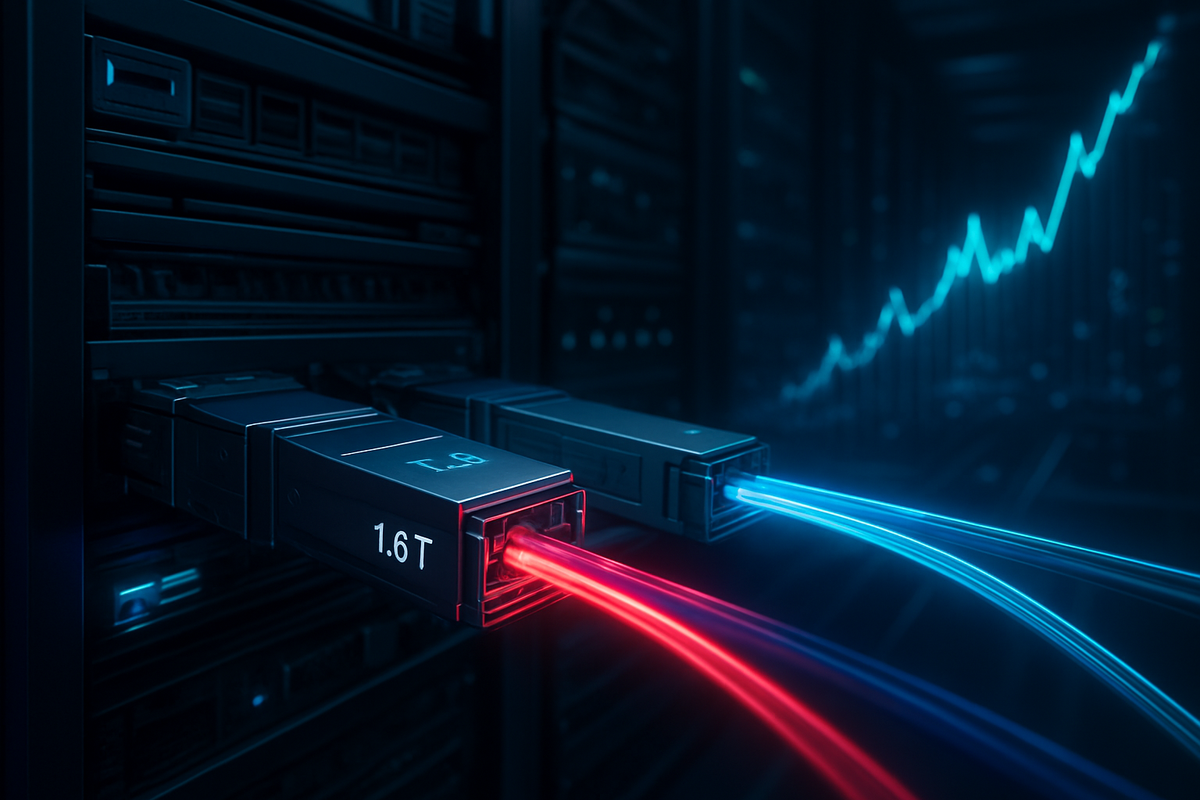
The primary fuse for Monday’s market fireworks was Nvidia’s announcement of a massive "moat-building" exercise. Seeking to solidify its "on-shore" supply chain and mitigate geopolitical risks, Nvidia committed $2 billion each to Lumentum Holdings (Nasdaq: LITE) and Coherent Corp. (NYSE: COHR). These deals are structured as strategic partnerships involving multi-billion dollar purchase commitments and the direct funding of new U.S.-based manufacturing facilities, specifically aimed at accelerating the production of 800G and 1.6T (1.6 Terabit) optical transceivers.
This news followed on the heels of AAOI’s own Q4 2025 earnings report, released just days prior, where the company stunned analysts by raising its 2026 revenue guidance to over $1 billion. AAOI management confirmed that they have secured their fourth volume order for 800G modules from a major hyperscaler—widely speculated to be Microsoft (Nasdaq: MSFT) or Amazon (Nasdaq: AMZN). The convergence of Nvidia’s massive capital injection into the sector and AAOI’s proven ability to ramp up high-speed production created a "perfect storm" for the stock, as investors scrambled to find the highest leverage in the optical space.
The Winners and Losers of the Optical Re-Rating
Applied Optoelectronics (Nasdaq: AAOI) emerged as the day's clear winner. Despite its smaller market capitalization relative to industry giants, AAOI’s vertical integration—specifically its internal production of Indium Phosphide (InP) lasers—has become its greatest asset. In an era where laser components are the scarcest resource in the 1.6T supply chain, AAOI’s self-sufficiency allows it to capture higher margins and avoid the supply delays plaguing its competitors.
Lumentum Holdings (Nasdaq: LITE) and Coherent Corp. (NYSE: COHR) also saw significant gains, rising 10% and 15% respectively. The $2 billion infusion from Nvidia provides these companies with the "dry powder" needed to build advanced fabrication plants on U.S. soil, a move that aligns with federal chips and science initiatives. Conversely, Marvell Technology (Nasdaq: MRVL), a leader in the Digital Signal Processors (DSPs) that power these optical modules, saw its stock dip 1% despite its market dominance. Analysts noted that while Marvell's technology is indispensable, the stock was weighed down by a Morgan Stanley downgrade citing "stretched valuations" and broader macroeconomic concerns. Nvidia (Nasdaq: NVDA) itself finished the day down 4%, as a general "risk-off" sentiment triggered by geopolitical tensions in the Middle East led investors to take profits on the chip giant while rotating capital into the faster-growing networking sub-sector.
Breaking the Copper Ceiling: The Significance of 1.6T
This event marks a historical turning point in data center architecture: the end of the "Copper Era." At speeds of 800G and 1.6T, traditional copper wiring suffers from massive signal degradation and heat generation, making it physically impossible to scale AI clusters to the "Gigawatt-scale" envisioned by Nvidia CEO Jensen Huang. The industry is now forced to transition to Silicon Photonics and Co-Packaged Optics (CPO), technologies that move the optical conversion directly onto the chip or into extremely close proximity.
Nvidia’s $2 billion bet on Lumentum is essentially a pre-emptive strike to secure the laser capacity required for this transition. By funding U.S. fabs, Nvidia is ensuring that its "AI Factories" will not be throttled by a shortage of light-emitting components. This sets a precedent where the dominant chipmaker acts as the "Kingmaker" for its own supply chain, potentially forcing other hyperscalers like Google (Nasdaq: GOOGL) and Meta (Nasdaq: META) to make similar multi-billion dollar commitments to secure their own optical futures.
The Road to 1.6T and Beyond
Looking ahead, the short-term focus for the market will be the transition from 800G to 1.6T modules. AAOI management has indicated that demand for 1.6T is already outstripping production capacity through 2027. Investors should watch for further announcements regarding AAOI's capacity expansion and whether they will follow Lumentum’s lead in seeking strategic capital from their largest customers.
In the long term, the "optical super-cycle" is likely to lead to a wave of consolidation. As the technology becomes more complex and the capital requirements for new fabrication plants grow, smaller players may become acquisition targets for either larger networking firms or the chipmakers themselves. The strategic pivot toward U.S.-based manufacturing also suggests that regulatory tailwinds and government subsidies will play an increasingly important role in who wins the race for the 1.6T market.
Conclusion: A New Era for AI Infrastructure
The 22.4% surge in Applied Optoelectronics and Nvidia’s multi-billion dollar investment in Lumentum signal that the "AI Trade" has entered a more sophisticated phase. It is no longer enough to simply build the fastest GPUs; those GPUs must be connected by an equally fast and reliable optical network. The validation provided by Nvidia’s $4 billion commitment suggests that bandwidth has become the "new gold" of the digital economy.
For investors, the key takeaways are the critical importance of vertical integration and the strategic necessity of on-shored supply chains. As we move into the second half of 2026, the focus will shift from "who can design the best chip" to "who can deliver the most light." Applied Optoelectronics’ performance today is a testament to the fact that in the race for AI supremacy, the infrastructure that carries the data is just as valuable as the processors that crunch it.
This content is intended for informational purposes only and is not financial advice.