The S&P 500 (NYSE ARCA:SPY) is currently locked in a high-stakes tug-of-war with one of the most significant psychological milestones in financial history. After first touching the 7,000 mark on January 28, 2026, the index has spent the last five weeks retreating and consolidating, unable to turn that round number into a floor. This stagnation has left investors questioning whether the historic "second wave" AI rally has finally met its match or if the market is simply catching its breath before a technical breakout.
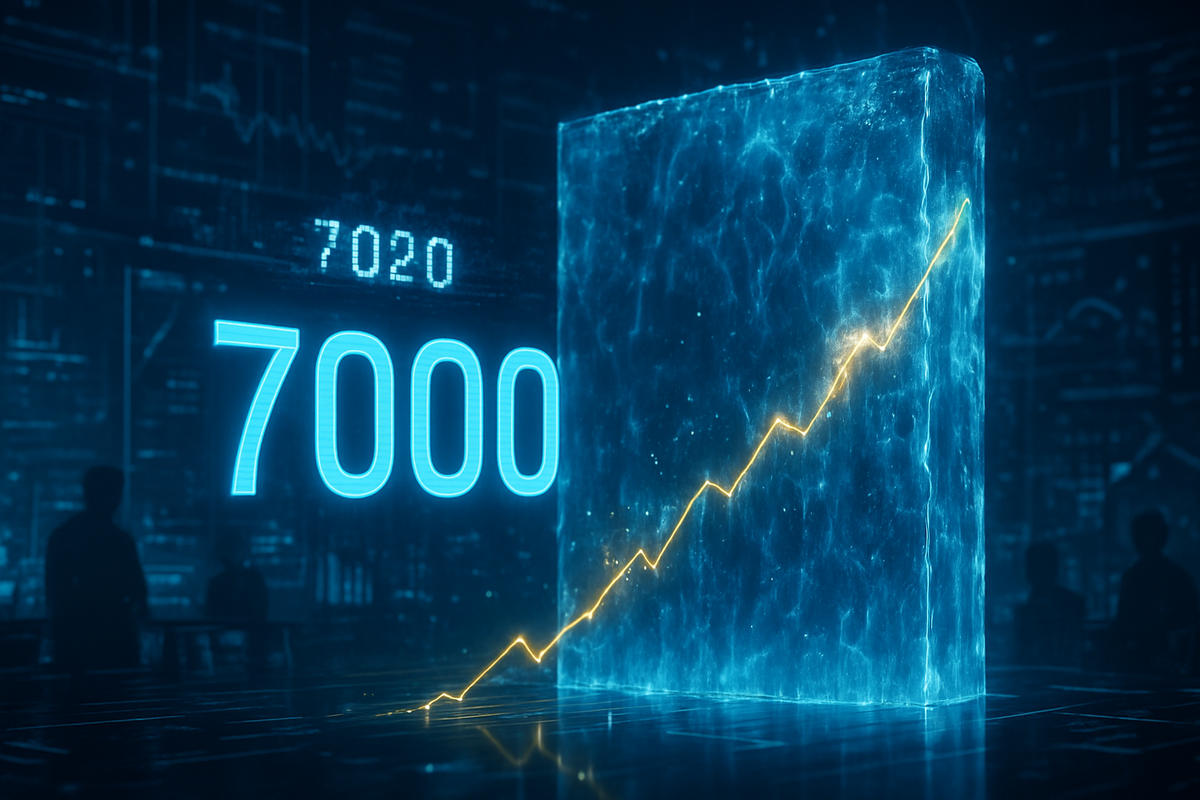
The immediate implications of this struggle are felt across the options market, where a massive concentration of positions—known as a "Gamma Wall"—at the 7,020 level is acting as a mechanical ceiling. As long as the index remains pinned below this threshold, volatility is expected to remain elevated, and any attempt at a rally is likely to be met with automated selling from market makers. For the broader public, the 7,000 level represents more than just a number; it is a barometer for the success of recent fiscal policies and the sustainability of the current economic expansion.
The January Peak and the Technical Ceiling
The road to 7,000 was paved by a relentless surge in late 2025, driven by record corporate earnings and the passage of the "One Big Beautiful Bill Act" (OBBBA). On January 28, 2026, the S&P 500 briefly eclipsed the milestone, reaching an intraday peak of 7,002.28. The moment was hailed as a triumph for the "Goldilocks" economy, characterized by 5.1% GDP growth and moderating inflation. However, the celebration was short-lived. By the closing bell that same day, the index had dipped back into the 6,900s, setting the stage for a month-long period of "indecision" as the market digested its 2025 gains.
The primary culprit behind this stall is a phenomenon known as the "Gamma Wall" centered around 7,020. In the options market, dealers who sell call options must hedge their exposure by buying or selling index futures. When there is a massive cluster of open interest at a specific strike price—like 7,000 or 7,020—market makers are forced to sell into strength as the price approaches that level to maintain "delta neutrality." This mechanical selling creates a "sticky" resistance that is difficult to break without a significant fundamental catalyst. Throughout February, every attempt to move toward 7,020 was swatted back down, resulting in a narrow trading range that has frustrated momentum traders.
Sector Leaders and the Widening Divide
The struggle at 7,000 has created a clear distinction between the winners of the AI infrastructure boom and the broader market participants. The standout performer of early 2026 has been the newly independent SanDisk (NASDAQ: SNDK), which has surged over 120% year-to-date following its successful spin-off from Western Digital (NASDAQ: WDC). Investors have flocked to SanDisk as a pure-play bet on high-performance AI storage, a sector that has outperformed even the traditional chip giants this quarter. Other hardware leaders like Seagate Technology (NASDAQ: STX) and Micron Technology (NASDAQ: MU) have also seen double-digit gains, providing much of the upward pressure that brought the index to the 7,000 doorstep.
However, the "Gamma Wall" has been less kind to the heavyweights that anchor the index. Nvidia (NASDAQ: NVDA), with a market capitalization hovering near $5 trillion, has seen its stock price flatten as investors scrutinize the massive capital expenditures of its primary customers. Similarly, Advanced Micro Devices (NASDAQ: AMD) and ASML Holding (NASDAQ: ASML) have entered a period of consolidation after their January breakouts. On the flip side, the market has seen a "Great Rotation" into more cyclical and value-oriented names. General Motors (NYSE: GM) and Morgan Stanley (NYSE: MS) have outperformed the tech-heavy components of the S&P 500 in recent weeks, as the OBBBA’s tax incentives for industrial depreciation begin to show up in corporate guidance.
Policy, Precedent, and the Broader Significance
This technical standoff fits into a broader historical trend where the market takes months, if not years, to decisively clear major "century" marks. Much like the struggle to hold 5,000 in 2024 and 6,000 in early 2025, the 7,000 level is a psychological barrier that requires a shift in investor narrative. Currently, that narrative is being shaped by the Federal Reserve’s "neutral plateau." In the January 2026 FOMC meeting, Chair Jerome Powell indicated that the federal funds rate would remain steady at 3.5%–3.75% for the foreseeable future. This lack of immediate rate cuts has removed one of the primary tailwinds that propelled the market in previous years.
Furthermore, the fiscal backdrop of 2026 is unprecedented. The OBBBA, signed into law on July 4, 2025, effectively made the 2017 tax cuts permanent and reinstated 100% bonus depreciation. This has injected roughly 0.8% of GDP in stimulus into the economy for 2026, creating a floor for corporate valuations. Historically, when the S&P 500 encounters a Gamma Wall during a period of strong fiscal support, the result is often a prolonged period of "sideways" movement followed by a "melt-up" once the options positioning clears. Investors are currently looking for a repeat of the 2017-2018 pattern, where tax reform eventually overpowered technical resistance.
The Road Ahead: Gamma Squeeze or Correction?
Looking forward, the market faces two distinct possibilities in the short term. The first is a "Gamma Squeeze," which would occur if the S&P 500 manages a back-to-back daily close above 7,020. Such a move would force market makers to flip from selling to buying as they re-hedge their positions, potentially catapulting the index toward 7,150 in a matter of days. This scenario would likely be triggered by a positive surprise in the upcoming March inflation data or a blockbuster earnings report from one of the remaining "Magnificent" tech stocks.
The alternative scenario is a deeper correction toward the 6,750 support level. If the 7,020 Gamma Wall continues to hold, frustrated investors may begin to take profits, leading to a "long liquidation" event. This would require a strategic pivot from growth-oriented investors toward defensive sectors like healthcare. Universal Health Services (NYSE: UHS) has already shown resilience in this environment, signaling that "smart money" may be preparing for a more cautious spring. Market participants should be prepared for high volatility regardless of the direction, as the concentration of options at 7,000 ensures that any break—up or down—will be magnified.
Final Assessment: A Market in Search of its Next Act
As of March 2, 2026, the S&P 500 stands at a historic crossroads. The breach of 7,000 was a milestone of achievement, but the subsequent struggle highlights the exhaustion of a market that has run very far, very fast. The "Gamma Wall" at 7,020 is a mechanical reality of modern, options-driven markets, but it is not an insurmountable one. The underlying fundamentals—strong GDP, stabilized interest rates, and significant fiscal stimulus—suggest that the bull market remains intact, even if it is currently pausing for breath.
For investors, the coming months will require patience and a focus on sector rotation. While the AI hardware rally led by SanDisk and Micron has been the primary engine of growth, the broader market’s ability to clear 7,000 will likely depend on the participation of the "old economy" stocks and a stabilization of Big Tech valuations. Watch the 7,020 level closely; a decisive break above it could signal the start of the next leg of the bull market, while a failure to do so may lead to a volatile, range-bound summer.
This content is intended for informational purposes only and is not financial advice.