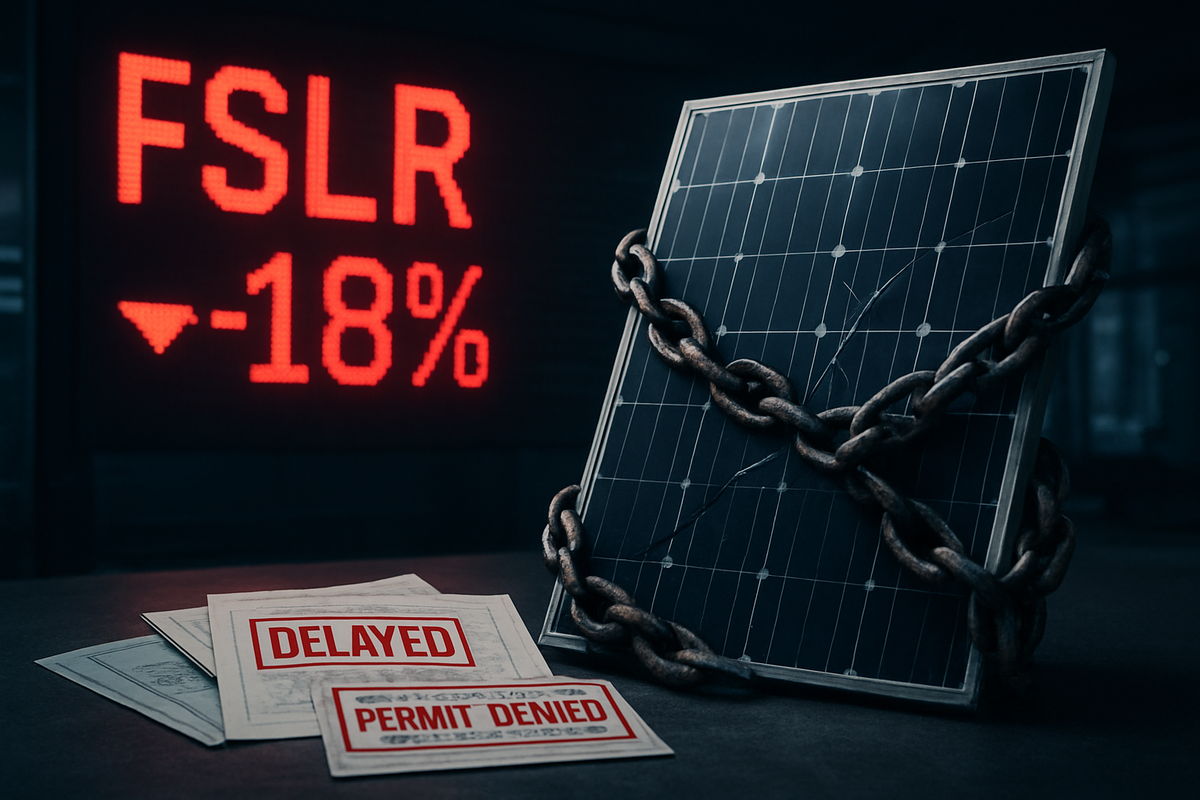
The domestic renewable energy sector was sent into a tailspin this past week as First Solar (NASDAQ: FSLR) issued a surprisingly conservative financial outlook for 2026, triggering a massive 18% sell-off in its shares. The Tempe, Arizona-based manufacturer, long considered the crown jewel of American solar production, stunned investors by forecasting 2026 revenue between $4.9 billion and $5.2 billion—a sharp "guidance cliff" that fell nearly $1 billion short of Wall Street’s consensus estimates of $6.1 billion.
This dramatic reassessment has immediate and chilling implications for the broader market. As the leading beneficiary of domestic manufacturing tax credits, First Solar’s struggles suggest that even the most protected players in the U.S. green energy transition are not immune to the "perfect storm" of regulatory bottlenecks, shifting trade policies, and grid interconnection delays. The crash on February 25, 2026, has effectively wiped out months of gains and forced a fundamental re-evaluation of the solar industry's growth trajectory for the mid-decade.
A "Perfect Storm" of Tariffs and Permitting Delays
The catalyst for the collapse was a fourth-quarter earnings call that quickly turned from a celebration of record 2025 sales into a sobering look at the challenges ahead. While First Solar (NASDAQ: FSLR) achieved a record $5.22 billion in revenue for the full year 2025, management revealed that 2026 would likely see a revenue stagnation or even a slight decline. Chief Executive Officer Mark Widmar detailed a strategic pivot that includes idling Southeast Asian factories in Malaysia and Vietnam to 20% capacity—a move intended to mitigate trade risks but one that will incur nearly $155 million in underutilization costs.
The timeline leading to this moment is defined by rapid-fire policy shifts. In late February 2026, a Supreme Court ruling briefly upended the administration's "reciprocal" tariff strategy. However, the executive branch moved quickly to invoke Section 122 of the 1974 Trade Act, imposing a fresh 15% across-the-board tariff on imported components and specialized solar glass. First Solar estimated these new trade barriers would provide a direct $135 million headwind to its 2026 bottom line. Simultaneously, a persistent freeze on federal permitting for utility-scale projects has caused a "slide right" in the project calendar, effectively pushing the revenue from several massive gigawatt-scale developments from 2026 into 2027.
The market reaction was swift and unforgiving. Beyond the 18% share price drop, major financial institutions including BMO Capital Markets and Baird immediately downgraded the stock, citing a "policy risk premium" that has become too high to ignore. Analysts at Deutsche Bank noted that while First Solar’s technology remains superior, the company is now navigating a "regulatory obstacle course" that makes short-term forecasting nearly impossible.
Sector-Wide Contagion: Winners and Losers
The ripples from First Solar’s guidance miss were felt across the entire clean-tech ecosystem. NextEra Energy (NYSE: NEE), the world’s largest renewable energy developer, saw its stock slide 3.3% as investors worried that First Solar’s permitting woes would translate to slower deployment for NextEra’s massive 2026 project pipeline. The utility giant exacerbated the situation by announcing a $2 billion equity unit offering the same day, signaling a desperate need for capital to manage infrastructure backlogs.
In the residential space, the news was even grimmer. Sunrun (NASDAQ: RUN) and Enphase Energy (NASDAQ: ENPH) both saw significant sell-offs, with Enphase dropping 7.6% in a single session. These companies are already reeling from the December 31, 2025, expiration of the Section 25D residential tax credit. First Solar’s admission of a "demand trough" confirmed fears that the "Solar Coaster" is currently on a steep descent.
However, the event has highlighted potential winners in the infrastructure space. Companies specializing in grid modernization and high-voltage transmission, such as Eaton (NYSE: ETN) and Hubbell (NYSE: HUBB), have remained resilient. As the market realizes that the bottleneck for solar is no longer the cost of panels but the ability to plug them into the grid, capital is beginning to rotate from module manufacturers to the "picks and shovels" of the electrical grid.
The "Solar Coaster" and the AI Power Hungry Era
This event fits into a broader, more complex industry trend: the collision between the "Energy Dominance" goals of the current administration and the surging power demands of Artificial Intelligence. While First Solar (NASDAQ: FSLR) is facing a 2026 revenue dip, the underlying demand for its thin-film modules remains high, particularly from data center operators who are increasingly willing to pay a premium for carbon-free energy. The current friction is largely artificial—driven by the "One Big Beautiful Bill Act" (OBBBA) and its strict Foreign Entity of Concern (FEOC) sourcing rules, which have forced manufacturers to purge their supply chains of non-domestic components.
Historically, this resembles the "solar winter" of the early 2010s, though the stakes are now much higher. In 2026, First Solar is relying on Section 45X tax credits to provide a staggering $2.1 billion to $2.2 billion in Adjusted EBITDA. This makes the company more of a "policy play" than a traditional manufacturing stock. The wider significance lies in the realization that the U.S. solar industry is currently operating on two tracks: a booming long-term demand curve fueled by AI, and a short-term regulatory nightmare fueled by trade protectionism and permitting gridlock.
Navigating the 2026 Reset
Looking ahead, First Solar (NASDAQ: FSLR) and its peers must prepare for a "reset year" in 2026. The company is betting heavily on its next-generation TOPCon patent protection and the completion of new domestic manufacturing hubs in Louisiana and South Carolina. Strategic pivots are already underway; the administration's recent rollback of certain NEPA (National Environmental Policy Act) handbook procedures in early March 2026 suggests a desperate attempt to unblock the 500+ projects currently stalled in the federal pipeline.
In the short term, investors should expect continued volatility as the industry adjusts to the loss of residential tax credits and the new tariff regime. However, the potential for a "coiled spring" recovery in 2027 remains. If the "SPEED Act"—which aims to limit judicial challenges to energy projects to 150 days—is fully implemented by the end of this year, the revenue "slide" that First Solar is currently experiencing could result in a record-breaking 2027 as delayed projects finally break ground.
The Investor’s Watchlist
The First Solar crash is a stark reminder that in the renewable energy sector, policy is often more important than performance. The key takeaways for investors are the fragility of the 2026 growth story and the heavy reliance on federal subsidies like the 45X tax credits. While the 18% drop was painful, it has reset valuations to a level that may attract long-term "value" seekers who are looking past the 2026 trough toward the massive project backlogs of 2027 and 2028.
Moving forward, the market will be hyper-focused on two metrics: the pace of federal permitting "selective acceleration" and the stability of Average Selling Prices (ASPs) in the face of global oversupply. Investors should watch for any signs of a "thaw" in the Interior Department’s project reviews, particularly for major developments like the Esmeralda Energy Center. For now, the solar sector remains a high-stakes arena where the path to a green future is paved with red tape.
This content is intended for informational purposes only and is not financial advice.