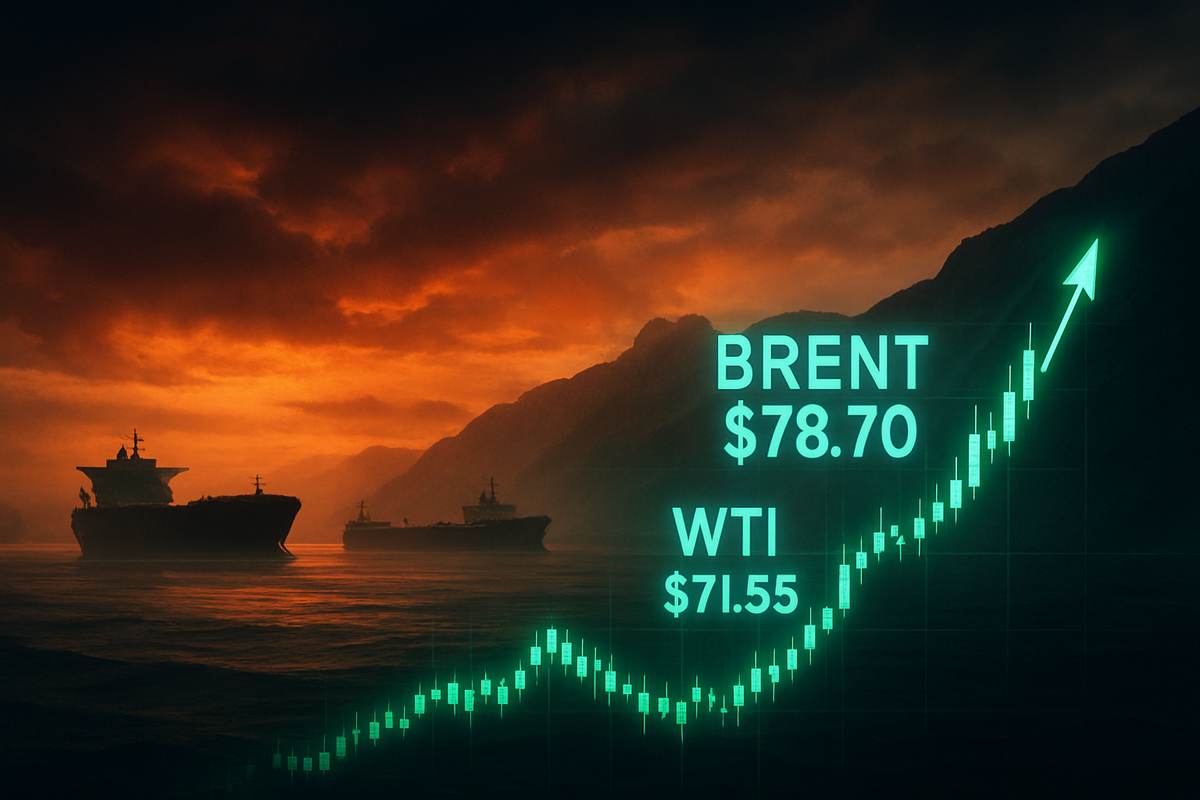
The global energy landscape shifted violently on March 2, 2026, as oil prices staged a massive rally following the outbreak of direct military hostilities between a U.S.-Israeli coalition and Iran. Brent Crude, the international benchmark, surged 8% to settle at $78.70 per barrel, while West Texas Intermediate (WTI) climbed 6.76% to $71.55. The spike comes on the heels of a weekend that saw the most significant escalation in Middle Eastern conflict in decades, effectively ending the "shadow war" era and plunging the region into a state of high-intensity kinetic engagement.
As of Monday morning, the market's primary anxiety centers on the potential for a sustained disruption of the Strait of Hormuz, a narrow waterway through which approximately 20% of the world's daily oil supply—some 20 million barrels—must pass. With several commercial tankers already reporting strikes and major shipping lines suspending transits, analysts are warning that the current price surge may only be the beginning of a broader inflationary shock that could derail global economic recovery efforts.
The Trigger: Operations Epic Fury and Roaring Lion
The immediate catalyst for the market turmoil was a series of coordinated strikes launched on February 28, 2026. The United States, under "Operation Epic Fury," and Israel, under "Operation Roaring Lion," targeted Iran’s nuclear infrastructure, ballistic missile sites, and command-and-control hubs. Most significantly, a "decapitation strike" in Tehran resulted in the death of Iran’s Supreme Leader and several high-ranking members of the Islamic Revolutionary Guard Corps (IRGC). The timeline leading to this explosion of violence began in mid-February, when nuclear negotiations in Geneva collapsed, prompting a massive U.S. naval buildup in the Persian Gulf.
Iran’s retaliation was swift and multi-pronged. By March 1, Tehran had launched hundreds of drones and missiles at Israeli territory and U.S. military installations across Bahrain, Qatar, and the UAE. In the maritime domain, the situation turned critical as Iranian forces targeted commercial vessels. Several tankers, including the Marshall Islands-flagged MKD Vyom and the U.S.-flagged Stena Imperative, were struck by projectiles. By the time markets opened on March 2, shipping activity through the Strait of Hormuz had collapsed by an estimated 80%, leaving over 700 vessels queued or stranded as carriers like Maersk and Hapag-Lloyd ordered a total halt to transits.
Corporate Winners and Losers in the Line of Fire
The shockwaves from the conflict produced a stark divide on Wall Street. Energy majors saw immediate gains as higher crude prices promised fatter margins for upstream operations. ExxonMobil (NYSE: XOM) saw its shares rise 4.7%, while Chevron (NYSE: CVX) climbed 3.9% in early Monday trading. Analysts from Bank of America noted that integrated oil giants are uniquely positioned to capture the "geopolitical risk premium," with price targets for XOM being revised upward to $151 as the conflict intensifies.
Conversely, the transport and logistics sectors are reeling under the weight of surging fuel costs. Airlines were the hardest hit, with United Airlines (NASDAQ: UAL) dropping nearly 8% and Delta Air Lines (NYSE: DAL) falling 7%. With jet fuel accounting for up to 30% of airline operating expenses, even a modest sustained increase in crude prices can erase annual profit projections. Similarly, logistics giants like United Parcel Service (NYSE: UPS) and FedEx (NYSE: FDX) faced selling pressure. While these companies often pass costs to consumers via fuel surcharges, the combined impact of higher energy prices and disrupted trade routes in the Middle East is expected to drive total shipping costs up by 10-18% in the coming weeks.
Inflationary Pressure and the Chokepoint Crisis
The broader economic significance of this event cannot be overstated. The Strait of Hormuz is the world's most important oil chokepoint; a total blockage would be catastrophic, with some analysts predicting oil could reach $150 per barrel if 20 million barrels per day are permanently removed from the market. Even at current levels, the impact on the American consumer is imminent. Before this surge, U.S. gasoline was projected to average $2.90 per gallon in 2026. Experts now warn that the national average could spike to $3.50 per gallon by the start of the summer driving season, acting as a "stealth tax" on household income.
This energy shock has also upended the Federal Reserve's playbook. Only weeks ago, the market was pricing in an 80% chance of an interest rate cut in late March 2026. Following the oil spike and a leap in the ISM Manufacturing Prices Index to 70.5, those odds have plummeted to near zero. Every $10 increase in the price of a barrel of oil is estimated to add 0.2 percentage points to the Consumer Price Index (CPI), creating a stagflationary environment that leaves the Fed with few good options. Comparisons to the 1973 oil embargo and the 2022 invasion of Ukraine are being frequently cited as templates for how supply shocks can trigger long-term structural inflation.
Looking Ahead: The Strategic Pivot to Energy Security
In the short term, the market will be looking for a coordinated response from the U.S. government. A release from the Strategic Petroleum Reserve (SPR) is widely expected, though the reserve currently sits at a historically low level of roughly 410 million barrels. While an SPR release can temporarily suppress prices by $10 to $15 per barrel, it is a finite solution to a deep-seated geopolitical crisis. Investors should also monitor domestic production levels; the U.S. is currently producing a record 13.6 million barrels per day, and further incentives for shale drillers may be on the horizon to insulate the domestic market from Middle Eastern volatility.
The long-term scenario remains highly uncertain. If the conflict evolves into a prolonged regional war, the shift toward alternative energy sources and localized supply chains will likely accelerate. However, for the next several months, the primary concern will be the safety of maritime corridors. The emergence of a permanent military escort system for tankers in the Persian Gulf is a distinct possibility, which would add further "security surcharges" to global trade. Strategic pivots by major corporations will likely focus on hedging fuel costs more aggressively and diversifying supply lines away from the Persian Gulf.
A New Era of Volatility
The events of March 2, 2026, mark a definitive turning point for global markets. The surge in Brent and WTI reflects not just a temporary supply hiccup, but a fundamental reassessment of geopolitical risk in the world's most vital energy corridor. For investors, the takeaway is clear: the era of low-cost energy and predictable inflation has been interrupted by the return of great-power conflict and state-on-state warfare.
Moving forward, the market will be hyper-sensitive to any news regarding the Strait of Hormuz and the potential for Iranian "asymmetric" strikes on Saudi Arabian or UAE infrastructure. The resilience of the U.S. consumer in the face of $3.50 gasoline and the Federal Reserve's willingness to hold rates higher for longer will be the two most critical factors to watch. In this new landscape, energy security is no longer just a policy goal—it is the primary driver of market value.
This content is intended for informational purposes only and is not financial advice.