WASHINGTON D.C. / TEL AVIV — In a dramatic escalation of long-simmering Middle Eastern tensions, a massive joint military operation by the United States and Israel targeted Iranian nuclear, military, and command facilities in the early hours of Saturday, March 2, 2026. The strikes, which reportedly involved hundreds of stealth aircraft and long-range precision missiles, have plunged the region into a state of total war. Most significantly, high-level intelligence sources in both Washington and Jerusalem have confirmed the death of Iran’s Supreme Leader, Ayatollah Ali Khamenei, during a targeted strike on a hardened bunker in the outskirts of Tehran.
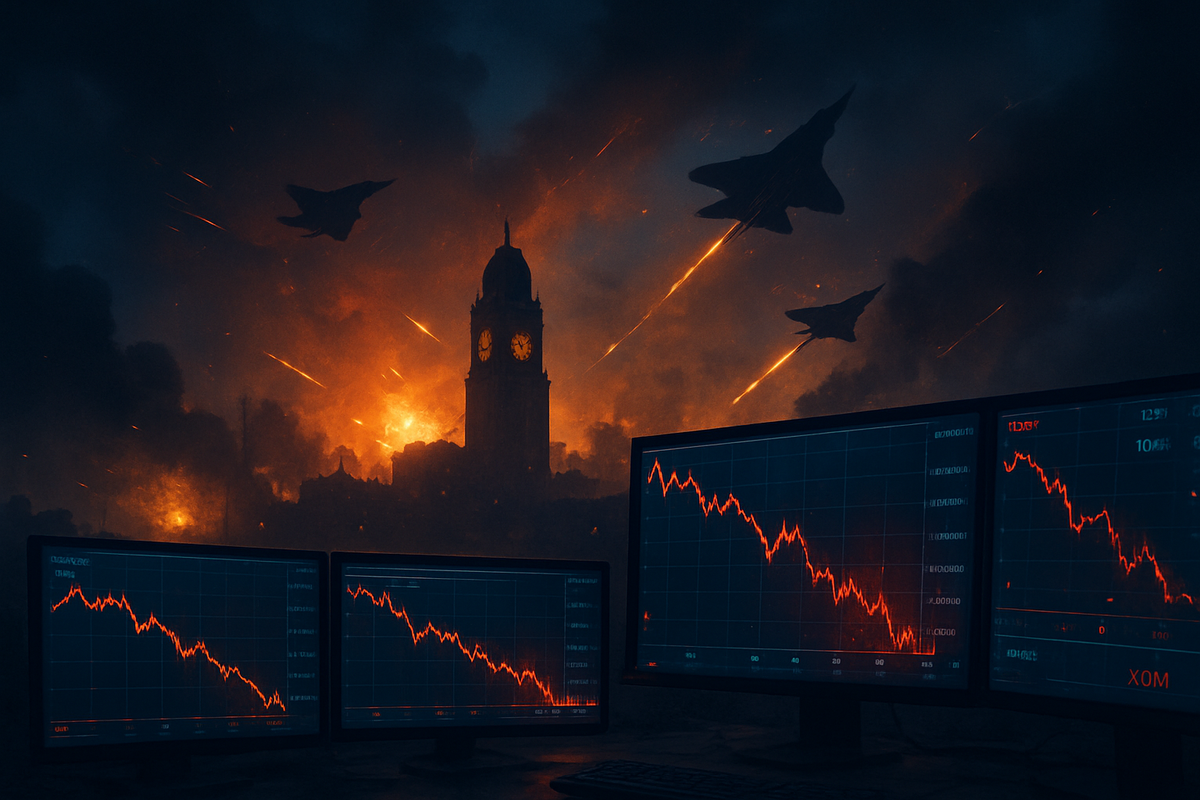
The immediate implications for global financial markets are profound. As news of the strikes and the decapitation of the Iranian leadership broke over the weekend, "risk-off" sentiment surged across global indexes. Cryptocurrency markets, the only major asset class trading 24/7, saw a "flash crash" with Bitcoin and Ethereum dropping over 12% in hours, while safe-haven assets like gold and U.S. Treasury futures spiked. With the S&P 500 (NYSEARCA:SPY) and Nasdaq-100 (NASDAQ: QQQ) expected to open sharply lower on Monday, investors are bracing for a period of extreme geopolitical uncertainty and a potential reconfiguration of the global energy landscape.
The Decisive Blow: Timeline of "Operation Epic Fury"
The strikes on March 2, 2026, represent the culmination of a deteriorating security environment that began in early 2025. Following the collapse of nuclear "backchannel" talks in Oman during the summer of 2025, Iran had reportedly reached a 90% uranium enrichment threshold—the technical requirement for a nuclear weapon. This "red line" prompted a series of smaller skirmishes throughout the fall of 2025, leading to the current, full-scale intervention dubbed "Operation Epic Fury" by U.S. Central Command.
On the ground, the operation began at approximately 3:00 AM Tehran time. Targeted strikes hit the Natanz and Fordow nuclear enrichment sites, while simultaneous "decapitation strikes" focused on the Iranian Revolutionary Guard Corps (IRGC) headquarters and the Supreme Leader’s residence. By sunrise, Iranian state media had gone silent, later returning to broadcast patriotic music and religious chants, eventually confirming "the martyrdom of the Great Leader." In retaliation, Iran’s remaining naval assets have reportedly begun mining the Strait of Hormuz, threatening to halt 20% of the world’s daily oil supply.
Defense and Energy: The New Market Leaders
In the immediate wake of the strikes, the defense and aerospace sectors have become the primary focus for institutional investors. Lockheed Martin (NYSE: LMT) and RTX Corporation (NYSE: RTX) are expected to see significant order backlogs as the U.S. and its allies move to replenish missile stockpiles and Iron Dome interceptors. Similarly, Northrop Grumman (NYSE: NOC), a primary contractor for the stealth bombers utilized in the Saturday raids, saw its shares surge in over-the-counter and international trading. For these companies, the shift from a "peacetime" footing to active regional conflict suggests a multi-year tailwind for earnings.
The energy sector is also undergoing a violent repricing. With the Strait of Hormuz effectively a war zone, Brent Crude prices are testing the $100 per barrel mark, a level not seen consistently since the early 2020s. U.S.-based oil majors like ExxonMobil (NYSE: XOM) and Chevron (NYSE: CVX) are positioned as "safe-haven" energy plays, as their production is largely insulated from Middle Eastern logistics. Conversely, industries sensitive to fuel costs, such as airlines—specifically Delta Air Lines (NYSE: DAL) and United Airlines (NASDAQ: UAL)—are facing a dual threat of soaring overhead and a potential sharp decline in international travel demand.
A Pivot Toward a Global War Economy
The significance of the March 2 strikes goes beyond a simple military engagement; it marks the definitive end of the forty-year "shadow war" between the West and the Islamic Republic. This event fits into a broader trend of deglobalization and the "weaponization of supply chains." As the U.S. and Israel move to dismantle the Iranian regime, the potential for "proxy retaliation" from groups like Hezbollah in Lebanon or the Houthis in Yemen remains high. This creates a secondary layer of risk for global shipping giants like Maersk and Hapag-Lloyd, further straining global trade routes.
Historically, major Middle Eastern conflicts have led to short-term market corrections followed by a "flight to quality." However, the 2026 strike is unique due to the direct involvement of U.S. assets and the confirmed death of a sovereign head of state. This introduces a "regime change" premium that markets have not had to price since the 2003 Iraq War. Policy implications are already emerging: the Federal Reserve may be forced to pause any planned interest rate cuts to combat the inflationary pressure of $100+ oil, even as the broader economy slows due to geopolitical shock.
Strategic Scenarios: What Investors Should Watch
Looking ahead, the primary short-term risk is the "vacuum of power" in Tehran. If the IRGC maintains control and launches a scorched-earth retaliation against Israeli civilian centers or Saudi Arabian oil facilities, the conflict could widen to include other regional powers. A strike on Saudi Aramco's infrastructure could send oil prices toward $150, a scenario that would likely trigger a global recession. Strategic pivots for investors should involve increasing exposure to cybersecurity firms like CrowdStrike (NASDAQ: CRWD) and Palo Alto Networks (NASDAQ: PANW), as Iranian state-sponsored cyberattacks are a highly probable form of retaliation against U.S. financial infrastructure.
In the long term, a successful transition in Iran could eventually open one of the world’s largest untapped markets and stabilize global energy prices. However, that outcome is years away. For now, the market opportunity lies in volatility and defensive positioning. Strategic adaptations will require a move away from high-multiple growth stocks that rely on cheap capital and stable global trade, toward "hard assets" and military-industrial providers.
The Bottom Line for 2026
The events of Saturday, March 2, 2026, have fundamentally altered the geopolitical and financial landscape. The death of Supreme Leader Ali Khamenei and the direct U.S.-Israeli intervention represent a "Black Swan" event that few analysts fully priced into their 2026 outlooks. As the smoke clears over Tehran, the global market is shifting from a focus on inflation and interest rates to the visceral reality of large-scale military conflict and energy security.
Moving forward, investors must remain vigilant. The coming months will likely be defined by "headline risk," where a single drone strike or diplomatic statement could swing the S&P 500 by several percentage points. The key takeaway is clear: the era of geopolitical stability in the Middle East has ended, and the "peace dividend" that buoyed markets for decades is being reinvested into the machinery of war. Watch the price of gold and the 10-year Treasury yield for cues on when the initial panic might subside.
This content is intended for informational purposes only and is not financial advice.