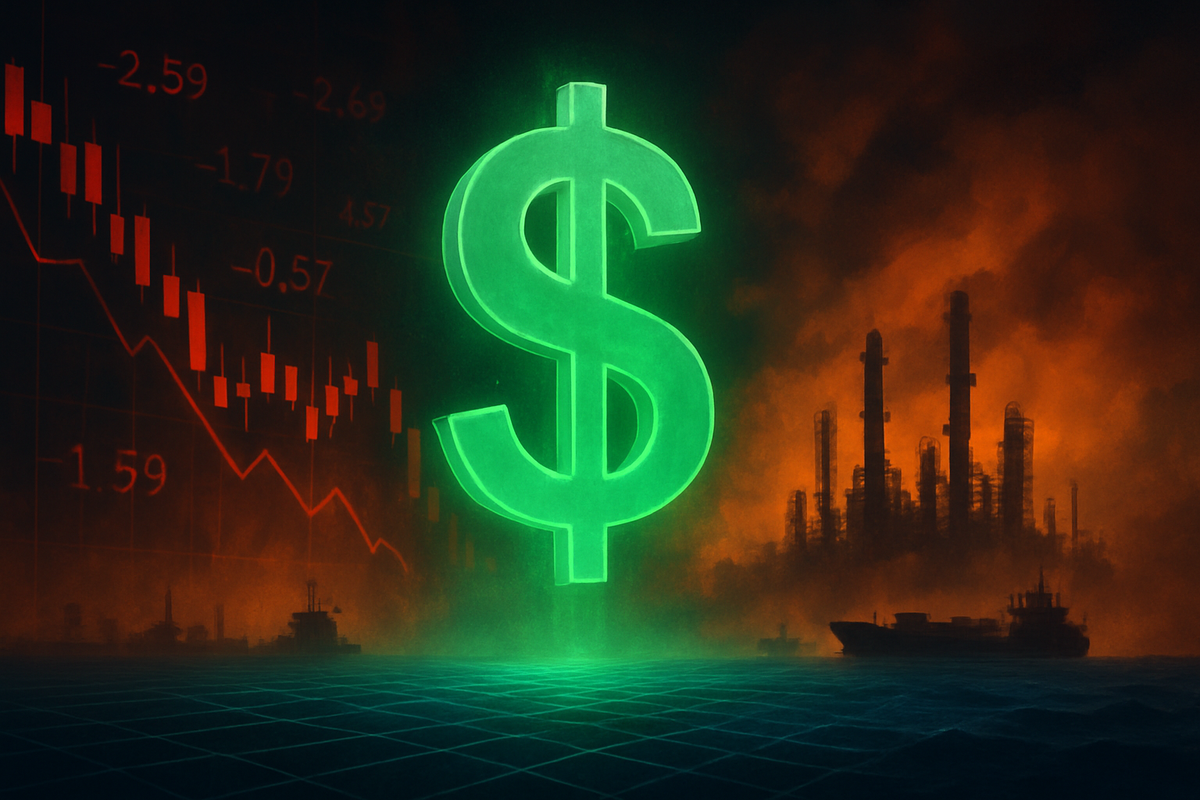
The global financial landscape underwent a seismic shift on March 2, 2026, as the U.S. Dollar Index (DXY) surged by approximately 1%, breaching the critical 98.50 level. This sharp ascent marks a five-week high for the greenback, fueled by a perfect storm of geopolitical instability and renewed inflationary pressures. As investors pivot away from volatile equity markets, the dollar has reasserted its dominance as the world’s premier safe-haven asset, casting a long shadow over international trade and emerging market stability.
The immediate implications of this "flight to safety" are being felt across all asset classes. While the dollar strengthens, foreign currencies and international equities are under intense pressure, with major indices in Asia and Europe recording significant intraday losses. The convergence of a major military escalation in the Middle East and a "hot" manufacturing price report has left market participants scrambling to hedge against a backdrop of potential stagflation and supply chain disruptions.
A Dual Crisis: Operation Epic Fury and the PPI Shock
The primary catalyst for the market's current turmoil is "Operation Epic Fury," a massive military operation that commenced over the weekend of February 28, 2026. Coordinated strikes by U.S. and allied forces targeted critical Iranian infrastructure, reportedly leading to the death of high-ranking leadership and the effective closure of the Strait of Hormuz—a vital artery for global oil shipments. Iran’s swift retaliation via drone strikes on regional energy facilities, including the Ras Tanura refinery in Saudi Arabia, has ignited fears of a prolonged energy crisis that could stifle global growth.
Simultaneously, the economic narrative was upended by the release of the U.S. Producer Price Index (PPI) and the S&P Global Manufacturing PMI. Wholesale prices rose by a staggering 0.8% month-on-month, far exceeding analyst expectations of 0.3%. This "manufacturing price spike" is being attributed to the cumulative friction of recent trade tariffs and rising input costs. The data suggests that despite the Federal Reserve’s long-standing efforts to cool the economy, inflation remains stubbornly embedded in the industrial sector, complicating the path for interest rate cuts in 2026.
The timeline of these events has been breathlessly rapid. Just as markets were adjusting to the "higher-for-longer" interest rate environment, the sudden eruption of kinetic warfare in the Middle East forced a massive liquidation of "risk-on" positions. By the opening bell on Monday, the DXY's 1.2% rise was a clear signal: the era of relative calm in the currency markets has ended, replaced by a defensive posture that prioritizes liquidity above all else.
Market Bifurcation: Defense and Energy vs. Technology and Travel
The current environment has created a stark divide between sector winners and losers. Defense contractors have seen a significant influx of capital as military budgets are expected to expand. Lockheed Martin (NYSE: LMT), Northrop Grumman (NYSE: NOC), and RTX Corporation (NYSE: RTX) all saw their share prices climb between 2% and 3% in early trading. Similarly, the energy sector has been bolstered by the supply shock, with giants like Exxon Mobil (NYSE: XOM), Chevron (NYSE: CVX), and Shell (NYSE: SHEL) rising 3% to 5% as Brent crude oil prices spiked above $82 per barrel.
On the losing end of the spectrum, the stronger dollar and rising fuel costs have battered the airline and logistics industries. Delta Air Lines (NYSE: DAL) saw shares tumble by more than 6%, a trend mirrored by international carriers as jet fuel prices soared in tandem with crude. Multi-national corporations with high foreign currency exposure are also feeling the heat. High-growth tech leaders such as NVIDIA (NASDAQ: NVDA) and Apple (NASDAQ: AAPL) faced selling pressure, dropping 3% to 4% as investors reassessed valuations in light of higher discount rates and potential manufacturing delays.
Furthermore, emerging markets are bearing the brunt of the dollar's strength. The iShares MSCI Emerging Markets ETF (NYSE: EEM) fell 1.5%, while major foreign indices like India’s SENSEX and Hong Kong’s Hang Seng slumped by 2% or more. The "dollar smile" theory is in full effect: when the U.S. economy outperforms or when global risk is high, the dollar wins, often at the expense of developing economies that hold significant dollar-denominated debt.
The Specter of Stagflation and Geopolitical Realignment
This event is more than a temporary market hiccup; it fits into a broader trend of "de-globalization" and the weaponization of trade and energy. Historically, such spikes in the DXY during times of conflict—reminiscent of the 1973 oil crisis or the initial stages of the 2022 invasion of Ukraine—precede periods of structural economic shifts. The current manufacturing price spikes suggest that the "Great Moderation" of low inflation is firmly in the rearview mirror, replaced by a volatile environment where supply-side shocks are the new normal.
The regulatory and policy implications are profound. The Federal Reserve now faces a "no-win" scenario: raise rates further to combat the manufacturing-led inflation and risk a deep recession, or hold steady and allow inflation to erode consumer purchasing power. Meanwhile, the closure of the Strait of Hormuz may force a permanent shift in energy supply chains, accelerating the push for domestic energy independence and renewable transitions, though these pivots will take years to manifest.
Historically, a sustained 1% daily move in the DXY is a rare event that often signals a regime change in the markets. Compared to the mid-2020s period of post-pandemic recovery, 2026 is shaping up to be a year of geopolitical fragmentation. Competitors to the U.S. dollar, such as the Euro or the Yen, have failed to provide an alternative haven, further cementing the "TINA" (There Is No Alternative) narrative for the greenback.
The Road Ahead: Potential Scenarios for 2026
In the short term, volatility is expected to remain the dominant theme. If "Operation Epic Fury" escalates into a multi-front regional war, we could see the DXY approach the 105 level, with gold—currently trading at record highs near $5,400—potentially moving even higher. Strategic pivots for corporations will likely involve aggressive hedging of currency and energy risks, as well as a continued move toward "friend-shoring" manufacturing to avoid the geopolitical hotspots currently roiling the markets.
The long-term outlook depends heavily on the duration of the energy supply disruption. If the Strait of Hormuz remains blocked for an extended period, the global economy may face a synchronized downturn. Conversely, a swift resolution could lead to a relief rally in equities, though the underlying "hot" PPI data suggests that the inflation problem will not be easily solved. Investors should be prepared for a period where traditional 60/40 portfolios struggle, as both stocks and bonds may correlate negatively in a high-inflation, high-geopolitical risk environment.
Summary and Investor Outlook
The 1% rise in the U.S. dollar on March 2, 2026, serves as a stark reminder of the greenback's role as the world's ultimate insurance policy. Triggered by the onset of "Operation Epic Fury" and exacerbated by alarming manufacturing price data, the move has punished multi-nationals and emerging markets while rewarding defense and energy sectors. The primary takeaway for investors is that the "risk-free rate" is no longer the only variable; geopolitical risk has returned as a primary driver of asset pricing.
Moving forward, the market will be hyper-sensitive to any headlines regarding Middle Eastern de-escalation or Federal Reserve rhetoric. For the coming months, watch for the "pass-through" effect of manufacturing prices into consumer CPI; if firms successfully pass these costs to the public, the dollar's strength may become a semi-permanent fixture of the 2026 economic landscape. Security, both national and financial, is now the market's most valuable commodity.
This content is intended for informational purposes only and is not financial advice