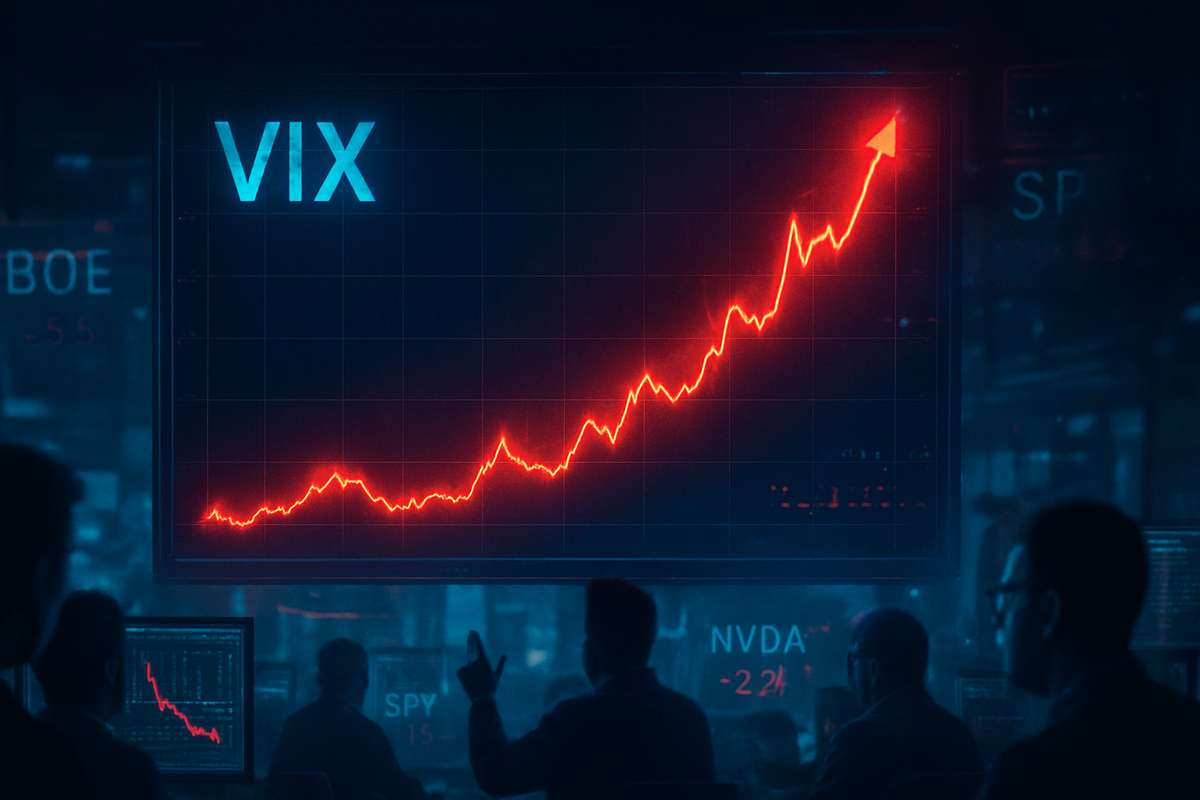
The "Fear Gauge" has officially woken up. On Monday, March 2, 2026, the Cboe Volatility Index (VIX) staged a dramatic 12% rally, piercing the psychologically significant 20-level to close at 22.40. This sudden spike signals a sharp departure from the relative complacency that defined the start of the year, as traders pivot from a "Goldilocks" growth narrative to a defensive "risk-off" posture. The move reflects growing anxiety over a congested economic calendar and escalating geopolitical friction, effectively ending a period of suppressed market swings.
The immediate implications of this jump are felt across the equity landscape. With the VIX now firmly in the "Caution Zone," the inverse correlation with major indices has tightened. The surge suggests that the cost of protection against market downturns is rising rapidly, as institutional investors scramble to buy "put" options to hedge their portfolios. For the average investor, this volatility level serves as a flashing yellow light, indicating that the path for the S&P 500 and the Nasdaq-100 is likely to be characterized by wider intraday swings and increased price sensitivity to any incoming headlines.
The Catalyst of Uncertainty: A Perfect Storm in Early March
The 12% spike in the VIX did not occur in a vacuum; it was the culmination of a weekend of shifting narratives and an anxious start to the trading month. The primary trigger for the Monday surge appears to be a combination of outcomes from the OPEC+ meeting held on March 1 and a renewed sense of "data dread" ahead of this Friday’s employment report. OPEC+ members signaled a potential for modest production increases starting in April, which initially sent crude oil prices into a tailspin before they rebounded on fears of supply chain disruptions in the Middle East. This energy volatility, coupled with a "Trump 2.0" administration's more aggressive rhetoric regarding upcoming trade summits, left investors feeling exposed.
Leading up to this moment, the market had been drifting on low volume, seemingly ignoring the "sticky" inflation trends observed in February. However, as the calendar turned to March 2, the realization set in that the Federal Open Market Committee (FOMC) meeting on March 17–18 would be a high-stakes event. Traders are now pricing in a higher probability that the Federal Reserve may hold rates steady rather than providing the cuts many had hoped for. This shift in sentiment was palpable on the trading floor as Cboe Global Markets (BATS:CBOE) saw a massive influx of VIX call option buying within the first hour of the New York open.
Industry reaction was swift. Analysts from major brokerage houses noted that the 22.40 level is a critical "pivot point" for the VIX. Historically, when the index sustains a move above 22, it often precedes a broader market correction of 3% to 5%. Market makers were seen widening their spreads in early trading, a classic defensive move during periods of rapid volatility expansion. The swiftness of the 12% move caught many short-volatility strategies off-guard, forcing a wave of covering that further fueled the VIX's ascent.
The Winners and Losers of the Volatility Spike
In a regime of rising fear, the leaderboard of the stock market undergoes a radical transformation. One of the most direct beneficiaries of this environment is Cboe Global Markets (BATS:CBOE), the exchange operator that owns the VIX. As trading volume in volatility-linked products and S&P 500 options skyrockets, Cboe’s transaction revenue typically sees a significant boost. Similarly, high-frequency trading firms like Virtu Financial (NASDAQ: VIRT) tend to thrive in these conditions, as increased market turbulence provides more opportunities for their automated market-making strategies to capture wider bid-ask spreads.
Conversely, high-growth technology giants, which have led the market’s recent rally, are feeling the heat. NVIDIA Corp (NASDAQ: NVDA), which is preparing for its major GTC AI conference later this month, saw its shares trade with increased variance as investors trimmed "high-beta" exposure. While AI remains a long-term thematic favorite, the rising VIX makes the cost of holding such volatile assets more expensive from a risk-management perspective. Other "Magnificent" peers like Apple Inc (NASDAQ: AAPL) also faced pressure, acting as a drag on the broader SPDR S&P 500 ETF Trust (NYSE: SPY).
For traders looking to capitalize directly on the chaos, leveraged volatility products saw massive inflows. The ProShares Ultra VIX Short-Term Futures ETF (NYSE: UVXY) jumped significantly on the day, tracking the spike in the VIX futures curve. However, for the Invesco QQQ Trust (NASDAQ: QQQ), which tracks the tech-heavy Nasdaq-100, the move to a VIX of 22.40 represents a significant headwind. As the "discount rate" for future earnings is re-evaluated against a backdrop of higher uncertainty, these growth-heavy vehicles are often the first to be sold in favor of safe-haven assets like gold or short-term Treasuries.
Wider Significance: Breaking the Cycle of Complacency
The VIX’s jump to 22.40 is more than just a daily statistic; it represents a fundamental shift in market "regime." Since the beginning of 2026, volatility has been suppressed, leading many to believe that the "Goldilocks" economy was untouchable. This move breaks that cycle of complacency, aligning the market more closely with the historical average of roughly 19.4. By piercing the 22 level, the market is signaling that the era of "easy gains" may be transitioning into a more "tactical" environment where stock picking and hedging are paramount.
This event fits into a broader trend of "system-level transformation" in the U.S. markets. With the 2026 midterm elections on the horizon and trade policies with China reaching a critical juncture, the VIX is beginning to price in a "geopolitical risk premium" that has been largely absent for the past six months. This has a ripple effect on competitors and partners globally, as a volatile U.S. market often leads to increased capital flight from emerging markets, further tightening global financial conditions.
Historically, 12% jumps in the VIX are often the "first tremor" before a larger event. Comparisons are already being drawn to the volatility regimes of 2018 and 2022, where early spikes served as precursors to more sustained downtrends. Regulatory implications may also emerge if the volatility persists; the SEC and other governing bodies often keep a closer eye on "gamma squeezes" and the impact of zero-day-to-expiration (0DTE) options during these high-stress periods, as these instruments can exacerbate the very moves that the VIX is designed to measure.
What Comes Next: A Gauntlet of Risk
The short-term outlook is dominated by a "Triple Threat" of economic data. Investors will be laser-focused on the March 6 Jobs Report, followed by the CPI and PCE inflation prints in the following week. If these data points suggest that the economy is overheating or that inflation is remaining stubbornly high, the VIX could easily challenge the "High Stress" threshold of 30.00. Conversely, a "cool" set of data could see the index mean-revert back toward the 18–19 range, though the 22.40 level will likely now act as a stiff ceiling for any future rallies.
Strategic pivots are already underway. Wealth managers are reportedly shifting client allocations toward "defensive value" sectors—such as utilities and healthcare—which tend to have lower correlations with the VIX. There is also an emerging opportunity in the fixed-income market, as the spike in equity volatility often leads to a "flight to quality," potentially driving down yields on the 10-year Treasury note if the fear persists. Traders will be watching the "VIX of the VIX" (VVIX) to see if the volatility of volatility itself is increasing, which would signal that the current spike is not just a one-off event.
Navigating the New Volatility Regime
The VIX’s climb to 22.40 marks the return of fear to a market that had perhaps grown too comfortable with its own success. The 12% jump serves as a stark reminder that market dynamics can shift in a heartbeat, particularly when a dense economic calendar meets a fragile geopolitical landscape. For investors, the key takeaway is the necessity of active risk management. The "buy the dip" mentality that worked so well in a low-volatility environment may need to be tempered with more sophisticated hedging strategies as we move further into March.
Moving forward, the market’s ability to digest this 22.40 level will be the ultimate test of its resilience. If the S&P 500 can hold its key technical support levels despite the rising VIX, it would suggest that the underlying "AI-driven" bull market remains intact. However, a sustained break above 25.00 on the VIX would likely indicate that a more prolonged period of market turbulence is at hand. Investors should keep a close watch on Cboe’s daily volumes and the Fed’s rhetoric in the coming weeks, as these will be the primary drivers of whether fear remains a guest or becomes a permanent resident on Wall Street.
This content is intended for informational purposes only and is not financial advice