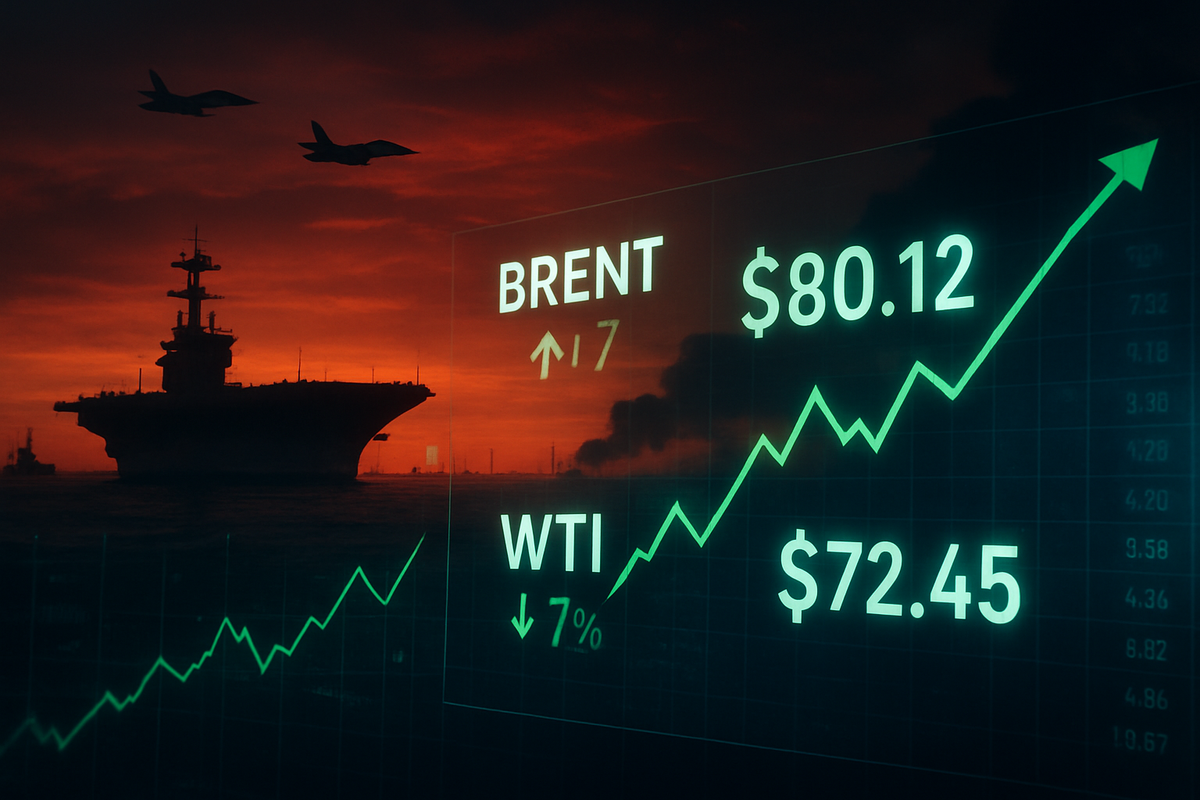
HOUSTON/LONDON – Global energy markets were thrown into a state of frantic volatility on Monday, March 2, 2026, as oil prices staged one of their most dramatic single-day rallies in recent years. West Texas Intermediate (WTI) futures surged over 7%, racing toward the $72 mark, while the international benchmark Brent crude breached the psychologically significant $80 barrier for the first time in months. The catalyst for the explosion in prices was a series of pre-dawn military strikes conducted by the United States and Israel against strategic targets within Iran, an escalation that analysts fear could lead to a broader regional war and a prolonged disruption of global energy supplies.
The sudden spike has effectively erased the bearish sentiment that dominated the early months of 2026. Prior to this weekend’s military action, the market had been focused on a potential supply glut as production from non-OPEC nations reached record highs. However, the introduction of a massive "geopolitical risk premium" has now taken center stage. According to data from Trading Economics, the intraday move represents the highest percentage gain since the initial weeks of the 2022 conflict in Ukraine, signaling that traders are bracing for a period of extreme uncertainty in the Persian Gulf.
Operation Epic Fury: A Weekend of Escalation
The military campaign, reportedly dubbed "Operation Epic Fury," commenced late Saturday evening and continued through Sunday. Joint U.S. and Israeli forces targeted Iranian drone manufacturing facilities, ballistic missile sites, and leadership hubs in response to what officials described as "imminent threats" to regional stability. The strikes follow months of deteriorating diplomatic relations and a breakdown in nuclear negotiations that had been teetering since late 2025. By Monday morning, Iranian officials had issued a chilling warning via the state-run media, threatening to close the Strait of Hormuz—the world’s most critical maritime oil chokepoint.
The timeline leading to this morning's market chaos began in mid-February, when intelligence reports indicated a surge in Iranian proxy activity across the Levant. According to the Energy Information Administration (EIA), Iran had reached a production peak of 3.5 million barrels per day (bpd) by early 2026, making it a critical, albeit sanctioned, player in global supply. The removal of this volume, coupled with the threat to the 15 million bpd that flows through the Strait of Hormuz, has left market participants scrambling for cover. Initial reactions from the floor of the New York Mercantile Exchange (NYMEX) described the atmosphere as "pure panic," as stop-loss orders were triggered and hedge funds rushed to pivot their positions from short to long.
Energy Giants Surge as Transport Stocks Retreat
In the equity markets, the reaction was swift and bifurcated. Major integrated oil companies, which have spent the last two years strengthening their balance sheets and refocusing on hydrocarbon production, saw their valuations soar. ExxonMobil (NYSE: XOM) and Chevron (NYSE: CVX) both saw gains exceeding 5% in early trading, as investors bet on higher margins for their non-Middle Eastern production assets. Similarly, BP (NYSE: BP) and Shell (NYSE: SHEL) experienced significant rallies on the London Stock Exchange, with analysts noting that these firms' recent pivots back to core oil and gas investments in 2025 have positioned them to capitalize on the current price environment.
Conversely, the transport and consumer sectors are reeling from the prospect of sustained high energy costs. Airlines, in particular, are facing a double-edged sword of rising fuel expenses and potential flight cancellations in the Middle East region. Shares of Delta Air Lines (NYSE: DAL) and United Airlines (NASDAQ: UAL) both dropped more than 4% pre-market, as the cost of jet fuel futures tracked the spike in crude. Logistics giants like FedEx (NYSE: FDX) also saw selling pressure, as the prospect of an "energy tax" on the global economy threatens to dampen consumer demand and increase the cost of doing business.
A Fundamental Shift in the Energy Landscape
This event represents a jarring reversal of the "energy transition" narrative that many expected would define 2026. Instead, the world is once again reminded of the fragile nature of energy security. The EIA had recently projected that Brent would average near $60 for the year, a forecast that now appears obsolete. This conflict fits into a broader trend of "energy regionalism," where western powers are forced to rely more heavily on domestic production and "friend-shoring" from stable partners like Guyana and Brazil.
The ripple effects are expected to reach far beyond the gas pump. A sustained price surge toward $90 or $100—a scenario now being modeled by major investment banks—could reignite inflationary pressures that central banks thought they had finally tamed. Historically, such spikes have led to aggressive interest rate hikes or, in the case of the 1970s oil shocks, periods of prolonged stagflation. Furthermore, regulatory bodies in the EU and the US may be forced to pause certain environmental mandates to prioritize immediate supply availability, a policy shift that would have been unthinkable just a month ago.
What Lies Ahead: De-escalation or Total Blockade?
The short-term outlook depends entirely on Iran's next move. If the Islamic Republic follows through on its threat to mine or block the Strait of Hormuz, analysts at Goldman Sachs warn that Brent could soar toward $140 per barrel within weeks. Such a move would likely trigger a massive military response from the U.S. Navy to keep the shipping lanes open, potentially turning a targeted strike into a full-scale regional war. Markets are currently pricing in a "limited conflict," but the risk of a "tail event" is higher than it has been in decades.
Investors should watch for the release of the next EIA Short-Term Energy Outlook, which will likely provide a revised framework for global supply-demand balances in light of the strikes. Strategic Petroleum Reserve (SPR) releases from the U.S. and its IEA partners are almost certain to be announced in the coming days to provide a temporary ceiling for prices. However, these are finite resources that cannot offset a total loss of Persian Gulf crude over the long term.
Final Assessment: A New Era of Risk
The events of March 2, 2026, serve as a stark reminder that the "geopolitical risk premium" is never truly gone, only dormant. The surge in oil prices is not merely a financial fluctuation; it is a signal of a deepening rift in the global order. For the market, the coming months will be defined by extreme volatility and a flight to safety.
Investors must remain vigilant, monitoring not just the price tickers, but the diplomatic cables and military movements in the Persian Gulf. While the energy sector may offer short-term gains, the broader economic implications of $80+ Brent could be profound, affecting everything from manufacturing costs to central bank policy. The "well-supplied" market of 2025 has vanished overnight, replaced by a landscape where energy security is once again the ultimate currency.
This content is intended for informational purposes only and is not financial advice.