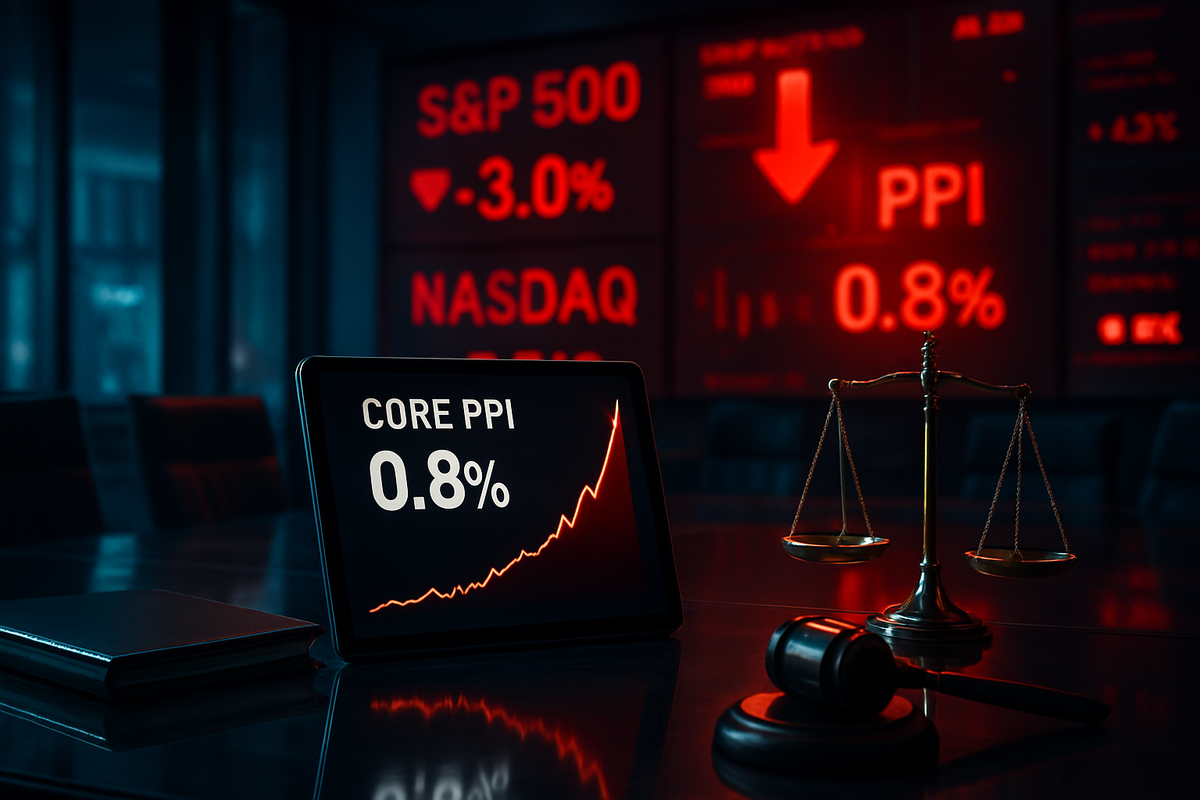
The release of the January 2026 Producer Price Index (PPI) has sent a clear and chilling signal through the financial markets: the fight against inflation is far from over. With a headline monthly increase of 0.5%, significantly higher than the 0.3% anticipated by economists, the report has reignited fears of "sticky" inflation that could plague the economy throughout the first half of the year. Even more alarming was the surge in core PPI—which excludes the volatile food and energy sectors—leaping by 0.8% in a single month, a figure that suggests underlying price pressures are becoming deeply entrenched in the service-oriented sectors of the U.S. economy.
This data has fundamentally altered the calculus for the Federal Reserve as it convenes for its mid-March policy meeting today, March 17, 2026. Prior to these numbers, many investors were pricing in a potential rate cut as early as this week. However, the persistence of services inflation, particularly in trade and professional equipment wholesaling, has effectively frozen the central bank in a "hawkish-neutral" stance. As policymakers gather in Washington, the prevailing sentiment on Wall Street has shifted from "when will they cut?" to a much more anxious "will they have to hike again?"
The Wholesale Breakdown: A Surge Led by Services
The January PPI report, released by the Bureau of Labor Statistics in late February, offered a stark contrast between a cooling goods sector and a white-hot services market. While overall goods prices actually dipped by 0.3%—aided by a 5.5% plunge in gasoline prices—the services sector told a different story. Final demand services rose by 0.8% in January, driven largely by a massive 2.5% jump in trade services margins. This specific metric measures the difference between the price a wholesaler or retailer pays for a product and the price they sell it for, indicating that businesses are aggressively raising prices to protect their bottom lines.
The timeline of this inflationary spike can be traced back to late 2025, when a confluence of geopolitical tensions in the Middle East and new trade tariffs on industrial metals began to filter through the supply chain. By the time January’s data was finalized, the impact was undeniable. A standout 14.4% spike was recorded in margins for professional and commercial equipment wholesaling, suggesting that the "higher-for-longer" input costs of 2025 are now being passed directly to business customers and, ultimately, consumers. This "second-round effect" is exactly what the Federal Reserve feared most: a self-reinforcing cycle where companies hike prices to maintain margins, regardless of falling raw material costs like energy.
Initial market reaction was swift and unforgiving. On the day the data was made public, the S&P 500 plummeted over 2.4%, marking one of the steepest single-day declines in the last six months. The tech-heavy Nasdaq Composite suffered even more, ending the month of February down 3.38%. Bond markets also reacted violently; although the 10-year Treasury yield initially spiked, it later settled near 3.95% as a "flight-to-quality" took hold among investors worried that the hot inflation data, combined with sluggish growth, was a precursor to a stagflationary environment.
Winners and Losers in a High-Margin World
The PPI surge has created a clear divide between companies that possess the "pricing power" to navigate inflation and those vulnerable to rising interest rates or input costs. Among the notable losers were high-growth technology giants like NVIDIA (NASDAQ: NVDA) and Broadcom (NASDAQ: AVGO). As wholesale inflation signals that interest rates will remain elevated, the discount rates used to value future earnings for these companies rise, naturally compressing their stock valuations. Both companies saw significant sell-offs following the report, despite their leadership in the artificial intelligence space.
Conversely, the retail sector has produced several surprising "winners." Companies that have mastered supply chain efficiency and membership-based models have actually seen their margins expand. Costco Wholesale (NASDAQ: COST) reported a gross margin expansion in its most recent quarterly filing, driven by a 14% increase in membership fees and the success of its private-label brands. Similarly, Lowe’s Companies (NYSE: LOW) and The Gap, Inc. (NYSE: GAP) have managed to improve operational resilience through productivity initiatives and tighter inventory management, allowing them to capture some of that 2.5% trade margin growth seen in the PPI data.
In the energy and utility sectors, Constellation Energy (NASDAQ: CEG) has emerged as a defensive powerhouse. Gaining nearly 12% in the weeks following the PPI release, the company has benefited from its role as a stable provider in a market where wholesale electricity costs are rising. Meanwhile, specialty retailers like Ulta Beauty (NASDAQ: ULTA) have successfully avoided aggressive discounting, maintaining a gross profit margin of 39.1% by focusing on exclusive product launches and brand loyalty—strategies that insulate them from the broader wholesale price volatility.
A "Stagflationary Bind" for the Global Economy
The significance of the January PPI report goes beyond just a single data point; it highlights a broader industry trend where the "disinflation" narrative of 2025 has stalled. The Federal Reserve is now facing what some analysts call a "stagflationary bind." While labor markets have shown signs of cooling and manufacturing is slowing, the price of services remains stubbornly high. This mirrors historical precedents from the late 1970s, where multiple "waves" of inflation forced central banks to keep rates high even as the economy softened, leading to prolonged periods of low growth.
This event has ripple effects far beyond U.S. borders. As the Fed stays hawkish, the U.S. Dollar remains strong, putting immense pressure on emerging markets that hold dollar-denominated debt. Domestically, the regulatory and policy implications are significant. The persistent rise in construction-related PPI—specifically copper wire, which is up nearly 30% year-over-year—is complicating federal infrastructure projects and housing affordability initiatives. If the Fed cannot lower rates because of this wholesale pressure, the cost of financing these massive public and private projects will continue to escalate, potentially leading to a "policy-induced" slowdown in the second half of 2026.
Looking Ahead: The Fed’s Final Stand
In the short term, all eyes are on the Federal Open Market Committee (FOMC) meeting concluding tomorrow, March 18, 2026. Market expectations for a rate hold are now at a staggering 98%. The real focus for investors will be the "Summary of Economic Projections" and the "dot plot," which will reveal whether Fed officials still believe any rate cuts are possible in 2026. If the Fed removes its projection of a 2026 cut, we could see another round of volatility in the equity markets as investors adjust to a truly "higher-forever" interest rate paradigm.
Strategically, companies will need to pivot from a growth-at-all-costs mindset to one of extreme operational efficiency. We are likely to see an increase in AI-driven automation as firms attempt to offset rising service labor and wholesale costs. For investors, the opportunity lies in "margin-defenders"—companies with low debt-to-equity ratios and the ability to pass costs to consumers without losing market share. Conversely, heavily leveraged firms in the construction and industrial sectors may face a "liquidity crunch" if the Fed is forced to keep rates at 3.50%–3.75% through the end of the year.
Summary for the Cautious Investor
The January 2026 PPI report has served as a wake-up call for a market that may have become too optimistic about the end of the inflation cycle. The 0.5% headline jump and the 0.8% core surge have effectively derailed the timeline for Federal Reserve rate cuts, forcing a re-evaluation of asset prices across the board. The key takeaway for the coming months is that the "services side" of the economy is now the primary driver of inflation, and until trade margins and professional service costs stabilize, the Fed will likely remain sidelined.
As we move forward, investors should watch for the February and March PPI prints to see if the January surge was a "one-off" or the start of a new upward trend. Furthermore, the performance of the retail sector will be a critical barometer for consumer health; if retailers like Walmart (NYSE: WMT) or Target (NYSE: TGT) begin to see margin compression, it may signal that the consumer's ability to absorb these higher wholesale prices has finally reached its limit. For now, the watchword remains "caution," as the market navigates a landscape where the path to lower rates has become increasingly narrow and fraught with risk.
This content is intended for informational purposes only and is not financial advice.