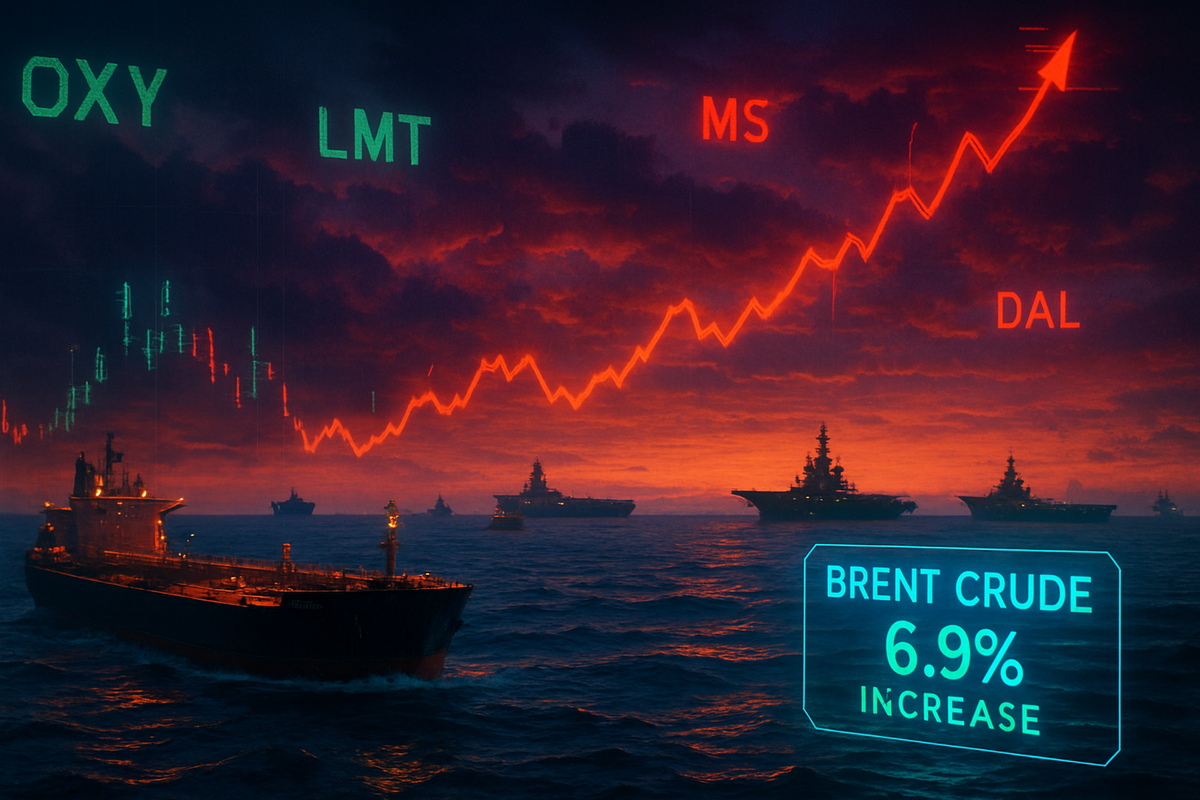
The global financial landscape has been thrust into a state of high-intensity volatility as the conflict between the United States and Iran escalates into a full-scale regional confrontation. As of March 17, 2026, the CBOE Volatility Index, better known as the VIX, has skyrocketed by over 70% year-to-date, reflecting a market gripped by uncertainty and the specter of a prolonged military engagement. This "fear gauge" peaked near the 30-point threshold this week, signaling that institutional investors are aggressively hedging against further downside risks.
The primary catalyst for this turmoil is the effective closure of the Strait of Hormuz, a critical maritime artery through which approximately 20% of the world’s daily oil supply flows. With Iranian forces declaring the waterway closed to "enemy" vessels, Brent crude oil prices experienced a dramatic 6.9% single-day surge on March 12, reaching $98.30 per barrel. Despite international efforts to stabilize prices through strategic reserve releases, the market remains on edge, fearing that a total blockade could drive prices well into triple digits and ignite a global inflationary spiral.
A Timeline of Escalation and Maritime Blockade
The current crisis traces its origins to late February 2026, when a series of coordinated military operations by the United States and its allies targeted Iranian nuclear facilities and command centers. The situation reached a boiling point following the assassination of senior Iranian leadership, which prompted the Islamic Revolutionary Guard Corps (IRGC) to launch retaliatory missile and drone swarms against Western assets in the region. By early March, the conflict had transitioned from localized skirmishes to a systemic threat to global trade, with Iran formally announcing the closure of the Strait of Hormuz.
Market reactions were instantaneous. On March 11, the VIX crossed the psychologically significant 25-point mark as reports surfaced of a sustained collapse in commercial maritime traffic. Currently, shipping through the Strait is estimated to be 97% below normal levels, forcing bulk carriers to attempt hazardous rerouting or seek permission-based transit under selective Iranian oversight. A recent projectile strike on a tanker near Fujairah has only served to underscore the extreme risks facing any vessel attempting to navigate the Gulf of Oman, further tightening the "war premium" embedded in energy prices.
By mid-March 2026, the rhetoric from Washington remained defiant. President Donald Trump, in a statement released via Truth Social, characterized the ongoing operations as a "Military Success," suggesting that the U.S. was prepared to maintain its posture even without the direct assistance of traditional NATO allies. This unilateral stance has added a layer of geopolitical unpredictability, as regional partners like Japan and South Korea weigh the implications of a destabilized Middle East on their own energy security.
Winners and Losers: Sector Rotation in a War Economy
The conflict has forced a sharp rotation within the equity markets, creating a stark divide between sectors benefiting from the crisis and those bearing the brunt of rising costs. Energy giants have been the primary beneficiaries of the "oil shock." Companies like Occidental Petroleum (NYSE: OXY) and ConocoPhillips (NYSE: COP) have seen their shares climb between 1.4% and 3.3% as the disruption in global supply bolsters their domestic production value. Investors are betting that a sustained period of high crude prices will significantly pad the bottom lines of U.S.-based explorers who are shielded from the direct chaos of the Persian Gulf.
Defense contractors initially led the market rally as the scale of the conflict became clear. Shares of Lockheed Martin (NYSE: LMT), Northrop Grumman (NYSE: NOC), and RTX Corporation (NYSE: RTX) surged between 3% and 6% in late February. However, as the conflict has entered its third week, some of these gains have moderated. Investors are now weighing the massive costs of depleting missile defense stockpiles against the potential for long-term government contracts, leading to increased volatility within the defense sub-sector.
Conversely, the banking and airline industries are facing significant headwinds. Large financial institutions like Morgan Stanley (NYSE: MS) and JPMorgan Chase & Co. (NYSE: JPM) have seen their stock prices pressured by "private credit jitters." Morgan Stanley recently fell over 4% after limiting redemptions in certain private credit funds, a move that echoed across the sector as Blackstone (NYSE: BX) and BlackRock (NYSE: BLK) also faced heavy withdrawal requests from nervous investors. Meanwhile, the airline industry is in a state of "catastrophic disruption." Delta Air Lines (NYSE: DAL), United Airlines (NASDAQ: UAL), and American Airlines (NASDAQ: AAL) have all seen shares drop between 3% and 6% as over 23,000 flights to the Middle East were canceled, resulting in nearly $1 billion in lost revenue and skyrocketing fuel expenses.
Broader Significance and Historical Precedents
The current US-Iran conflict is more than a localized geopolitical event; it represents a major structural shift in global market dynamics. The 70% spike in the VIX mirrors previous periods of extreme stress, such as the early days of the 2020 pandemic or the 2008 financial crisis, but with the added complication of a direct energy supply shock. This "new and severe layer of cost pressure" is threatening to derail the global disinflationary trend that had been the hallmark of 2025, with analysts now warning that the blockade could add 0.8% to global inflation figures by the end of 2026.
Historically, energy shocks triggered by conflicts in the Middle East—such as the 1973 oil embargo—have led to prolonged periods of stagflation. While the U.S. is more energy-independent today than it was in the 1970s, the interconnected nature of global finance means that a collapse in European or Asian manufacturing due to high energy costs will inevitably ripple back to American shores. The rotation into defense and energy is a classic "risk-off" maneuver, but the depth of the sell-off in banks suggests a deeper concern about systemic liquidity and the health of the private credit markets.
Furthermore, the unilateral nature of the U.S. military strategy in 2026 marks a departure from the coalition-based approaches of the early 21st century. This shift has significant policy implications, as it may accelerate the fragmentation of global trade and push nations like China and India to seek alternative energy alliances, further complicating the long-term outlook for U.S. diplomatic and economic influence in the region.
The Road Ahead: Potential Scenarios and Strategic Pivots
In the short term, the market's trajectory will be dictated by the duration of the Strait of Hormuz blockade. If diplomatic backchannels can secure a limited reopening of the waterway, we could see a rapid "relief rally" where the VIX retraces its gains and airlines recover some lost ground. However, if the IRGC continues to enforce a total blockade, the world may be looking at $120+ oil, which would likely push the U.S. and Europe into a tactical recession. Investors should prepare for continued volatility and may need to pivot toward high-yield defensive assets or commodities if the conflict enters a stalemate phase.
Longer-term, this event is likely to accelerate the global transition toward renewable energy and domestic nuclear power as Western nations seek to permanently decouple their economies from Middle Eastern volatility. For the defense sector, the shift will likely be toward "attrition warfare" technologies, such as low-cost drones and high-capacity missile defense systems, as the conflict highlights the rapid depletion rates of traditional high-cost munitions. Strategic adaptations will be required for global logistics and travel companies, which must now factor in a "permanent risk premium" for routes traversing the Middle East.
Summary and Investor Outlook
The US-Iran conflict of 2026 has fundamentally altered the risk landscape for the foreseeable future. With the VIX up 70% and oil prices surging, the "war premium" is now the dominant narrative in the market. The rotation into energy and defense stocks highlights a defensive posture among investors, while the struggles of the banking and airline sectors serve as a reminder of the systemic risks inherent in global instability.
Moving forward, the market will remain hyper-sensitive to any developments in the Persian Gulf. Investors should closely watch the "private credit" space for signs of further liquidity crunches, as well as the monthly inflation prints which will reflect the true cost of the oil spike. While the immediate focus is on the military outcome, the lasting impact will likely be felt in the restructuring of global energy supply chains and a renewed focus on national security as an economic priority.
This content is intended for informational purposes only and is not financial advice