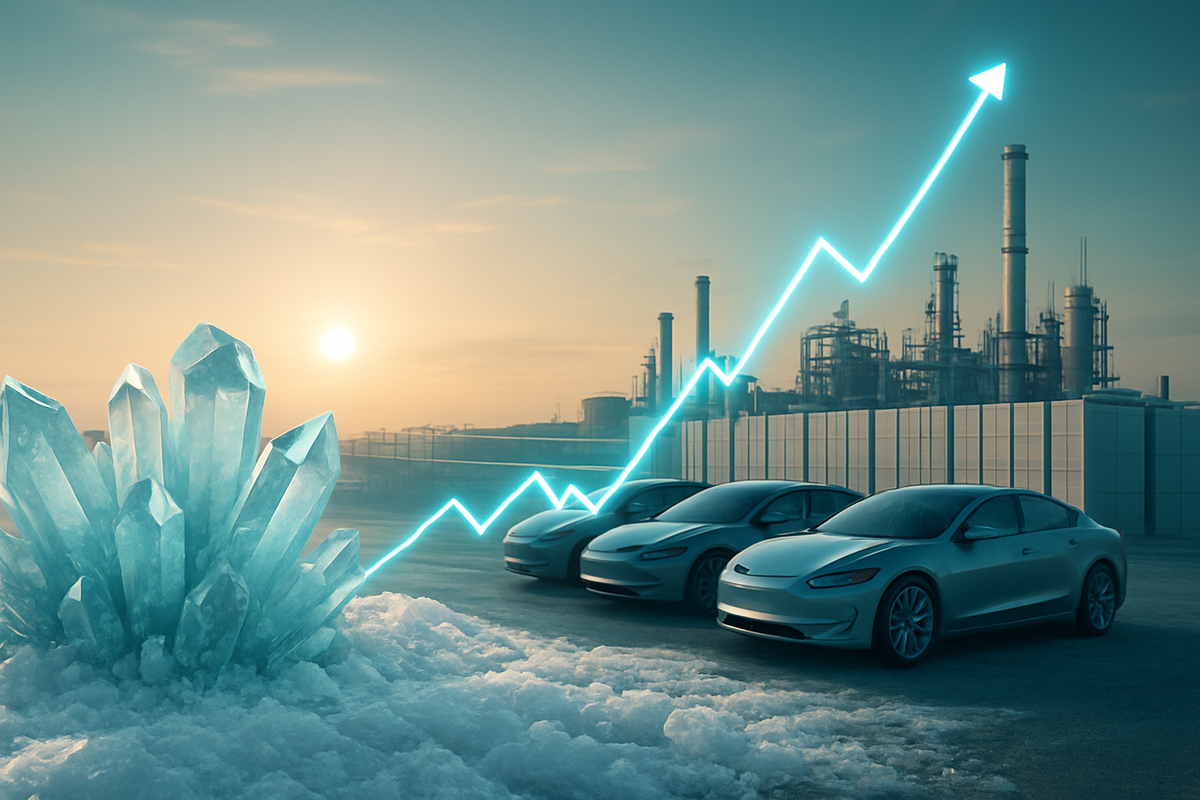
As of late February 2026, the global materials sector is witnessing a dramatic resurgence, spearheaded by a powerhouse performance from Albemarle (NYSE: ALB). After two years of grueling price compression and market skepticism, the world’s largest lithium producer has seen its stock price climb to a 52-week high of $206.00 this month, marking a stunning recovery from the "lithium winter" of 2024 and mid-2025. This rally is largely driven by a tightening global supply and a surprisingly robust second wave of electric vehicle (EV) adoption, alongside an explosion in demand for stationary energy storage systems.
The immediate implications are clear: the era of oversupply that plagued the industry in 2024 is officially over. As lithium carbonate spot prices stabilize around $20,800 per tonne—nearly double their 2025 lows—investors are flocking back to the materials sector. Albemarle’s lean operational strategy, characterized by significant capital expenditure cuts and a pivot toward high-margin projects, has positioned it as the primary beneficiary of a market that is shifting from a massive surplus to a projected deficit of 1,500 tonnes by the end of 2026.
From Retrenchment to Recovery: The Timeline of a Turnaround
The road to this month’s gains began in the dark days of early 2025, when the lithium market was awash in excess inventory. Albemarle (NYSE: ALB) made the difficult decision to idle its high-cost Kemerton lithium hydroxide plant in Australia and slash its capital spending by 65%. These moves, while painful at the time, allowed the company to preserve its balance sheet while higher-cost competitors, particularly marginal "lepidolite" miners in China, were forced to exit the market entirely. This disciplined approach created the supply vacuum that is now being filled by Albemarle’s lower-cost brine and hard-rock operations.
Key to this recovery was the strategic divestment of non-core assets. In early 2026, Albemarle closed the sale of its Ketjen catalyst business for approximately $660 million. This cash infusion, combined with a 16% year-over-year revenue increase in its Energy Storage division during Q4 2025, has silenced critics who feared a prolonged liquidity crunch. Management’s focus on volume growth—reporting a 17% increase in energy storage volumes—has proven that even in a volatile price environment, scale and efficiency remain the industry's ultimate competitive advantages.
Market reaction to these developments has been overwhelmingly positive. Institutional investors, who had largely abandoned the lithium space in 2024, are now re-entering positions. Analysts have pointed to Albemarle's projected 2026 earnings per share (EPS) of $7.20 as a sign of a "fundamental pivot." This is a stark contrast to the negative earnings and massive write-downs reported just twelve months ago. The industry has moved from a survival mindset to one of strategic expansion, with Albemarle leading the charge in the Western hemisphere.
Sector Winners and the Changing Competitive Landscape
While Albemarle (NYSE: ALB) has captured the spotlight, the broader materials sector is seeing a tiered recovery. Sociedad Química y Minera (NYSE: SQM) remains a formidable winner, recently finalizing its "NovaAndino Litio" partnership with the Chilean state-owned Codelco. This deal secured SQM’s operating rights in the Salar de Atacama through 2060, providing a level of long-term stability that has seen its stock price double from its 2025 lows. As the world’s lowest-cost brine producer, SQM is uniquely positioned to thrive even if prices experience minor corrections in the second half of the year.
The landscape has also been reshaped by massive consolidation. Rio Tinto (NYSE: RIO) has emerged as a top-five global lithium player following its $6.7 billion acquisition of Arcadium Lithium in March 2025. By integrating Arcadium’s Argentina-based Rincon project and Canadian assets, Rio Tinto has positioned itself as the premier "Western alternative" to Chinese-dominated supply chains. This shift has placed significant pressure on smaller, single-asset developers like Lithium Americas (NYSE: LAC), which are now finding themselves as potential acquisition targets for diversified mining giants looking to bolster their green metal portfolios.
Conversely, the "losers" in this cycle are the high-cost Chinese producers who relied on low-grade lepidolite ore. As global environmental standards tighten and market participants demand greater transparency in the "battery passport" era, these marginal players have struggled to return to profitability. Furthermore, traditional automotive manufacturers who were slow to pivot to plug-in hybrids (PHEVs) are finding themselves disadvantaged. In early 2026, PHEV sales have surged by 33% globally, acting as a critical bridge for consumers and sustaining lithium demand even as full battery electric vehicle (BEV) growth rates in the U.S. remained moderate at 7%.
Broader Industry Trends and Geopolitical Ripple Effects
The 2026 lithium rally is more than just a commodity price cycle; it is a reflection of a fundamental shift in the global energy transition. The Battery Energy Storage System (BESS) sector has emerged as a massive secondary driver of demand, growing by over 40% year-over-year. As utilities worldwide integrate more intermittent renewable energy into their grids, the demand for large-scale lithium-ion battery arrays has decoupled slightly from the ups and downs of the passenger vehicle market. This diversification of demand provides a much-needed safety net for companies like Albemarle (NYSE: ALB).
Policy implications continue to play a pivotal role in market performance. The U.S. Inflation Reduction Act (IRA) and similar European directives have created a bifurcated market where "clean" and "traceable" lithium commands a premium. Albemarle’s domestic investments in North Carolina and its refining presence in the EU have allowed it to capture these incentives, while Chinese competitors like Ganfeng Lithium face increasing trade barriers in Western markets. This geopolitical "deglobalization" of the battery supply chain has turned lithium into a strategic asset, often compared to the importance of oil in the 20th century.
Historical precedents, such as the silicon boom of the early 2000s or the shale gas revolution, suggest that we are entering a phase of industrial maturity. The wild price swings of the "Lithium 1.0" era (2021–2024) are being replaced by "Lithium 2.0," characterized by long-term offtake agreements between miners and OEMs. Major automakers are no longer just buying lithium on the spot market; they are becoming equity partners in mines, a trend that reinforces the stability of companies with proven reserves and operational expertise.
The Path Ahead: Strategic Pivots and Market Scenarios
Looking toward the remainder of 2026 and into 2027, the primary challenge for the industry will be managing the next wave of supply without inducing another glut. Albemarle (NYSE: ALB) is expected to stay the course with its "disciplined growth" model, focusing on the ramp-up of its Meishan plant in China and the potential restart of its Kemerton facility if prices hold above the $25,000/tonne mark. Strategic pivots toward Direct Lithium Extraction (DLE) technologies also represent a significant opportunity, as these methods promise to reduce the environmental footprint and processing time of brine operations.
In the short term, market participants should watch for potential bottlenecks in the midstream refining sector. While raw material supply is increasing, the capacity to convert that material into battery-grade hydroxide and carbonate remains concentrated. This creates a "value-add" opportunity for integrated players. In the long term, the emergence of solid-state batteries and recycled lithium could disrupt the market, though these technologies are unlikely to reach meaningful scale before 2030. For now, the primary scenario remains one of "steady tightening," as the delayed projects from the 2024 downturn fail to meet the accelerating demand of the late 2020s.
Potential challenges include the persistent high-interest-rate environment in the U.S. and Europe, which continues to affect the affordability of new EVs for the average consumer. However, the shift toward affordable "entry-level" EV models—priced under $30,000—is expected to be a major catalyst in 2027. If Albemarle and its peers can continue to drive down production costs through technological innovation, they will be well-positioned to serve this mass-market explosion.
Final Assessment: What Investors Should Watch
The resurgence of Albemarle (NYSE: ALB) and the materials sector in early 2026 serves as a powerful reminder of the cyclical but inevitable growth of the green economy. The key takeaway for investors is the importance of "survivability" in commodity markets; Albemarle’s ability to weather the 2024 crash through aggressive cost-cutting has allowed it to emerge stronger and more dominant. As the market rebalances, the focus has shifted from mere production capacity to operational excellence and geopolitical alignment.
Moving forward, the market appears to be on a more sustainable trajectory than the speculative frenzy of years past. Investors should keep a close eye on lithium inventory levels in China and the pace of BESS deployment in North America. Any significant policy changes regarding EV subsidies or trade tariffs could provide short-term volatility, but the underlying trend of electrification remains intact.
In the coming months, Albemarle’s quarterly earnings reports will be the litmus test for the sector's health. Continued expansion of EBITDA margins and the successful execution of its simplified project pipeline will be the primary metrics to monitor. As the "white gold" rush enters its more mature phase, the companies that can bridge the gap between resource extraction and high-tech chemical manufacturing will be the long-term victors in the materials sector.
This content is intended for informational purposes only and is not financial advice.