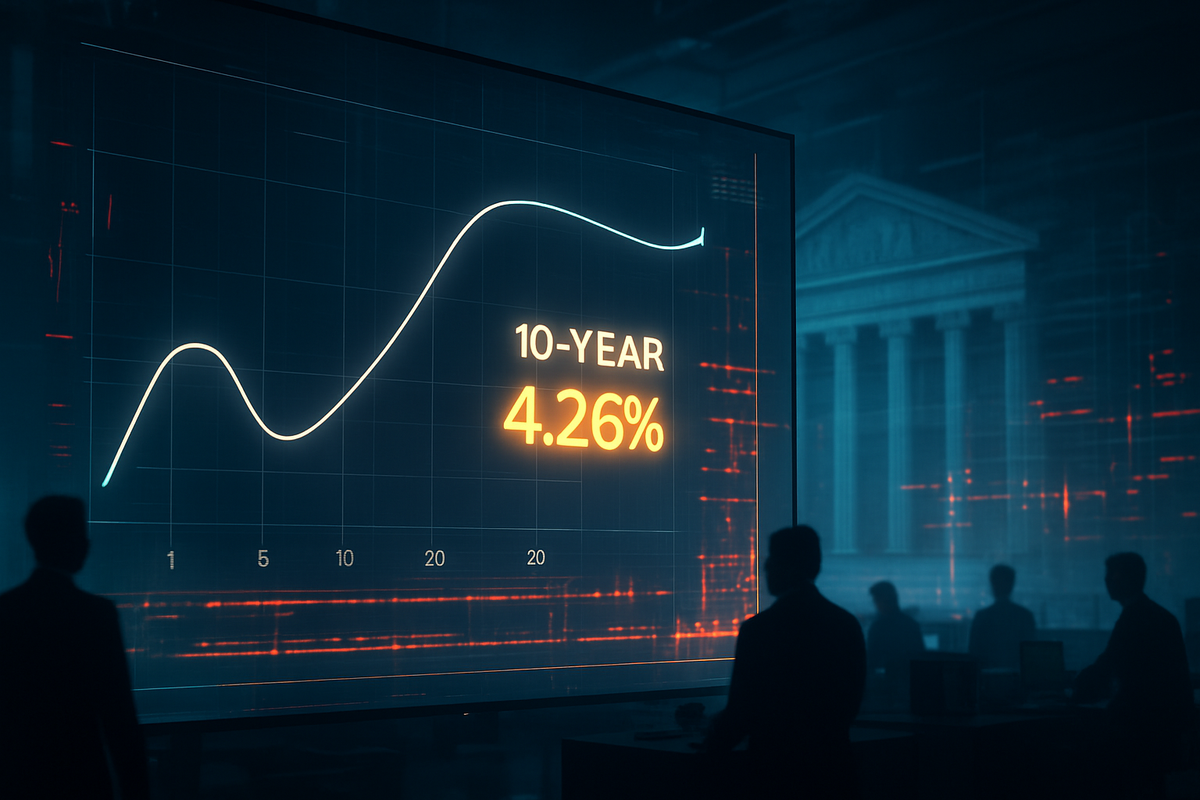
The transition of power at the Federal Reserve has historically been a period of market adjustment, but the shift occurring in February 2026 has introduced a volatility not seen in decades. As the market digests the nomination of Kevin Warsh to succeed Jerome Powell, the "Yield Curve Twist" has become the defining narrative of the first quarter. On January 30, 2026, the benchmark 10-year Treasury yield surged to a multi-year high of 4.26%, signaling a fundamental repricing of risk and a structural return of the "term premium."
This surge comes at a paradoxical moment. While traders are pricing in at least two to three short-term rate cuts for the latter half of the year, long-term borrowing costs are moving in the opposite direction. This divergence is the direct result of a new monetary framework—informally dubbed the "Warsh Doctrine"—which prioritizes an aggressive, active reduction of the Federal Reserve’s $6.8 trillion balance sheet. For the first time in the post-pandemic era, the market is grappling with a central bank that is no longer acting as the buyer of last resort for long-duration debt.
The 4.26% Pivot: A Timeline of the Twist
The road to the 4.26% peak began in late 2025 as Core PCE inflation remained stubbornly anchored near 3.0%, preventing the Powell-led Fed from initiating the long-awaited pivot to lower rates. However, the true catalyst arrived on January 30, 2026, when the White House officially nominated former Fed Governor Kevin Warsh to take the helm of the central bank starting in May. Warsh, known for his "Sound Money" philosophy and critical view of the Fed’s massive footprint in the bond market, immediately shifted the market’s focus from the "Fed Funds Rate" to the "Balance Sheet."
Initially, the "Yield Curve Twist" manifested as a surge in short-term Treasury bills toward 3.7% while the 10-year yield broke through key technical resistance at 4.20%. This was not a traditional "bear steepening" where all rates rise; rather, it was a structural realignment. Market participants began pricing in "Active Quantitative Tightening" (Active QT), a policy where the Fed doesn't just let bonds mature but actively sells Treasury and Mortgage-Backed Securities (MBS) into the open market. This policy shift is intended to drain liquidity more rapidly and restore market-driven price discovery, but the immediate side effect has been a sharp increase in the term premium—the extra yield investors demand for the risk of holding long-term debt.
Financial Squeeze: Winners and Losers in a High-Yield Era
The sudden rise in long-term yields has sent shockwaves through the financial sector, particularly for institutions that rely on a traditional upward-sloping yield curve. Large-cap banks like JPMorgan Chase & Co. (NYSE: JPM) and Bank of America Corp. (NYSE: BAC) have seen their Net Interest Margins (NIM) come under renewed pressure. While higher long-term rates theoretically help lending profitability, the "twist" has kept short-term funding costs high, squeezing the spread that banks earn. Regional players and fintech lenders like SoFi Technologies, Inc. (NASDAQ: SOFI) are facing a double-edged sword: the prospect of lower short-term rates provides some relief on deposit costs, but the high 10-year yield makes their long-term loan originations more expensive for consumers.
The most acute pain is being felt in the mortgage and real estate investment trust (REIT) sectors. Companies such as AGNC Investment Corp. (NASDAQ: AGNC) and Annaly Capital Management, Inc. (NYSE: NLY), which invest heavily in agency MBS, have had to navigate a "funding squeeze." As the Fed signals active sales of MBS, the supply-demand imbalance has widened spreads, devaluing existing bond portfolios. Conversely, some "winners" are emerging among private credit funds and insurance companies, which can now lock in higher long-term yields for their portfolios without the "distortionary" interference of a bond-buying central bank.
The Significance of Active QT and the Term Premium
The shift toward a Kevin Warsh-led Fed represents the most significant change in central banking philosophy since the 2008 financial crisis. For nearly two decades, the "Fed Put"—the idea that the central bank would support markets through asset purchases—has suppressed the term premium. By introducing "Active QT," the Fed is effectively telling the market that it will no longer manipulate the long end of the curve. This is a move toward what Warsh describes as "Price Discovery," where the market, not the government, determines the cost of long-term capital.
This event fits into a broader trend of "Global Normalization." Central banks in Europe and Japan have also been retreating from unconventional stimulus, but the U.S. move is the most aggressive. The ripple effects are significant: a higher 10-year yield strengthens the U.S. dollar, which complicates the inflation-fighting efforts of emerging markets and increases the cost of dollar-denominated debt globally. Historically, this type of "twist" echoes the early 1980s, where the Fed had to convince markets of its long-term commitment to stability, even at the cost of short-term volatility.
Navigating the 'Sound Money' Transition
In the short term, markets should expect continued volatility as the Fed transitions from the "Powell Era" of data-dependency to the "Warsh Era" of strategic footprint reduction. The primary challenge for investors will be decoupling their expectations for the Fed Funds Rate from long-term Treasury yields. We are entering an environment where "cuts" to the overnight rate may not lead to lower mortgage rates or cheaper corporate bonds. Corporations that delayed refinancing in 2025 in hopes of a return to 3% yields are now forced to adapt to a "higher-for-longer" reality at the 10-year mark.
Strategic pivots are already underway. Many firms are moving toward shorter-duration debt or seeking alternative financing through private markets. If the Warsh Fed successfully reduces its balance sheet without triggering a liquidity crisis, the long-term outcome could be a healthier, more transparent financial system. However, the "potential for a policy error" remains high if the market cannot absorb the supply of bonds as the Fed retreats.
Summary of the New Monetary Landscape
The February 2026 Yield Curve Twist marks a watershed moment for the global economy. With the 10-year Treasury yield at 4.26%, the era of suppressed volatility and central bank dominance over the long end of the curve appears to be ending. The nomination of Kevin Warsh has catalyzed a "QT-for-cuts" framework that trades lower short-term rates for an aggressive reduction in the Fed’s market influence.
For investors, the key takeaways are clear: the term premium is back, and the yield curve is no longer a simple predictor of economic health. Moving forward, the market will be watching the pace of active asset sales and the Fed’s ability to manage its $6.8 trillion exit. Success will be measured not just by inflation targets, but by the restoration of a market where risk is priced by investors, not by the printing press.
This content is intended for informational purposes only and is not financial advice