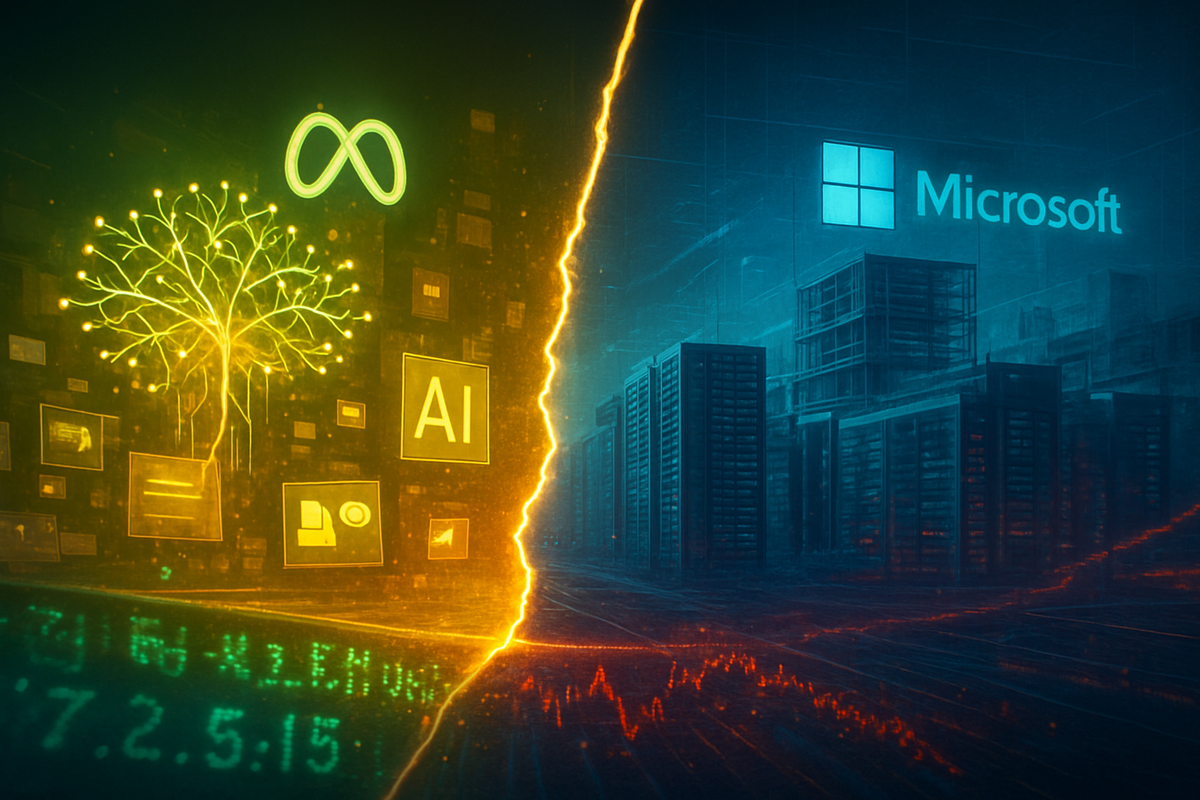
The final week of January 2026 marked a watershed moment for the technology sector, as the long-anticipated "AI reckoning" finally arrived for the market’s biggest players. On January 28, 2026, two of the world's most influential companies, Meta Platforms (NASDAQ: META) and Microsoft (NASDAQ: MSFT), reported quarterly earnings that sent shockwaves through the Nasdaq. Despite both companies beating headline revenue and earnings expectations, their stock prices diverged sharply: Meta shares surged 8% in the following sessions, while Microsoft’s valuation plummeted by 8%, wiping out over $350 billion in market capitalization in a single day.
This divergence signals a fundamental shift in investor sentiment regarding the "AI investment theme." The era of rewarding companies simply for spending billions on high-end infrastructure appears to be over. Instead, the market has entered a phase of high discernment, favoring "AI-enabled users" who can demonstrate immediate return on investment (ROI) over "AI providers" who face mounting capital costs and intensifying competition from low-cost alternatives. As of late February 2026, the contrast between these two titans has become the defining narrative for the tech sector’s outlook for the remainder of the year.
The Tale of Two Earnings: Jan 28, 2026
The drama unfolded after the closing bell on January 28, when both companies released results for the period ending December 31, 2025. Meta Platforms (NASDAQ: META) reported a powerhouse fourth quarter, with earnings per share (EPS) of $8.88, significantly outperforming the analyst consensus of $8.19. Revenue grew 24% year-over-year to $59.89 billion, driven by a resurgence in the digital advertising market. CEO Mark Zuckerberg successfully convinced investors that the company's massive pivot toward AI was already bearing fruit, noting that AI-driven recommendation engines had increased ad impressions by 18% while simultaneously raising the average price per ad.
Microsoft (NASDAQ: MSFT), meanwhile, posted what would normally be considered a stellar quarter: EPS of $4.14 on revenue of $81.30 billion, both beating estimates. However, the underlying details of the report spooked a market that had grown weary of the "AI arms race." The primary catalyst for the sell-off was the growth rate of Azure, Microsoft’s cloud computing platform. While Azure grew 39% in constant currency, it missed the "whisper numbers" of 40%+ that many aggressive traders had baked into the stock’s premium valuation. More concerning was Microsoft’s capital expenditure (CapEx), which ballooned to a record $37.5 billion for the quarter—a staggering 66% increase from the previous year.
The timeline leading up to this divergence was marked by increasing anxiety over the "monetization gap." Throughout 2025, investors had largely ignored rising costs as long as the AI narrative remained intact. However, by the start of 2026, the arrival of more efficient, lower-cost AI models began to challenge the necessity of Microsoft’s massive infrastructure build-out. When CEO Satya Nadella guided for even higher spending in the coming quarters to address capacity constraints, the market reacted with skepticism rather than the usual enthusiasm for growth-at-any-cost.
Winners and Losers in the AI Pivot
The primary winner in this new landscape is undoubtedly Meta Platforms (NASDAQ: META). By integrating AI directly into its core advertising business via tools like "Advantage+," Meta has demonstrated a tangible "AI flywheel" where increased spending leads directly to higher margins and revenue. Analysts from firms like Morgan Stanley have praised the company for maintaining a 41% operating margin even as it guides for 2026 CapEx between $115 billion and $135 billion. For Meta, AI is a tool for efficiency and monetization within an existing, high-margin ecosystem.
In contrast, Microsoft (NASDAQ: MSFT) has emerged as a temporary loser in the valuation game, burdened by "concentration risk." Reports surfaced following the earnings call that nearly 45% of Microsoft’s remaining performance obligations—a key forward-looking indicator—are tied to its partnership with OpenAI. This has raised concerns that Microsoft’s AI future is too heavily dependent on a single partner, especially as competitors like Alphabet (NASDAQ: GOOGL) and Amazon (NASDAQ: AMZN) have begun rolling out their own vertically integrated AI stacks that may offer better price-to-performance ratios for enterprise customers.
The ripples of this divergence extend to the broader semiconductor and cloud sectors. Nvidia (NASDAQ: NVDA), the primary beneficiary of the AI infrastructure boom, saw its stock become volatile as investors weighed Meta’s continued spending against the potential for Microsoft to eventually pull back or seek more efficient hardware. Other advertising-tech players like Snap Inc. (NYSE: SNAP) and Pinterest (NYSE: PINS) initially rallied alongside Meta, as the "ad-tech AI boom" appeared more resilient than the "cloud infrastructure boom."
The End of Blind Faith: Broader Market Significance
This event represents the end of the "blind faith" era of AI investing. For the past three years, any mention of AI integration was enough to send a stock higher. However, the February 2026 market dynamics suggest that investors are now applying traditional valuation metrics to AI-related growth. The "DeepSeek" factor—the late-January 2026 launch of an extremely efficient AI model that cost a fraction of traditional models to train—has fundamentally altered the narrative. If high-performance AI can be commoditized and built cheaply, the massive $150 billion annual infrastructure spend of the "Hyperscalers" may eventually be viewed as a valuation trap.
Historical precedents such as the dot-com bubble of 2000 are being cited with increasing frequency. While the long-term utility of the internet was real, many of the companies building the initial infrastructure suffered when their customers could not immediately monetize the new technology. The current CapEx-to-sales ratios for the "Magnificent Seven" have surpassed the peaks seen in the late 1990s, leading analysts to warn of a "hyper-capital cycle" that could squeeze margins if revenue growth begins to plateau.
Furthermore, regulatory and policy implications are beginning to surface. As companies like Meta and Microsoft pour over $100 billion a year into data centers and energy infrastructure, governments are looking closer at the environmental and competitive impacts. The divergence in stock performance reflects a market that is increasingly prioritizing companies that can navigate these headwinds while delivering bottom-line results today, rather than promising a "superintelligence" breakthrough in the indefinite future.
What Comes Next: Strategic Pivots and Scenarios
Moving forward, Microsoft (NASDAQ: MSFT) faces a significant strategic challenge. To regain its footing, the company must prove that its massive CapEx is not just "defensive spending" to keep up with competitors, but a driver of incremental revenue that outpaces the cost of capital. A potential pivot could involve Microsoft diversifying its AI partnerships or accelerating the deployment of its own in-house "Maia" AI chips to reduce its reliance on external providers and lower operating costs. Investors will be watching the next two quarters closely for any sign that the OpenAI "backlog" is converting into realized Azure revenue.
For Meta Platforms (NASDAQ: META), the challenge will be sustainability. While the market is currently rewarding its 41% operating margins and AI-driven ad growth, the company’s plans to spend upwards of $130 billion in 2026 leave little room for error. Any slowdown in the global advertising market or a regulatory crackdown on AI-driven data collection could quickly turn Meta’s "success story" into a cautionary tale of overextension. Zuckerberg’s focus on "Meta Superintelligence Labs" suggests the company is looking beyond ads, but the market's current favor is firmly rooted in the company's existing revenue streams.
In the short term, expect a "Show-Me" market where volatility remains high around any company reporting high AI spending. The divergence between "Infrastructure Providers" (Microsoft, Amazon) and "AI Implementers" (Meta, and increasingly, specialized enterprise software firms) is likely to widen. Market opportunities may emerge in "Efficiency Tech"—companies that help firms run AI models more cheaply and with less energy—as the focus shifts from raw power to cost-effective utility.
Wrap-up: The New AI Reality
The divergence of Meta and Microsoft in early 2026 serves as a definitive signal that the AI investment theme has matured. Investors are no longer content with the promise of future dominance; they are demanding proof of monetization and disciplined capital allocation. Meta’s ability to turn AI into immediate ad revenue has made it the current gold standard, while Microsoft’s struggle with capacity constraints and high costs has rendered it a "wait-and-see" story for the first time in years.
As the market moves forward, the "Great AI Rotation" will likely continue to favor companies that can show operating leverage alongside their technological ambitions. The key takeaways for investors are clear: monitor CapEx-to-revenue ratios, watch for the commoditization of AI models, and prioritize companies that have a clear, direct path to monetizing their AI investments. In the coming months, the focus will stay on quarterly cloud growth rates and the actual dollar impact of AI tools on corporate balance sheets.
The lessons of February 2026 will resonate for the rest of the decade. While AI remains the most significant technological shift of our time, the financial markets have proven that even the most revolutionary technology must eventually answer to the laws of economics.
This content is intended for informational purposes only and is not financial advice