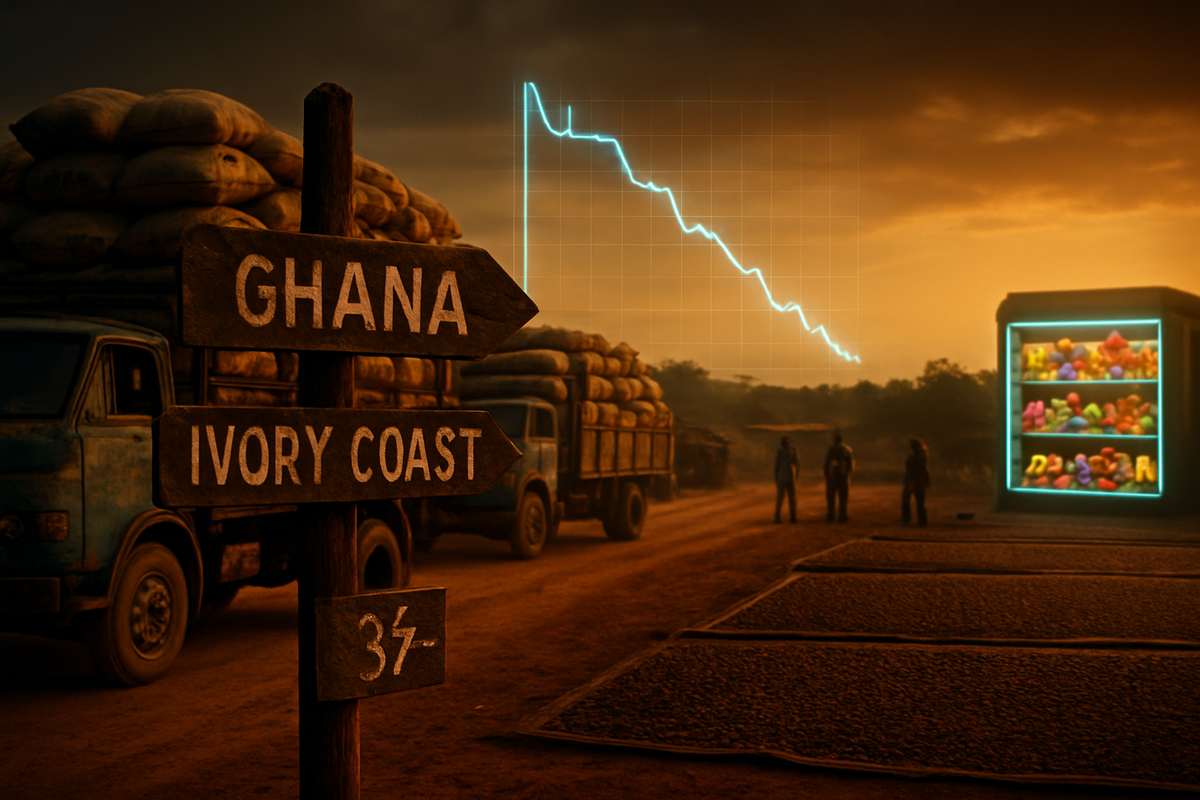
The global cocoa market is currently mired in a state of unprecedented volatility, as international prices for the "brown gold" have plummeted to near $3,000 per metric ton—a staggering 66% collapse from the record peak of $12,906 reached in late 2024. This dramatic reversal has ignited a high-stakes geopolitical standoff in West Africa, where the world's two largest producers, Ghana and Ivory Coast, have taken diametrically opposed paths to survive the fallout. As the pricing gap between the neighbors widens, a massive smuggling crisis is unfolding, threatening to destabilize the region’s supply chains and leave the industry’s major players in a precarious position.
While Ghana has moved aggressively to slash its farmgate prices to remain solvent, Ivory Coast’s regulatory body has chosen to hold the line at significantly higher levels. This divergence has essentially created a "smuggler’s paradise," with Ghanaian beans flowing illegally across the border into Ivorian warehouses to fetch a higher price. This regional friction is compounded by a shift in global consumer behavior, as the 2025 "Year of the Gummy Bear" trend persists into early 2026, with buyers increasingly opting for non-chocolate alternatives. With ICE cocoa inventories surging to a six-month high of 2.15 million bags, the market is facing a structural glut that neither producer nor manufacturer seems ready to absorb.
The Great Divergence: A Timeline of the Cocoa Collapse
The current crisis began in late 2024, when supply shortages and climate-driven crop failures pushed cocoa futures to historic, unsustainable heights. As production finally began to recover throughout 2025, the market entered a "liquidation phase," with prices spiraling downward. By early February 2026, the situation reached a breaking point. Ghana’s cocoa regulator, COCOBOD, implemented a drastic 28.6% reduction in its farmgate price, a defensive move aimed at managing the state’s mounting debt and adjusting to a world market that no longer supports premium pricing.
In stark contrast, Ivory Coast’s Coffee-Cocoa Council (CCC) has maintained its farmgate price at 2,800,000 CFA francs per metric ton (approximately 2,800 CFA per kilogram). This policy, intended to protect the livelihoods of Ivorian farmers, has inadvertently created an arbitrage opportunity of nearly $60 per bag. The result has been a surge in cross-border smuggling, with Ghanaian beans being rebranded as Ivorian to capitalize on the price gap. To mitigate the resulting warehouse backlog and attempt to stay ahead of the smuggling curve, the Ivory Coast recently moved its mid-crop harvest start date forward to March 1, 2026.
The situation is further complicated by "buyer reluctance" on the global stage. Heavy industry buyers and chocolate manufacturers are currently refusing to pay official farmgate prices that sit well above current world market levels. This standoff has led to a buildup of deliverable supply, as evidenced by the 2.15 million bags sitting in ICE-monitored warehouses. The market is no longer wondering if there is enough cocoa; the question is now whether anyone is willing to buy it at the prices mandated by West African governments.
Corporate Whiplash: Winners and Losers in the Crash
The rapid descent in cocoa prices has created a "whiplash" effect for major public companies. The iPath Series B Bloomberg Cocoa Subindex Total Return ETN (NYSE Arca: NIB) has been one of the most visible casualties, tracking the sharp decline in futures as speculative interest dries up. For investors, the ETN has transitioned from a high-flying hedge against inflation to a cautionary tale of commodity volatility, as the projected surplus for the 2025/26 season continues to weigh on the index.
On the manufacturing side, The Hershey Co (NYSE: HSY) and Mondelez International (NASDAQ: MDLZ) find themselves in a complex operational bind. While lower input costs are generally a positive, both companies are currently processing high-cost cocoa that was hedged and purchased during the 2025 highs. Mondelez International (NASDAQ: MDLZ) reported a significant collapse in gross margins, falling from 38.6% to 28.2% in its most recent filings, as it absorbs the cost of these legacy contracts. CFO Luca Zaramella recently warned of a $500 million hit in Q1 2026 due to inventory revaluations, noting that the company cannot easily lower shelf prices to match the spot market without damaging profitability.
The Hershey Co (NYSE: HSY) has similarly seen its profits take a nosedive, reporting a 60% decline in annual earnings as the company struggles with "unprecedented cocoa inflation" legacy costs. To mitigate this, Hershey has aggressively pivoted its marketing toward "salty snacks" and its non-chocolate portfolio, such as gummies and protein bars. While these companies may eventually benefit from $3,000/tonne cocoa, the transition period is proving to be a financial minefield, especially as consumers continue to balk at the high prices of finished chocolate bars.
Broken Alliances and the 'Gummy Bear' Shift
The current price war highlights the fragility of the Living Income Differential (LID) and other price-coordination alliances between Ghana and Ivory Coast. For years, the two nations sought to act as a "Cocoa OPEC" to dictate terms to the global market. However, the 2026 divergence shows that national economic pressures often override regional solidarity. Historically, when prices collapse, smuggling has always been a side effect, but the scale of the current arbitrage—driven by Ghana's debt crisis—is unprecedented and threatens the long-term credibility of West African supply data.
Furthermore, the industry is grappling with a shift in consumer taste that many believe is permanent. The "Year of the Gummy Bear" trend, which saw manufacturers like Hershey and Ferrara heavily promote non-chocolate candies during the 2025 holiday seasons, has fundamentally changed the confectionery aisle. Consumers have developed "sticky" habits for multi-sensory, non-chocolate snacks like Nerds Gummy Clusters, which are cheaper to produce and lack the supply chain volatility of cocoa. This demand destruction means that even if cocoa prices remain low, the chocolate industry may never fully regain the market share it lost during the 2024 price spike.
Scenarios for a Market in Flux
In the short term, the market will likely see a period of forced stabilization. If smuggling continues at its current pace, Ivory Coast may be forced to capitulate and cut its farmgate prices to match Ghana’s "emergency reset" before the mid-crop season ends. Such a move would likely send another shockwave through cocoa futures, as it would signal a total abandonment of the higher price floor. Strategic pivots are already underway at the corporate level, with major grinders and manufacturers investing more heavily in "cocoa-extended" products that use less raw cocoa butter and more vegetable-based alternatives.
Long-term, the industry may move toward more decentralized sourcing. The volatility in West Africa is encouraging major buyers to look toward emerging producers in Ecuador and Brazil, where supply chains are often more automated and less reliant on government-mandated farmgate prices. This "de-risking" of the cocoa supply chain could lead to a permanent reduction in the influence held by the Ivory Coast and Ghana, forever altering the geopolitical landscape of the commodity.
Closing the Gap: What to Watch for in 2026
The cocoa market of 2026 is a study in the consequences of extreme price cycles. The transition from a $12,000 record to a $3,000 collapse has left a trail of broken alliances, smuggling corridors, and corporate margin compression. For the Ivory Coast and Ghana, the coming months will be a test of economic endurance as they navigate a world that is increasingly comfortable with chocolate alternatives.
Investors should closely monitor the ICE inventory reports and the official farmgate price announcements scheduled for the Ivorian mid-crop in March. If inventories continue to climb toward the 2.5 million bag mark, further downward pressure on the iPath Series B Bloomberg Cocoa Subindex Total Return ETN (NYSE Arca: NIB) is likely. For The Hershey Co (NYSE: HSY) and Mondelez International (NASDAQ: MDLZ), the key metric will be volume recovery; if consumers don't return to chocolate despite lower input costs for producers, the "Gummy Bear" era may be here to stay.
This content is intended for informational purposes only and is not financial advice.