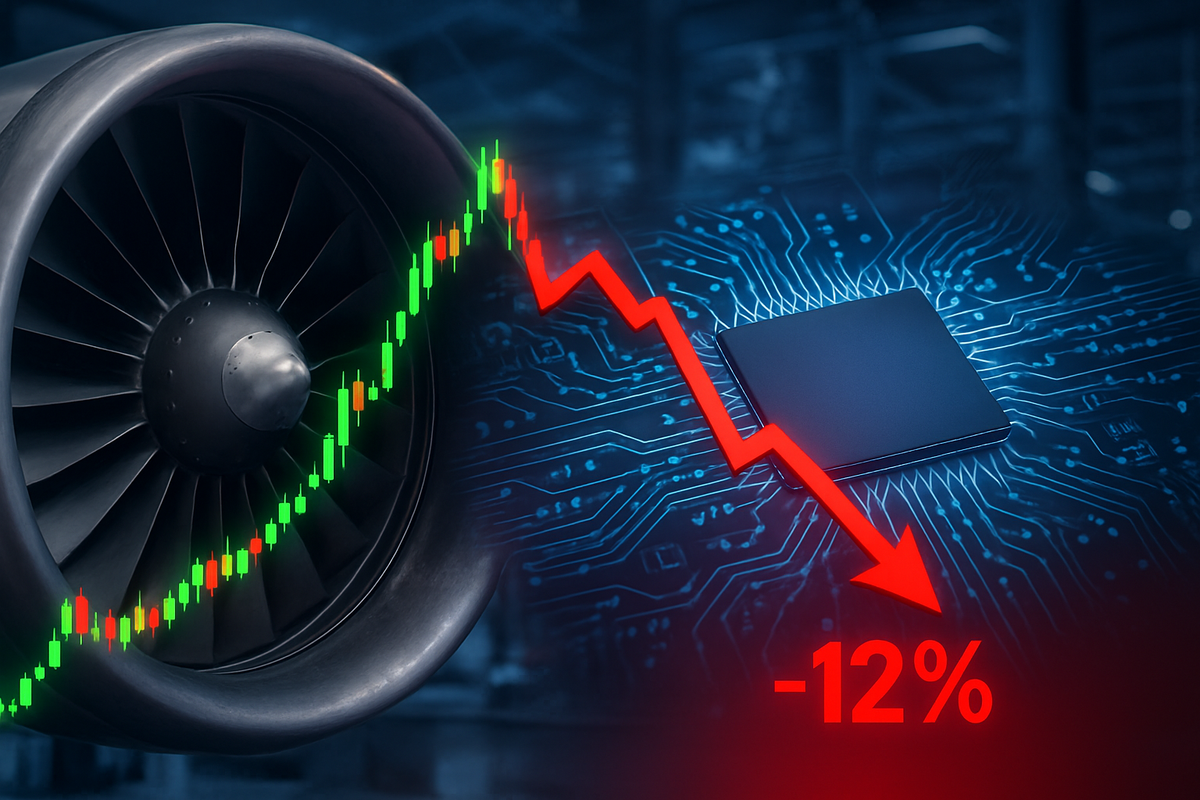
In a jarring disconnect between top-line growth and market sentiment, HEICO Corporation (NYSE: HEI) reported record-breaking financial results for the first quarter of fiscal 2026, only to see its share price crater by 12% in early trading on February 26, 2026. Despite posting a 14% surge in sales to $1.18 billion and a 13% rise in net income to $190.2 million, investors focused on underlying fissures in profitability and the company's increasingly leveraged balance sheet.
The sell-off underscores a "show-me" phase for the aerospace darling, as the premium valuation previously afforded to HEICO’s consistent growth story met the cold reality of margin compression. While the company’s Flight Support Group continues to ride the tailwinds of a global aerospace aftermarket boom, its Electronic Technologies Group faced unexpected headwinds, leading analysts to question whether the firm’s aggressive acquisition strategy is beginning to weigh on its historical agility.
A "Low-Quality" Beat and the Margin Mirage
HEICO’s fiscal first quarter, which concluded on January 31, 2026, appeared on the surface to be a standard-issue victory for the Florida-based aerospace parts manufacturer. The company reported a record net income of $190.2 million, or $1.35 per diluted share, comfortably beating the Zacks consensus estimate of $1.29. However, the market’s reaction turned sour as investors peeled back the layers of the report. A significant portion of that earnings beat—approximately $0.15 per share—was attributed to a one-time $21.8 million discrete income tax benefit related to stock option exercises. Excluding this non-operational boost, HEICO would have fallen short of analyst expectations, signaling a rare operational miss for a company known for its reliability.
The most concerning data points emerged from the Electronic Technologies Group (ETG), which focuses on high-reliability electronics for defense and space. While ETG sales rose 12% to $370.7 million, its operating margin plummeted to 19.8% from 23.1% in the prior year. Management attributed the decline to a "less favorable product mix" within defense contracts and a surprising cooling in demand for specialized space products. This margin contraction stood in sharp contrast to the Flight Support Group (FSG), where operating margins improved to a robust 24.5% on the back of strong commercial airline demand. The divergence between the two segments suggests that HEICO’s diversification is currently acting as a drag rather than a hedge.
Furthermore, the company’s free cash flow margin contracted significantly, falling to 14% compared to 18% in the same period last year. High performance-based compensation payments and distributions under the HEICO Leadership Compensation Plan weighed on cash from operations, which fell 12% year-over-year to $178.6 million. For a company that trades at a premium multiple based on its cash-compounding ability, the combination of weakening cash flow and margin pressure in the electronics division provided the catalyst for the sharp double-digit stock decline.
Winners and Losers in the Aerospace Aftermarket
The fallout from HEICO’s report has immediate implications for its peers in the aerospace and defense electronics sectors. TransDigm Group (NYSE: TDG), often seen as HEICO’s closest rival in the high-margin "parts manufacturer approval" (PMA) space, emerged as a relative winner by contrast. In its most recent report, TransDigm maintained an industry-leading EBITDA margin of over 52%, reinforcing its position as the premier operator in the segment. Investors seeking safety in the aerospace aftermarket may rotate away from HEICO’s more diversified but currently strained portfolio into TransDigm’s pure-play proprietary parts model.
Conversely, companies with heavy exposure to the space and defense electronics sectors, such as L3Harris Technologies (NYSE: LHX) and Moog Inc. (NYSE: MOG.A), are now under a magnifying glass. While Moog recently reported record sales driven by space demand, HEICO’s warnings of a "cyclical slowdown" in specific space products could indicate a peaking of the market. Similarly, RTX Corporation (NYSE: RTX) and its Collins Aerospace division may see increased pressure on their original equipment margins as HEICO’s Flight Support Group continues to gain market share in the replacement parts business, despite the parent company’s stock woes.
Smaller aftermarket players like AAR Corp (NYSE: AIR) could find themselves in a strategic sweet spot. As HEICO pauses to integrate its recent acquisitions and manage its debt, AAR Corp may find more room to expand its distribution and MRO services without as much competition for "tuck-in" deals. However, the overall industry sentiment remains cautious; if the profitability pressure seen at HEICO’s ETG segment spreads to other electronics-heavy firms like Woodward, Inc. (NYSE: WWD), the entire sub-sector could face a valuation reset.
Broad Industry Trends and the Leverage Trap
HEICO’s current predicament reflects a broader shift in the aerospace and defense landscape of 2026. The industry is currently grappling with a "two-speed" recovery: while commercial aviation is in a "super-cycle" of aftermarket demand due to delays in new aircraft from Boeing and Airbus, the defense and space sectors are beginning to normalize after years of frantic post-pandemic spending. HEICO’s ETG segment is the proverbial canary in the coal mine, suggesting that the era of easy growth in defense electronics may be giving way to more competitive pricing and inventory corrections.
The event also highlights the growing risk of "acquisition fatigue" among high-growth compounders. HEICO’s net debt to EBITDA ratio rose to 1.79x at the start of 2026, up from 1.60x at the end of fiscal 2025. This increase was driven by the $190 million acquisition of Axillon Fuel Containment and the more recent purchase of EthosEnergy Accessories and Components. While these deals expand HEICO’s footprint into aeroderivative gas turbine parts, they have temporarily strained the balance sheet. In an era where interest rates remain a critical variable, investors are less forgiving of increased leverage when it is not immediately accompanied by margin expansion.
Historically, HEICO has used market downturns and sector rotations to its advantage, but the 2026 landscape is different. The company is now much larger, making it harder for small "tuck-in" acquisitions to move the needle. The 12% drop serves as a reminder that even the most respected market compounders are not immune to the laws of physics; as they grow, maintaining historical margins requires flawless execution, particularly when moving into lower-margin service-oriented businesses like EthosEnergy.
Strategic Pivots and the Road Ahead
Looking forward, HEICO management faces the challenge of proving that the ETG margin dip is a temporary transition rather than a structural decline. In the short term, the market will be looking for a stabilization of margins in the defense electronics division and a return to the company’s target 20%+ free cash flow margins. If management can successfully integrate the EthosEnergy and Axillon deals while capturing the expected synergies, the current stock price dip could be viewed as a classic "buy the dip" opportunity for long-term investors.
However, a strategic pivot may be required if the slowdown in space demand persists. HEICO may need to slow its M&A pace to focus on internal "lean" initiatives—much like Honeywell International (NASDAQ: HON), which has recently accelerated its aerospace spinoff to streamline operations. There is also the potential for HEICO to refocus its capital allocation toward stock buybacks if the share price remains depressed, a move that would signal confidence in the company’s intrinsic value despite the current earnings noise.
In the long term, the company’s ability to navigate the transition from a pure parts manufacturer to a broader service and component provider will be the ultimate test of its business model. The EthosEnergy acquisition represents a significant bet on the aeroderivative market; if this segment underperforms, it could lead to further impairment charges or restructuring. Conversely, if it opens new doors in the power generation and energy sectors, it could fuel HEICO’s next decade of growth.
Navigating the Volatility: A Market Wrap-up
The 12% decline in HEICO’s stock following a record-breaking quarter is a stark illustration of the high expectations baked into premium aerospace stocks in 2026. While the headline numbers of $1.18 billion in sales and $190.2 million in net income were impressive, they were overshadowed by a "low-quality" earnings beat and legitimate concerns over segment-specific profitability. The Flight Support Group remains a powerhouse of organic growth, but it cannot carry the entire weight of the company’s valuation if the Electronic Technologies Group continues to struggle.
Moving forward, the market will be hyper-focused on HEICO’s margin trajectory and its ability to deleverage following its recent acquisition spree. The aerospace industry remains fundamentally strong, but the era of "growth at any cost" has clearly ended. Investors should watch for the company’s Q2 report in May 2026 to see if the ETG product mix improves and if the integration of EthosEnergy begins to yield the promised operational benefits.
In summary, HEICO remains a formidable player with a proven track record, but the current quarter has served as a wake-up call. The road to the next record high will require more than just top-line growth; it will require the margin discipline and cash flow generation that made the company a market darling in the first place. For now, the "wait-and-see" approach adopted by the market seems justified until the quality of earnings catches up with the quantity of growth.
This content is intended for informational purposes only and is not financial advice.