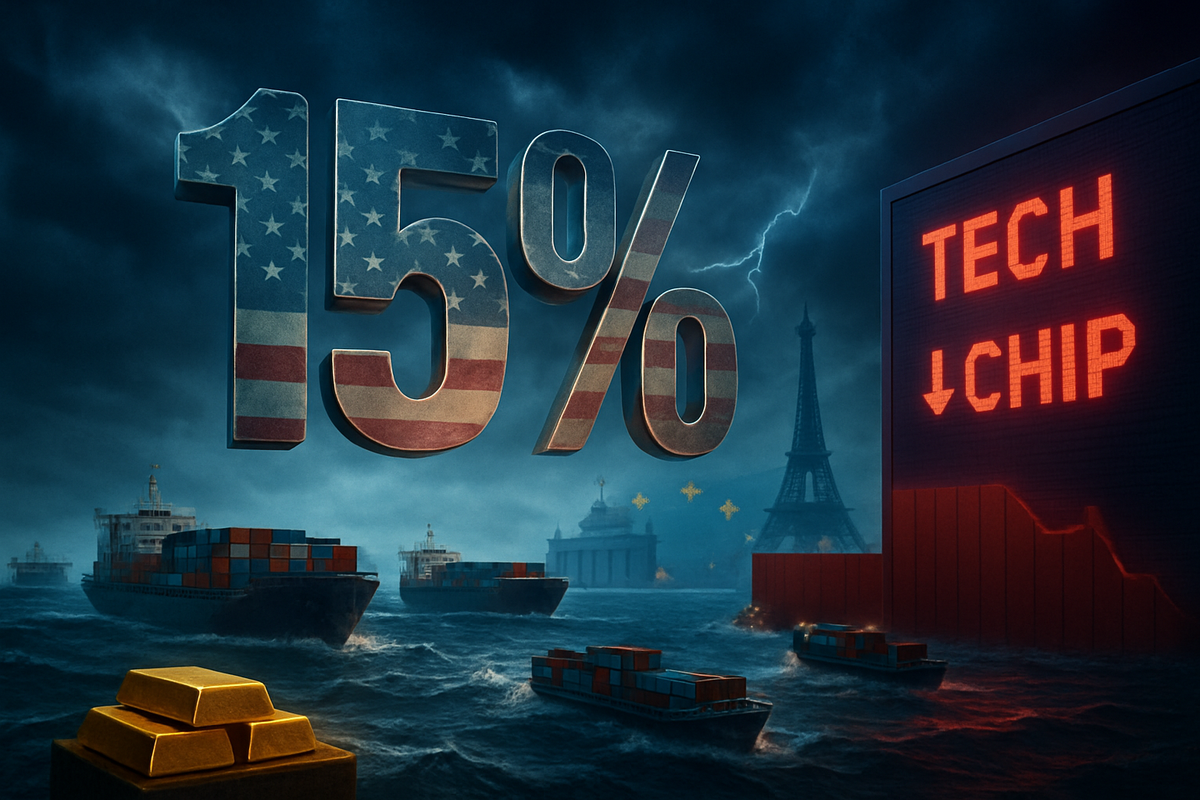
NEW YORK — Global financial markets were plunged into a state of high-velocity volatility this week as the Trump administration officially implemented a sweeping 15% emergency global tariff. The move, enacted via Section 122 of the Trade Act of 1974, has effectively upended decades of trade norms overnight, sending the CBOE Volatility Index (VIX) spiking to 21.5 and forcing institutional investors into a rapid "risk-off" rotation. While the administration frames the surcharge as a necessary tool to address a "chronic and debilitating" balance-of-payments deficit, the immediate fallout has seen billions in market capitalization wiped out from the tech sector and a sharp, retaliatory posture from the European Union.
The geopolitical landscape shifted dramatically on February 20, 2026, after the U.S. Supreme Court ruled in Learning Resources Inc. v. Trump that the President could not use the International Emergency Economic Powers Act (IEEPA) for broad, non-emergency trade duties. Pivoting within 24 hours, the administration invoked Section 122—a rarely used provision that allows for a temporary 150-day surcharge of up to 15% on imports. The new duties became effective at 12:01 a.m. on February 24, 2026. This aggressive timeline left global supply chains in disarray, with shipping vessels scrambling to clear customs before the deadline. The European Commission responded almost instantly, threatening to deploy its "Anti-Coercion Instrument" (ACI) to block U.S. firms from public contracts and reactivating a €22.5 billion retaliation list targeting iconic American brands.
The Tech Divergence: Hardware Bleeds While Software Braces
The most immediate victims of the new trade regime have been the titans of the hardware and semiconductor industries. Nvidia (Nasdaq: NVDA) and Advanced Micro Devices (Nasdaq: AMD) saw their shares tumble between 12% and 18% in the days following the announcement. Investors are pricing in significant margin compression as the cost of imported components rises, compounded by additional 25% national security tariffs on high-end AI accelerators. Apple (Nasdaq: AAPL) has also faced stiff headwinds; despite some exemptions for consumer electronics, the broader logistics chaos and the threat of retaliatory European duties on high-end tech services have rattled investor confidence in the iPhone maker’s global ecosystem.
Conversely, the software sector has emerged as a complex "safe haven" with significant caveats. While digital products do not cross physical borders and are technically "tariff-proof," the broader sector—including giants like Microsoft (Nasdaq: MSFT) and Salesforce (NYSE: CRM)—has not been immune to the market’s jittery mood. These companies are currently navigating a "Software-mageddon" reset, where the shift from "per-seat" licensing to "Agentic AI" models is already straining valuations. The added layer of global trade uncertainty has turned what was once a steady growth play into a period of extreme price discovery. While the Software/SaaS indices outperformed the Nasdaq by 8% in early 2026, the overall sentiment remains fragile as the threat of an EU "Digital Services Tax" looms as a potential retaliatory measure.
A Flight to Safety: Gold and Defensives Surge
As growth stocks faced a punishing sell-off, capital has aggressively rotated into defensive assets and commodities. Gold (GC=F) reached a historic milestone this week, surging past $5,100 per ounce. Analysts now view the precious metal as the ultimate "portfolio insurance" against a dual-threat environment of tariff-induced inflation and geopolitical instability. In the equity markets, the "Real Economy" trade is back in vogue. Walmart (NYSE: WMT) and Costco (Nasdaq: COST) have seen significant inflows as investors bet on their ability to utilize bulk-buying power to mitigate rising import costs for consumers.
Industrial heavyweights have also found themselves in the winner's circle. Caterpillar (NYSE: CAT) and GE Vernova (NYSE: GEV) have capitalized on the accelerating trend of "onshoring"—the relocation of manufacturing back to U.S. soil to bypass the 15% global surcharge. This pivot toward domestic production, coupled with the ongoing buildout of AI-centric data centers, has provided a tailwind for industrial and utility stocks. Healthcare and Biotech sectors also saw a 14% sprint as institutional funds diversified away from over-concentrated, trade-sensitive technology positions.
The End of Globalization 2.0 and the Inflationary Impulse
The significance of the Section 122 tariffs extends far beyond short-term stock fluctuations; it marks a fundamental "Balkanization" of global supply chains. For decades, the tech industry relied on a just-in-time, globalized model that prioritized efficiency over national boundaries. The 15% surcharge has shattered that paradigm, forcing a transition to "Globalism 2.0," where trade is dictated by geopolitical alliances rather than market efficiency. This shift is already manifesting in the U.S. economy, where the Core PCE Deflator—the Federal Reserve's preferred inflation metric—has remained stubbornly at 2.9%, well above the 2% target.
The regulatory implications are equally profound. By utilizing Section 122, the Trump administration has bypassed traditional congressional oversight, though the 150-day expiration clause creates a ticking clock for trade negotiations. If the EU proceeds with its "Phase 2" retaliation—targeting €18 billion in industrial products and agricultural staples like beef and poultry—the inflationary pressure on U.S. consumers could become a major political liability. Historically, such trade wars have led to prolonged periods of stagflation, and market participants are now weighing whether the Fed will be forced to keep interest rates "higher for longer" to combat the inflationary impulse of the tariffs.
Navigating the 150-Day Window: What Comes Next?
The immediate focus for the market is the 150-day window provided by the Section 122 statute. This period is expected to be a high-stakes diplomatic theater. The European Union has offered a "Framework of a Future Deal," signaling a willingness to negotiate on industrial standards and digital trade if the U.S. rescinds the global surcharge. However, if the administration chooses to extend the tariffs or increase them further, we may see the activation of the EU’s "Trade Bazooka," which would target U.S. tech firms' ability to operate in the single market.
For corporations, the strategic pivot is already underway. Expect to see a massive wave of capital expenditure directed toward Southeast Asian "friendly" hubs and domestic manufacturing facilities. Companies that can successfully navigate this "China + 1" or "Onshoring" strategy will likely emerge as the long-term winners. Meanwhile, the software sector may see a wave of consolidation as firms look to bolster their balance sheets against the dual threats of trade volatility and the AI-driven licensing reset.
Final Thoughts: A New Market Paradigm
The implementation of the 15% global tariff has fundamentally altered the risk calculus for the 2026 market. The era of low-tariff, high-efficiency global trade is being replaced by a more fragmented and expensive reality. While the "flight to safety" in gold and defensive stocks provides a temporary refuge, the broader market remains vulnerable to the retaliatory cycles that characterize trade wars.
Investors should closely monitor the Core PCE inflation data and the VIX in the coming months. The key question remains whether the U.S. economy’s resilient 2.4% GDP growth can withstand the twin pressures of higher import costs and retaliatory export barriers. As we move deeper into 2026, the ability of the administration to leverage these tariffs into a favorable "Future Deal" with Europe will determine whether this week’s market shock was a temporary correction or the beginning of a prolonged economic realignment.
This content is intended for informational purposes only and is not financial advice.