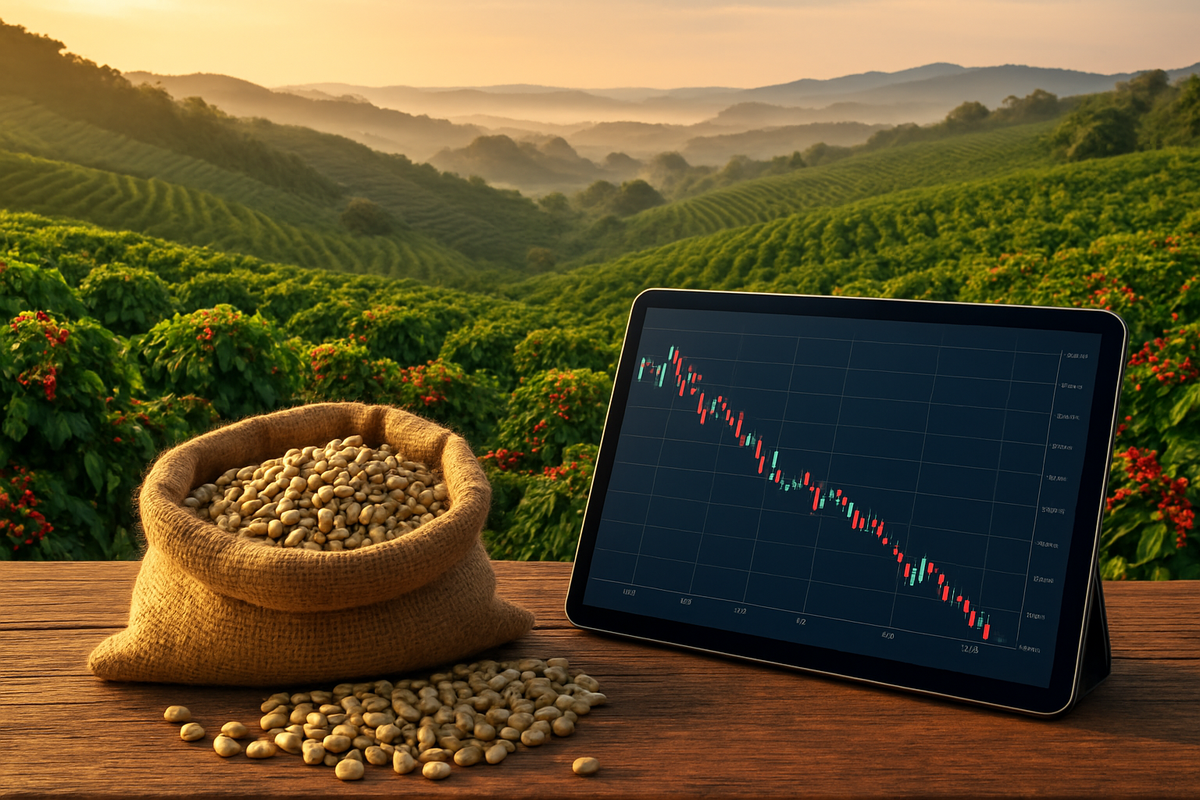
After four years of supply deficits and volatile price spikes that pushed global coffee inventories to their lowest levels in a quarter-century, the market is finally signaling a major turning point. Analysts and agricultural agencies are converging on a record-breaking forecast for Brazil’s 2026/27 harvest, which is expected to inject massive liquidity into the global supply chain and provide much-needed relief to both roasting giants and weary consumers.
As of late February 2026, the prospect of an incoming "coffee wall" has already begun to reshape the financial landscape. Market participants are watching a shift from a scarcity-driven environment to one of surplus, as Benchmark Arabica futures consolidate within the $2.50 to $2.80 range—down significantly from the three-dollar peaks seen in early January. For the broader market, this transition represents more than just a price correction; it is a structural reset of the global coffee trade.
Record Production Amidst Weather Volatility
The primary engine of this recovery is the projected 2026/27 Brazilian coffee crop, which StoneX analysts estimate will reach an all-time record of 70.7 million 60kg bags. This represents a staggering 13.5% increase from the previous cycle. The surge is largely attributed to the "on-year" in the biennial cycle for Arabica trees, a biological phenomenon where the plants produce higher yields every second year. Arabica production alone is expected to skyrocket by 29.3%, reaching 47.2 million bags. While Robusta (Conilon) production is forecasted for a slight 8.9% dip from its own record highs, the sheer volume of Arabica is more than enough to offset the difference.
The journey to this record forecast was not without its hurdles. In late 2025, the market was gripped by anxiety as irregular rainfall and unseasonably dry weather in key growing regions like Minas Gerais and São Paulo threatened early flowering. However, the narrative shifted dramatically in January and February 2026. Data from Somar Meteorologia indicates that rainfall in Minas Gerais hit 113% to 138% of the historical average during the critical fruit-setting stage. This moisture "saved" the crop, ensuring the biological potential of the trees could be fully realized as the harvest approaches later this year.
This production boom comes at a critical juncture for the industry. Between 2021 and 2025, the global coffee market endured a period of historic tightness. Global ending stocks reached a 25-year low on a stocks-to-use basis, and ICE certified inventories had withered to fewer than 400,000 bags by late 2025. The 2026/27 surplus is essentially the first significant opportunity for the industry to begin rebuilding these depleted safety buffers, which should, in theory, reduce the extreme price volatility that has characterized the last 48 months.
Corporate Impact: Strategic Resilience and Margin Expansion
The shift toward lower raw material costs is creating a clear divide between winners and losers in the corporate world. For major roasters and retailers, the 2026 outlook is one of margin expansion. Starbucks Corporation (NASDAQ: SBUX) has already begun signaling a pivot in its procurement strategy. In its late January earnings call, the company noted that while 2025 was a year of "inflationary headwinds," they are now moving toward a "price-to-be-fixed" (PTBF) contract model. This allows them to lock in lower bean prices as the massive Brazilian crop hits the market, a move expected to significantly boost operating margins in the second half of 2026.
Similarly, Nestlé SA (OTCMKTS: NSRGY) is viewing the 2026 supply surge as a tailwind for its "strategic reset." Under new leadership, the company is prioritizing "Real Internal Growth" (RIG)—focusing on volume over further price hikes. By utilizing lower green coffee costs, Nestlé aims to recover gross margins for its Nescafé and Nespresso brands back to the 16% to 17% range. This strategy is designed to recapture market share from "white label" or generic competitors that gained ground during the high-inflation era of 2024.
On the other side of the ledger, the iPath Series B Bloomberg Coffee Subindex Total Return ETN (NYSEArca: JO) has felt the brunt of the bearish supply news. The ETN, which tracks coffee futures, has recently touched 15-month lows as the "scarcity premium" evaporates. For investors in coffee-linked financial products, the influx of 70.7 million bags acts as a persistent ceiling on price appreciation. Meanwhile, the sector is seeing aggressive consolidation, with Keurig Dr Pepper (NASDAQ: KDP) finalizing its acquisition of JDE Peet's in early 2026. The combined entity is reportedly closing underperforming plants in Brazil and the U.S. to streamline operations and maximize the synergies offered by the lower-cost environment.
Broader Significance and Industry Trends
The 2026 coffee recovery is occurring against a backdrop of significant regulatory and consumer shifts. One of the most critical factors is the one-year delay of the EU Deforestation Regulation (EUDR). Originally set for 2025, the regulation’s delay to December 2026 has temporarily eased supply bottlenecks in Europe, preventing localized price spikes and allowing companies more time to map their supply chains. This "regulatory breathing room" has harmonized global prices, preventing a bifurcated market where "certified" coffee carried a massive premium over "non-certified" beans.
Furthermore, the "Lipstick Effect"—the consumer tendency to indulge in small, affordable luxuries during times of economic uncertainty—remains a dominant force. While consumers have traded down from high-end café specialty drinks, there has been a surge in demand for premium at-home options, such as cold brew concentrates and high-quality Ready-to-Drink (RTD) products. The record harvest in Brazil provides the raw materials necessary for companies to innovate in these high-margin categories without having to pass extreme costs onto the consumer.
Historically, periods of record production in Brazil have led to "long tails" of lower prices, but analysts warn that the current climate era makes these cycles more fragile. While the 2026/27 crop appears secure, the long-term trend of rising temperatures in the "Coffee Belt" means that the industry is only one extreme weather event away from returning to a deficit. The current surplus is a welcome reprieve, but it has not lessened the urgency for companies to invest in climate-resilient coffee varieties and sustainable farming practices.
Navigating the "Surplus Narrative"
As the market prepares for the 2026/27 harvest to begin in earnest, the short-term focus will be on the "pegamento" (fruit set) and the final sizing of the beans. If favorable weather continues through the Brazilian winter, there is potential for further downward pressure on prices, with some analysts targeting a move toward $2.20 per pound for Arabica. In the long term, the industry must decide how to allocate the windfall from lower input costs: whether to pass savings to consumers to stimulate volume growth or to reinvest in supply chain stability.
Strategic pivots are already underway. We are seeing a move away from defensive "price-taking" and toward offensive innovation. Market opportunities are emerging in the "Economy-Good-Better-Best" pricing models, where brands offer a range of products to capture every segment of the consumer base. However, the challenge will be managing the potential for "over-correction" in prices, which could disincentivize farmers from investing in their crops for the 2027/28 cycle, potentially sowing the seeds for the next supply crunch.
Conclusion and Market Outlook
The 2026 coffee market is characterized by a transition from crisis to stabilization. Brazil’s forecasted 70.7 million-bag crop is the primary catalyst for this shift, providing the volume necessary to rebuild global stocks and temper the inflationary pressures that have haunted the beverage industry since 2021. The 13.5% jump in production is a testament to the resilience of the biennial cycle and the timely arrival of beneficial rains in early 2026.
Moving forward, the market will transition from watching the weather to watching the consumer. With bean prices consolidating at more manageable levels, the focus shifts to how effectively companies like Starbucks and Nestlé can translate lower costs into higher volumes and better earnings. Investors should keep a close eye on Brazilian harvest progress reports starting in May and watch for any shifts in the Brazilian Real, which could influence farmer selling behavior and introduce late-year volatility. For now, the "Coffee Crisis" has been put on ice, replaced by a narrative of recovery and renewed growth.
This content is intended for informational purposes only and is not financial advice.