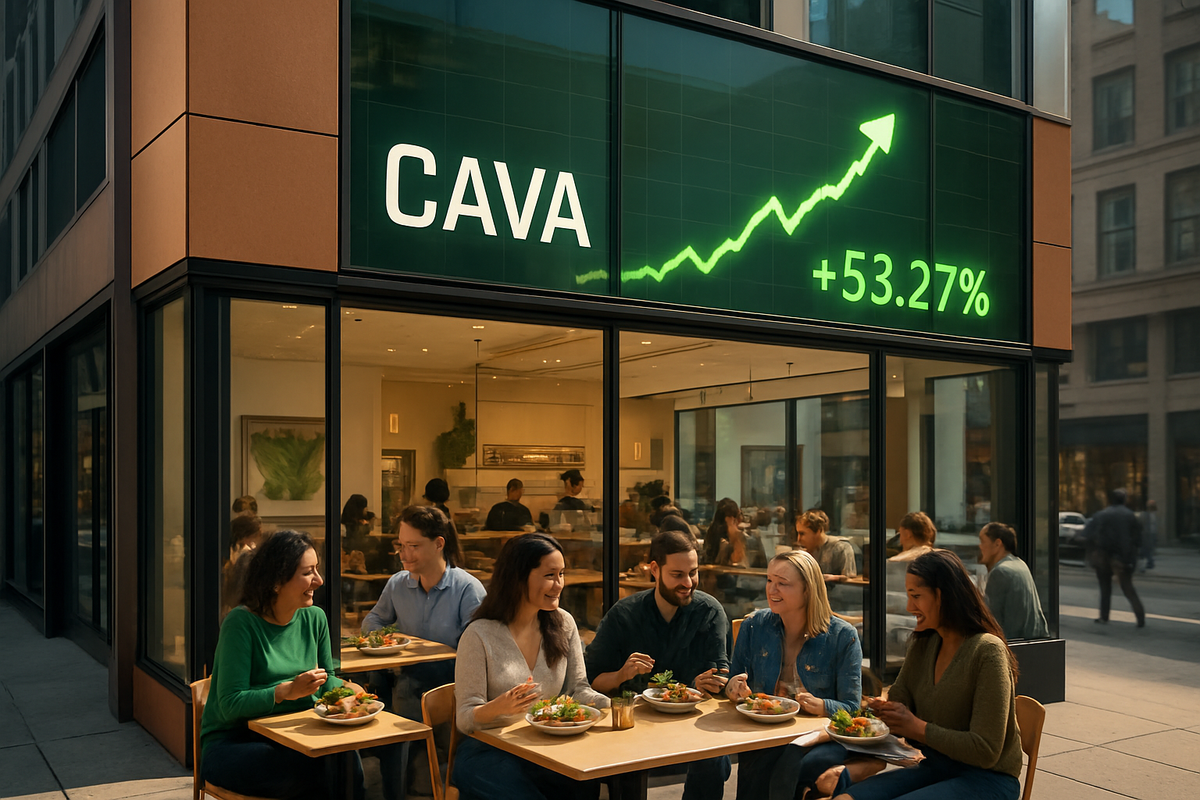
Shares of Mediterranean fast-casual leader Cava Group (NYSE: CAVA) skyrocketed on February 26, 2026, as the company delivered a "blowout" earnings report that shattered Wall Street's conservative expectations. The stock jumped as much as 26% during intraday trading, reaching record highs, after management issued a 2026 same-store sales forecast that suggests the brand is decoupled from the broader slowdown currently plaguing the American restaurant industry.
The rally marks a definitive turning point for the company following a volatile 2025. While many restaurant chains are struggling with "slop bowl fatigue" and a pullback from inflation-weary households, Cava’s results confirm a growing divergence in the "K-shaped" consumer economy. For investors, the surge reinforces Cava's position as the premier growth story in the fast-casual space, proving that its unique value proposition and affluent customer base remain resilient even as discretionary spending elsewhere falters.
A Perfect Storm of Execution and Optimism
The stock’s massive leap followed the release of Cava’s fourth-quarter and full-year 2025 results. For the first time in the company’s history, annual revenue surpassed the $1 billion milestone, clocking in at $1.17 billion. In the fourth quarter specifically, revenue rose 21.2% year-over-year to $275 million, beating the analyst consensus of $268 million. Earnings per share (EPS) of $0.04 also topped estimates, but the real catalyst was same-store sales (SRS). While analysts had modeled a potential decline of up to 1.4%, Cava reported a surprising 0.5% increase, driven largely by steady foot traffic.
The momentum was bolstered by the company’s bullish guidance for 2026. Management projected same-store sales growth of 3% to 5% for the coming year, a figure that many institutional investors viewed as ambitious given the current macroeconomic climate. This optimism is backed by an aggressive expansion strategy; Cava opened 72 net new restaurants in 2025, bringing its total footprint to 439 locations. On the earnings call, executives reaffirmed their long-term goal of operating 1,000 restaurants by 2032, signaling that the company is only in the early innings of its national rollout.
Market reaction was swift and overwhelmingly positive. Investment banks including Stifel, Truist Securities, and Morgan Stanley immediately raised their price targets on February 26. Stifel analysts moved their target to $90 from $75, noting that first-quarter 2026 comparable sales are already trending ahead of management’s guidance. This rapid re-rating by the analyst community underscores the market's belief that Cava has found a "sweet spot" in the market—offering healthy, premium options that customers are unwilling to cut from their budgets.
The Widening Gap: Winners and Losers in Fast-Casual
The surge in Cava Group (NYSE: CAVA) stock stands in stark contrast to the fortunes of its closest competitors, highlighting a significant reshuffling of the fast-casual leaderboards. Chipotle Mexican Grill (NYSE: CMG), long the gold standard of the industry, has faced a difficult start to 2026. In its own Q4 report earlier this month, Chipotle reported a 2.5% decrease in comparable sales and issued a tepid "approximately flat" forecast for the year ahead. Having lost over 30% of its market value in the last twelve months, Chipotle is struggling to maintain its premium brand perception amidst rising operational costs and shifting consumer preferences.
The situation is even more dire for Sweetgreen (NYSE: SG). As Cava’s stock hit new highs on February 26, Sweetgreen’s shares plummeted to near-record lows. Analysts are bracing for an 11.7% drop in Sweetgreen’s same-store sales, with some experts questioning the long-term viability of its business model in a high-interest-rate environment. Sweetgreen has seen its stock price erode by roughly 82% year-over-year, as it fails to achieve the same operational efficiency and consistent traffic that Cava has mastered.
Traditional Quick Service Restaurant (QSR) giants like McDonald’s (NYSE: MCD) are also feeling the heat, though for different reasons. While McDonald's has leaned into aggressive value deals to capture lower-income diners, it has ceded the "aspirational" dining segment to Cava. Investors are increasingly viewing Cava as the primary beneficiary of a flight to quality. While the "losers" of 2026 are those caught in the middle—brands with neither the scale of the QSR giants nor the brand loyalty of Cava—the Mediterranean chain is carving out a near-monopoly on the healthy-living dining segment.
Deciphering the K-Shaped Consumer Reality
Cava’s success on February 26, 2026, serves as a powerful case study for the broader economic trends of the mid-2020s. We are currently witnessing a bifurcated consumer landscape where high-income households (earning $150,000 or more) are increasing their share of total food spending. These consumers are prioritizing health and convenience over price, which plays directly into Cava’s Mediterranean-inspired menu. This "K-shaped" recovery has allowed premium fast-casual brands to maintain pricing power even as low-to-middle income households retreat to home cooking or extreme discount menus.
Furthermore, Cava has successfully navigated the technological shift that defined the industry in 2025. The company’s deployment of advanced kitchen display systems (KDS) and AI-driven inventory management has allowed it to maintain speed of service and labor efficiency. While many competitors were bogged down by rising labor and commodity costs, Cava used its technological edge to improve margins. This operational discipline is a rare find in the high-growth restaurant sector, providing a historical precedent similar to the early 2010s rise of digital-first dining.
The regulatory environment has also played a role. While newer labor laws in key markets have increased costs for the entire sector, Cava’s higher average check size allows it to absorb these costs more effectively than low-margin competitors. This "economic moat" is becoming more apparent as the industry consolidates. The ripple effect is clear: regional chains and struggling national brands are being forced to rethink their footprints, while Cava is aggressively moving into the vacuum they leave behind in prime suburban and urban locations.
The Road Ahead: Strategic Pivots and Potential Risks
Looking forward, Cava management has indicated that 2026 will be the "Year of the Mainstay," focusing on menu innovation to drive repeat traffic. A key part of this strategy is the upcoming nationwide launch of roasted salmon, which Truist Securities analysts identified as a potential major traffic driver. By adding higher-protein, premium items, Cava is moving deeper into the dinner daypart, a segment that has traditionally been difficult for fast-casual brands to master. If successful, this pivot could significantly increase the average transaction value and further differentiate Cava from salad-centric competitors.
However, the road ahead is not without its challenges. With a price-to-earnings (P/E) ratio currently sitting around 74x, the stock is priced for perfection. Any stumble in execution or a broader systemic shock to consumer confidence could lead to a sharp correction. UBS analysts, while raising their price target on February 26, maintained a "Neutral" rating for this very reason, cautioning that the valuation leaves little room for error. The primary risk remains a deeper-than-expected recession that could finally force even high-income diners to scale back on $18 grain bowls.
In the long term, Cava’s success or failure will likely hinge on its ability to maintain its cultural relevance as it scales toward its 1,000-store goal. The "scarcity value" that currently drives its high multiples will naturally diminish as the brand becomes more ubiquitous. For now, the company is focusing on "smart growth"—entering high-traffic markets like the Pacific Northwest and the Midwest with a mix of digital-only "pick-up" stores and traditional dine-in locations to maximize its reach.
A New Benchmark for Restaurant Growth
The stock jump of February 26, 2026, confirms that Cava Group has evolved from a niche Mediterranean concept into a dominant force in the American dining landscape. The company’s ability to beat estimates and raise guidance in a period of economic uncertainty is a testament to its strong brand equity and operational excellence. For investors, the takeaway is clear: in an era of consumer caution, quality and health-focus remain the ultimate defensive plays.
Moving forward, the market will be watching closely to see if Cava can maintain its margin expansion as it enters new, less affluent markets. The success of the "roasted salmon" launch and the continued integration of AI-driven kitchen technologies will be key metrics in the coming quarters. While the high valuation may give some value investors pause, the growth trajectory and competitive displacement occurring in the fast-casual sector suggest that Cava's momentum is far from over.
As the industry moves into the second half of 2026, Cava has set a new benchmark for what success looks like in a high-cost, high-competition environment. Investors should keep a close eye on upcoming quarterly traffic data to ensure the current growth isn't just a temporary "sugar high" from new store openings, but a sustained shift in how Americans choose to eat out.
This content is intended for informational purposes only and is not financial advice.