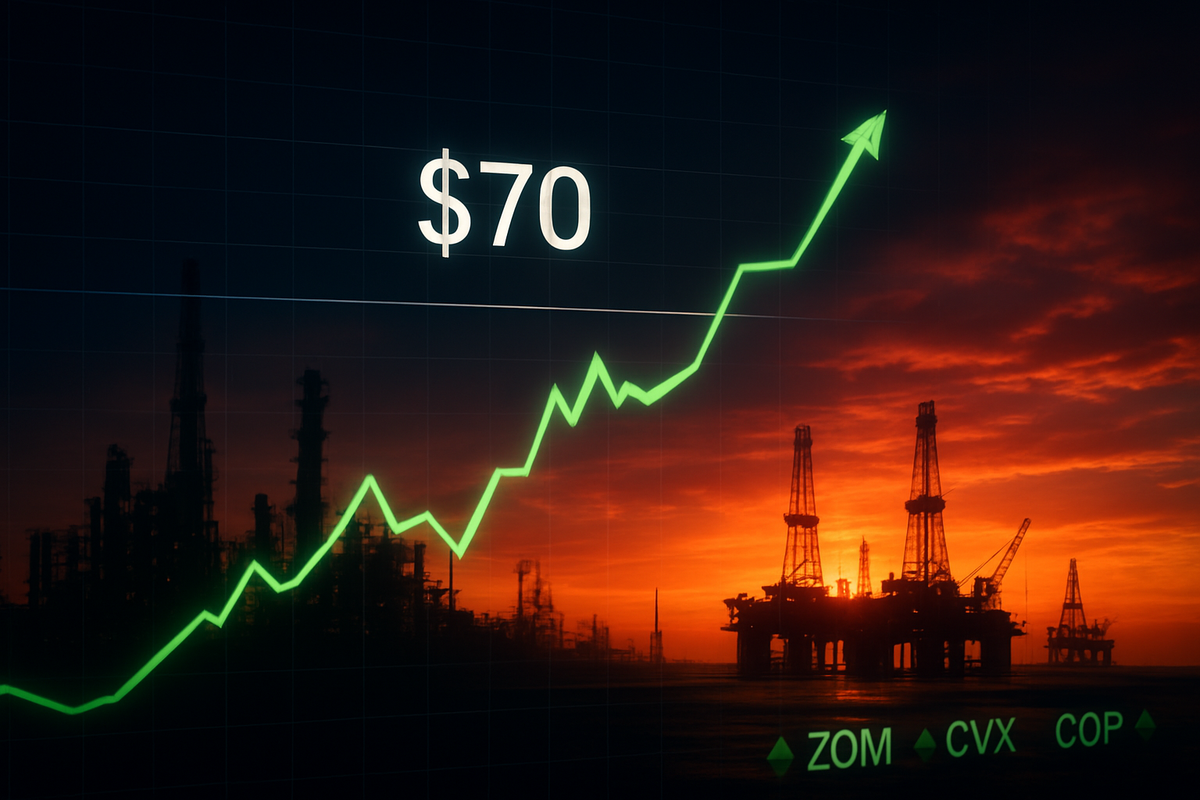
LONDON, February 26, 2026 — Global energy markets have reached a definitive turning point as Brent crude oil decisively cleared the psychological $70 per barrel resistance level this week. This technical breakout marks the culmination of a multi-month bottoming process that began in late 2025, signaling a shift from a bearish consolidation phase to a renewed bullish regime. As prices stabilize above this key threshold, traders are now eyeing immediate technical targets between $72.75 and $75.00, driven by a combination of tightening supply signals and a sudden escalation in geopolitical tensions.
The move above $70 is not merely a round-number milestone; it represents a fundamental change in market sentiment. For much of the past six months, Brent had been pinned within a restrictive range of $62 to $68, weighed down by concerns of a global oversupply and cooling industrial demand. However, the breach of the 200-day moving average and the confirmation of a classic inverted head-and-shoulders pattern have forced short-sellers to cover their positions, providing the momentum needed to propel the benchmark into a new trading tier.
The Path to the Breakout: From Consolidation to Impulse
The road to $70 was paved during a volatile "bottoming process" that saw Brent test and defend a pivotal support zone at $66.75 in early January. Throughout late 2025, the market appeared directionless, but technical analysts began noting a series of higher lows that suggested institutional accumulation. The breakout accelerated in mid-February following the collapse of high-stakes nuclear negotiations in Geneva between the U.S. and Iran. This geopolitical friction effectively re-introduced a "war premium" to the oil market, estimated by analysts to be between $7 and $10 per barrel, as concerns grew over potential disruptions near the Strait of Hormuz.
By February 24, the technical "impulse wave" was in full effect, with Brent trading between $71.25 and $72.30. The movement has been further supported by the "core eight" OPEC+ members, led by Saudi Arabia and Russia, who reaffirmed their decision to pause planned production increases through the end of the first quarter. This strategic pause was intended to offset the typical 10–15% drop in seasonal demand, but when coupled with the sudden risk premium, it created a supply-side squeeze that the market was not fully prepared for.
Initial market reactions have been swift. The energy sector, which had lagged behind high-growth technology for much of the previous year, is seeing a significant rotation of capital. Investors are moving back into "physical reality" assets, viewing the $70 floor as a sign that the energy bear market of 2025 has officially concluded. Technical indicators like the Relative Strength Index (RSI) are trending upward but have not yet reached overbought territory, suggesting there is still room for the current rally to run toward the $75 mark.
Energy Giants Rebound as Margins Expand
The primary beneficiaries of this price surge are the major integrated energy firms, which are seeing an immediate expansion in upstream margins. ExxonMobil (NYSE: XOM) has been a standout performer, with its stock entering a spectacular uptrend as the higher crude price directly bolsters its massive global production portfolio. Analysts note that for every dollar increase in the price of Brent, Exxon's free cash flow increases by hundreds of millions, allowing the company to accelerate its share buyback programs and dividend growth.
Chevron (NYSE: CVX) has similarly capitalized on the momentum, hitting a 14-month high near $113.00 this week. Investors have been heartened by the company's operational focus in the Permian Basin and Guyana, where production costs remain low enough to generate exceptional returns at current price levels. CEO Mike Wirth’s strategy of prioritizing capital discipline over aggressive volume growth has made Chevron a favorite for institutional investors seeking "safe" exposure to the rising oil price.
Meanwhile, ConocoPhillips (NYSE: COP) has staged a remarkable recovery. Despite a lackluster earnings report in early February that saw the stock dip temporarily, the shares have surged more than 18% in the last four weeks, reaching a 52-week high of $113.80. The rebound was triggered by management's announcement of a $1 billion cost-reduction initiative for 2026, which, combined with the $70+ oil environment, led to a wave of price target upgrades from major Wall Street firms including UBS (NYSE: UBS) and Citigroup (NYSE: C), with some targets now reaching as high as $133.
Geopolitics vs. Fundamentals: A Precarious Balance
While the technical breakout is clear, the underlying fundamental picture remains complex. This event fits into a broader industry trend where geopolitical instability is masking an expected physical surplus later in the year. The International Energy Agency (IEA) and the Energy Information Administration (EIA) continue to forecast a global oversupply of 2.3 to 3.8 million barrels per day for the full year 2026. This creates a "mismatch" between the current spot price, driven by headlines and technicals, and the long-term supply-demand models that suggest a return to the $50–$60 range if tensions ease.
Historically, such breakouts are often followed by a "test and fail" period if the physical market does not tighten alongside the paper market. However, the current situation draws parallels to the 2022 energy crisis, where a sudden removal of perceived supply security fundamentally rerated energy assets. The ripple effect is being felt across the sector, with oilfield service providers and midstream pipeline companies also seeing renewed interest as the incentive to maintain—or even slightly increase—U.S. shale production returns.
Regulatory and policy implications are also looming. In the United States, record production levels of approximately 13.6 million barrels per day have provided some cushion, but the plateauing of the Permian Basin suggests that future growth will have to come from more expensive natural gas-heavy regions. This puts pressure on policymakers to address energy security without derailing the ongoing transition to renewable sources, a balance that becomes much harder to maintain when crude is north of $70 and gasoline prices begin to creep up at the pump.
Looking Ahead: The Road to $75 and Beyond
In the short term, technical analysts are laser-focused on the $72.75 level, which represents a significant monthly high from mid-2025. If Brent can close above this mark on a weekly basis, the path to $75.00 becomes the path of least resistance. Beyond $75, the next major hurdle sits at $76.65, a level that could trigger a secondary wave of buying from trend-following algorithms and commodity index funds.
However, a strategic pivot may be required if the geopolitical situation de-escalates. If a new diplomatic breakthrough occurs in the Middle East, the $7–$10 "war premium" could evaporate overnight, sending prices back toward the $60 support zone. Market participants must remain vigilant for any signs that OPEC+ might reverse its production pauses prematurely to capture higher prices, which could inadvertently flood the market and collapse the current breakout.
The most likely scenario for the coming months is one of "high-floor" volatility. As long as Brent remains above $68, the technical bottoming process is considered valid, providing a safety net for energy stocks. Investors should watch for the release of upcoming inventory data and any shifts in the Federal Reserve's rhetoric, as a stronger dollar could provide a headwind to further oil price gains even in a bullish technical environment.
Summary and Investor Takeaways
The breakout in Brent crude above $70/barrel marks a significant shift in the 2026 financial landscape. By confirming a bottoming process and clearing long-standing resistance, the oil market has signaled that the period of deep consolidation is over. For investors, the immediate technical targets of $72.75 and $75.00 provide a clear roadmap for the weeks ahead, while the performance of majors like ExxonMobil, Chevron, and ConocoPhillips underscores the renewed profitability of the energy sector.
Moving forward, the market will be a tug-of-war between bullish technical momentum and bearish long-term supply forecasts. The lasting impact of this breakout will depend on whether the geopolitical risk remains high enough to offset the projected global surplus. For now, the "physical reality" trade is back in favor, and the energy sector appears poised to lead the market higher as long as the $70 floor holds.
Investors should closely monitor the $72.75 resistance level and keep a sharp eye on headlines from Geneva and the Strait of Hormuz. While the technicals are undeniably bullish, the 2026 oil market remains a high-stakes environment where geopolitical shifts can override charts in an instant.
This content is intended for informational purposes only and is not financial advice.