In late January 2026, the financial markets witnessed a historic re-rating of the data storage sector as Seagate Technology (NASDAQ: STX) delivered a blockbuster fiscal second-quarter earnings report that sent its shares skyrocketing by more than 19% in a single trading session. This dramatic surge, which pushed the company’s stock to an all-time high of over $440, was not merely a reaction to a standard earnings beat; rather, it served as a definitive signal to investors that the artificial intelligence (AI) "supercycle" has finally arrived for the world of hard-disk drives (HDDs).
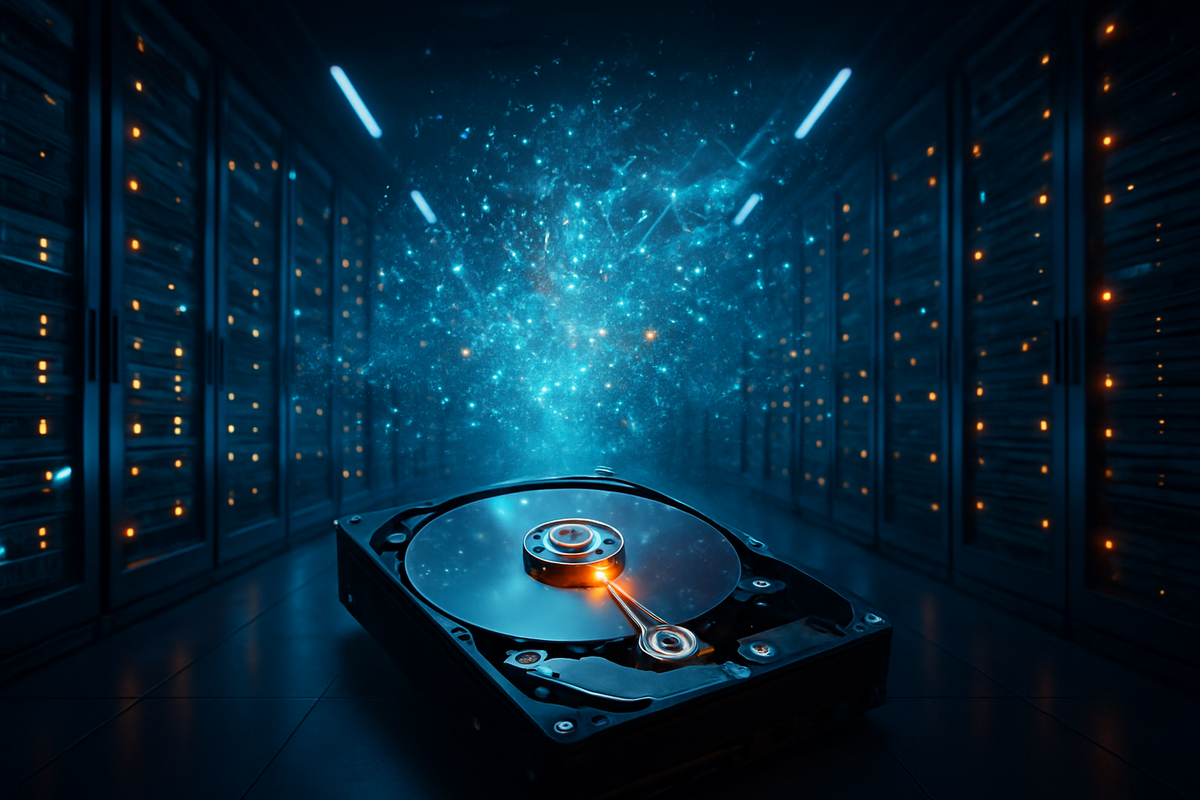
The immediate implications of this rally are profound, as Wall Street has shifted its perception of Seagate from a legacy hardware manufacturer to a critical pillar of AI infrastructure. For years, the narrative surrounding the storage industry was one of slow, cyclical growth dominated by the looming threat of solid-state drives (SSDs). However, the sheer volume of "unstructured data" required to train and maintain generative AI models has created an insatiable appetite for high-capacity, cost-effective storage—a demand that only the latest generation of HDDs can currently satisfy at scale.
A Perfect Storm of Performance and Scarcity
The catalyst for the January 28, 2026, stock jump was Seagate’s fiscal Q2 2026 earnings report, which outperformed even the most optimistic analyst projections. The company reported a non-GAAP earnings per share (EPS) of $3.11, smashing the consensus estimate of $2.84 and marking a 53% increase compared to the previous year. Quarterly revenue reached $2.83 billion, surpassing expectations of $2.71 billion, driven by a record-breaking 42.2% gross margin.
The timeline leading up to this moment was defined by the successful commercialization of Seagate’s Heat-Assisted Magnetic Recording (HAMR) technology, marketed under the Mozaic 3+ platform. While the industry had been skeptical of HAMR’s mass-market viability for years, the Q2 report confirmed that these 30TB+ drives are now fully qualified by every major U.S. cloud "hyperscaler." Perhaps most importantly for the market's reaction, management revealed that Seagate’s production capacity for high-density "nearline" drives is effectively sold out through the remainder of the 2026 calendar year, with customers already negotiating supply agreements for 2027 and 2028.
Winners and Losers in the Storage Arms Race
While Seagate stole the spotlight, the ripples of this event have been felt across the entire storage ecosystem. Western Digital (NASDAQ: WDC) has emerged as a parallel winner, seeing its own shares rise in sympathy. Although Western Digital is taking a different technological path with its UltraSMR (Shingled Magnetic Recording) drives, it reported even higher gross margins of 46.1% in its most recent filing. Both companies are benefiting from a rare "sold-out" era where they possess immense pricing power over tech giants like Amazon, Microsoft, and Google.
On the other side of the spectrum, the "All-Flash" proponents like Pure Storage (NYSE: PSTG) find themselves in a complex position. While Pure Storage continues to capture the high-performance AI inference market with its massive 300TB flash modules, the resurgence of the HDD market proves that the "death of the disk" was premature. Pure Storage maintains industry-leading gross margins of 74.1%, but the capital expenditure (CapEx) required for AI "data lakes"—massive repositories of raw training data—favors the significantly lower cost-per-terabyte offered by Seagate and Western Digital. Meanwhile, Micron Technology (NASDAQ: MU) continues to thrive by providing the high-speed HBM3E and HBM4 memory that feeds the AI GPUs, but it is increasingly competing with HDD makers for a slice of the broader data center power budget.
The Wider Significance: Moving Beyond the Chip
Seagate’s rally underscores a fundamental shift in how the market values AI infrastructure. For the past two years, investor attention was almost exclusively focused on the "compute" layer—the GPUs and specialized chips provided by companies like NVIDIA. However, the January 2026 earnings season has highlighted that high-performance compute is useless without a massive "memory bank" to store the training sets and the daily outputs of generative models.
This event mirrors historical precedents such as the early 2000s fiber-optic boom, where the focus shifted from the computers themselves to the pipes and storage that connected them. The regulatory and policy implications are also beginning to emerge, as the energy consumption of these massive storage arrays becomes a point of contention for environmental regulators. Seagate’s HAMR technology, which offers higher density with fewer platters, is being positioned not just as a cost-saver, but as a "green" alternative that reduces the physical footprint and power requirements of the modern data center.
What Lies Ahead: The Multi-Year Visibility
In the short term, investors should expect continued volatility as the market digests the reality of a supply-constrained environment. The primary challenge for Seagate and its peers will be managing the "lumpiness" of hyperscale orders while trying to expand manufacturing capacity without overcommitting to future surpluses. If the AI demand remains as durable as current projections suggest, the storage sector could see a multi-year period of sustained profitability that breaks its historical pattern of boom-and-bust cycles.
The potential for strategic pivots is also on the horizon. We may see more vertical integration, with cloud providers attempting to secure their own storage supply chains or HDD makers entering deeper partnerships with AI software firms to optimize data retrieval speeds. The next 12 to 18 months will likely be characterized by a "capacity grab," as enterprises and governments alike race to build sovereign AI clouds, further straining the global supply of high-capacity drives.
The Market Minute Wrap-Up
The 19% surge in Seagate Technology's stock is a watershed moment for the storage industry. It confirms that the AI revolution is as much about data persistence as it is about processing speed. The key takeaway for investors is the transition of the HDD market from a commodity business into a high-margin, high-visibility infrastructure play. With capacity sold out through 2026 and margins hitting record highs, the "old" world of spinning disks has found a definitive place in the "new" world of artificial intelligence.
Moving forward, the market will be watching for any signs of demand softening or technical hurdles in the rollout of even higher-capacity 40TB and 50TB drives. Additionally, the ongoing competition between high-density QLC SSDs and HAMR HDDs will be the primary battlefield for storage supremacy. For now, Seagate sits at the throne of the areal density kingdom, and the AI boom is providing the tailwinds for a journey that few saw coming just a few years ago.
This content is intended for informational purposes only and is not financial advice.